A pregnant woman carried on a hammock for miles to reach a hospital because of deplorable road conditions has reignited questions about the Boakai administration’s commitment to rural infrastructure. With more than US$226 million in reported road-related allocations and announcements across three fiscal years, this investigation examines the gap between government budget commitments and the reality facing ordinary Liberians. Where has the money gone, and why are communities still struggling to access basic healthcare because of impassable roads?
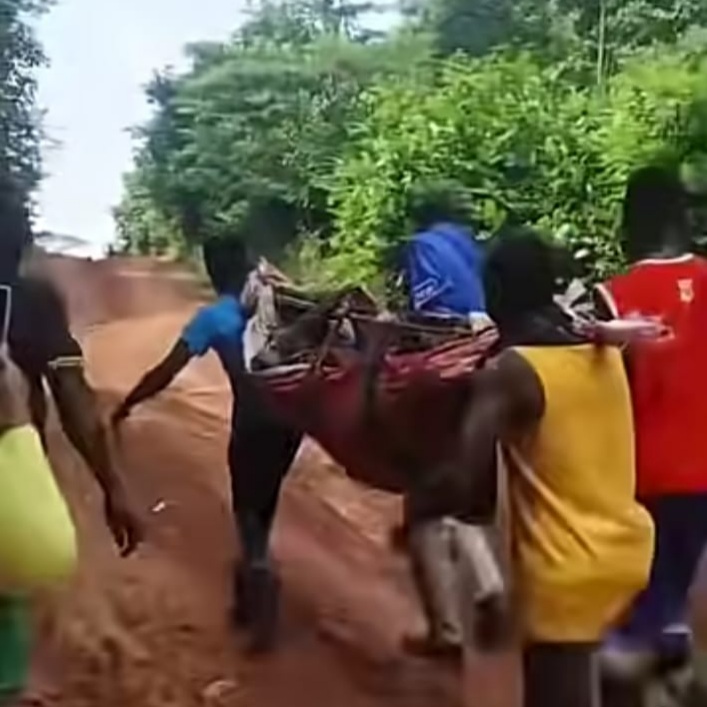
MONROVIA, LIBERIA – In the 21st century, in a country that proudly identifies itself as Africa’s oldest independent Black republic, a pregnant woman reportedly had to be carried on a hammock for several miles to reach a hospital in Bokhoma, Gbarpolu County, because vehicles could not access her village due to deplorable road conditions.
The heartbreaking incident, involving young people who placed the woman on a hammock and carried her on their shoulders in search of medical attention, has once again exposed the difficult realities facing residents of Liberia’s rural communities.
While the young people deserve commendation for their courage and compassion, their actions raise a much bigger question about the responsibility of the government: Why should citizens still have to depend on human shoulders to reach a hospital because there are no accessible roads?
For the pregnant woman, the journey was more than a difficult trip to a medical facility. It was a painful demonstration of what happens when poor infrastructure turns access to basic healthcare into a struggle for survival.
But beyond the human tragedy lies a political and financial accountability question for President Joseph Nyuma Boakai’s administration.
Since assuming office in January 2024, President Boakai has repeatedly emphasized infrastructure development as part of his government’s national development agenda. Road construction, rehabilitation and connectivity have also featured prominently in successive national budgets.
Yet, for some communities in the interior, accessible roads remain an unfulfilled expectation.
OVER US$226 MILLION IN ROAD-RELATED ALLOCATIONS: WHERE IS THE IMPACT?
An examination of available government budget records and National Road Fund financial reporting shows substantial allocations for road-related activities during the first three fiscal years of the Boakai administration.
In FY2024, the National Road Fund received a legislative appropriation of approximately US$40.63 million. In FY2025, approximately US$52.86 million was announced for road works and infrastructure. For FY2026, the government announced approximately US$133 million for road construction, equipment procurement and regional connectivity.
Together, these figures amount to approximately US$226.49 million in reported road-related allocations and announcements.
However, this is not yet a reconciled total of exclusive road-construction appropriations. The figures cover different budget categories, and the FY2026 allocation requires further verification against the approved budget.
Nevertheless, the figures raise important questions about how public resources are being translated into visible improvements in rural communities.
Where are the roads being constructed? Which counties and districts are benefiting? How much of the appropriated money has actually been released and spent? Which projects have been completed, and which remain unfinished?
These are questions the Ministry of Public Works, the Ministry of Finance and the National Road Fund should be prepared to answer.
DEVELOPMENT BEYOND MONROVIA
Liberia’s development cannot be measured only by activities in Monrovia, government announcements or the amount of money appearing in national budgets.
For citizens in remote communities, development means being able to transport a sick relative to a hospital without carrying that person on their shoulders for miles. It means farmers getting their produce to markets, children reaching schools during the rainy season, and pregnant women accessing emergency healthcare without risking their lives on dangerous journeys.
The Boakai administration must therefore demonstrate that its road-development commitments are reaching the people who need them most.
The government should publish a clear account of road projects funded under the 2024, 2025 and 2026 budgets, including the amounts appropriated, funds released, contractors engaged, project locations and implementation status.
The National Legislature, which approves public expenditure, also has a responsibility to demand answers about the utilization and impact of these resources.
HOW MANY MORE LIBERIANS MUST SUFFER?
The incident involving the pregnant woman should not become another heartbreaking story that disappears after public attention shifts elsewhere.
How many more pregnant women must be carried on hammocks for miles before rural road accessibility becomes an urgent national priority? How many patients must endure similar journeys because ambulances and ordinary vehicles cannot reach their communities?
President Boakai’s government owes rural Liberians more than promises and budget figures. They deserve roads that connect them to hospitals, schools, markets and opportunities.
A nation cannot meaningfully measure development by millions appropriated for roads while citizens are still being carried on hammocks for miles to access basic medical care.
For the pregnant woman and the young people who carried her, yesterday’s journey may have been an act of desperation and compassion. For the government, it should be a call for accountability.
Liberians deserve to know not just how much money has been appropriated for roads, but where that money has gone and why so many communities remain inaccessible.