
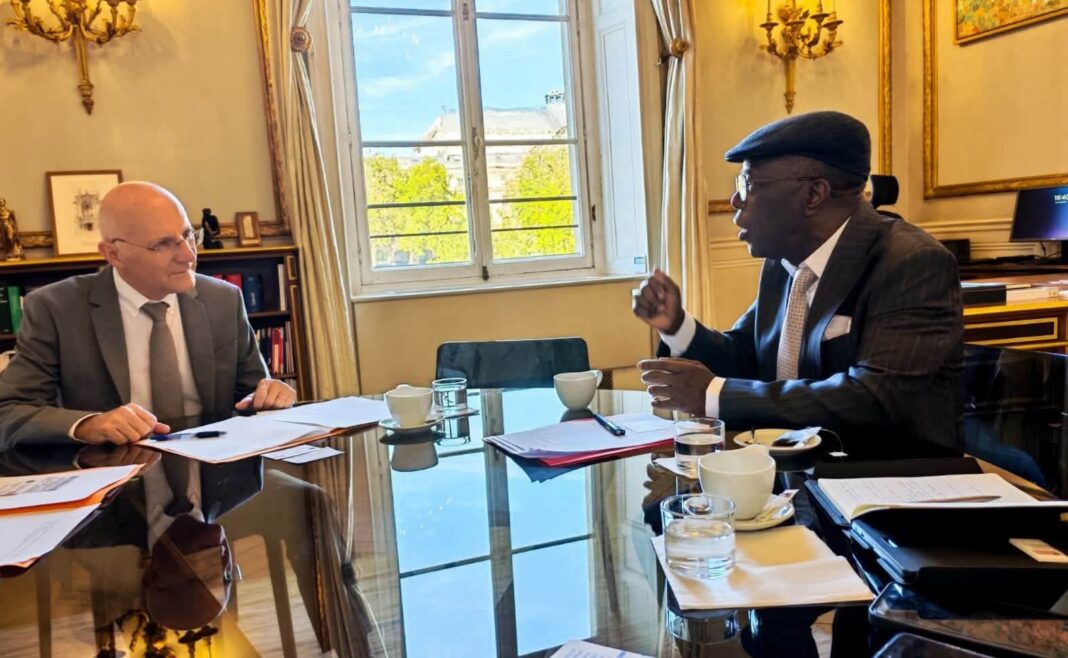
PARIS, FRANCE – Liberia’s effort to strengthen the efficiency and modernization of its justice system has gained a new international dimension following high-level discussions in Paris between Chief Justice Yamie Quiqui Gbeisay and France’s First President of the Court of Cassation, Christophe Soulard.
The September 21 engagement focused heavily on areas that directly affect the administration of justice, including judicial training, digitalization, case management, professional exchanges, institutional accountability and alternative dispute resolution.
The discussions were facilitated by Liberia’s Paris Mission as part of efforts to deepen judicial cooperation between the two countries.
Rather than focusing solely on diplomatic relations, the engagement centered on the systems and practices that determine how courts operate and how efficiently justice is delivered.
Digitalization emerged as one of the key areas of potential cooperation.
For Liberia, modernizing court administration could have implications for the way cases are recorded, managed, monitored and processed, particularly as courts confront the need to handle increasing volumes of litigation while maintaining accurate records and timely proceedings.
The French Court of Cassation provides an example of how judicial institutions can use technology and structured information to improve court administration.
First President Christophe Soulard has publicly discussed the French court’s efforts to develop digital and information-sharing mechanisms designed to help identify emerging or repetitive litigation and enable courts to respond more efficiently.
The Court of Cassation has also emphasized digital tools for communicating judicial decisions and making jurisprudence more accessible to legal professionals and members of the public.
These areas of experience could form part of the professional exchanges being considered between the Liberian and French judiciaries.
Case management was another central issue.
Effective case management can influence how quickly matters move through the courts, how judicial resources are allocated and how litigants experience the justice system.
The proposed cooperation could therefore provide opportunities for Liberian judicial officials to study systems used elsewhere and identify practices that may be adapted to Liberia’s legal and institutional environment.
Judicial training would provide another component of the potential partnership.
The proposed exchanges could allow judges and judicial personnel from Liberia and France to share professional experiences and approaches to court administration, judicial ethics, legal reasoning and emerging challenges confronting justice institutions.
The importance of judicial dialogue has been emphasized by Soulard in his recent public work.
In September 2026, the Court of Cassation reported that Soulard joined the presidents of the Court of Justice of the European Union and the European Court of Human Rights for discussions on the legitimacy of justice, access to courts, judicial confidence, digitalization and the relationship between national and European jurisdictions.
That emphasis on dialogue and institutional learning is relevant to the proposed Liberia-France judicial relationship.
Institutional accountability was also identified during the Paris meeting, placing professional standards and public confidence alongside technological modernization.
The two sides also discussed alternative dispute resolution, an area that can provide mechanisms for resolving appropriate disputes without requiring every matter to proceed through full litigation.
Taken together, the areas discussed suggest that the proposed cooperation is aimed at strengthening both the institutional capacity of the courts and the experience of people who use them.
For Liberia, that could have practical implications if the discussions eventually produce a formal framework for cooperation.
The two judiciaries are considering a potential Memorandum of Understanding that could establish a long-term institutional partnership.
Such an arrangement could provide a basis for continued judicial exchanges, training programs, technical cooperation and institutional learning.
The proposed partnership also comes within a broader period of strengthening Liberia-France relations.
France’s Ministry for Europe and Foreign Affairs says Liberia and France signed a general cooperation agreement following President Boakai’s official visit to France in October 2025, covering a range of development and cooperation areas.
Judicial cooperation would add institutional development and rule-of-law collaboration to that relationship.
The significance of the Paris meeting therefore extends beyond the two senior judicial officials who participated.
It places modernization of Liberia’s justice system within a wider international cooperation framework and opens the possibility of Liberia learning from a judicial institution with extensive experience in digital transformation, case management, judicial communication and professional development.
At the same time, any future cooperation would have to reflect Liberia’s own constitutional structure, legal traditions and institutional priorities.
The proposed partnership is therefore not simply about importing foreign judicial practices. It is about creating channels through which both institutions can exchange experience and identify approaches that can work within their respective legal systems.
The Paris meeting has now opened that conversation at the highest judicial level.
The next step will be determining whether the proposed institutional partnership can be translated into a formal agreement and sustained programs that produce measurable improvements.
For Liberia’s justice sector, the most consequential outcome would be whether cooperation on training, digitalization, case management, accountability and alternative dispute resolution eventually reaches judges, court personnel and litigants.