MONROVIA – The government of Liberia is preparing for a nationwide data collection exercise aimed at identifying and understanding the country’s evolving risks of money laundering, terrorist financing and proliferation financing as the government moves into the second round of its National Risk Assessment.
The exercise, scheduled to run from September through November 2026, will be conducted by specialized working groups established to support Liberia’s Second Round National Risk Assessment, commonly referred to as NRA 2. The exercise is expected to gather critical information from major sectors and institutions across the country to provide a clearer picture of the financial and criminal risks confronting Liberia.
The assessment comes as Liberia seeks to strengthen its Anti Money Laundering and Countering the Financing of Terrorism framework and respond to changes in the country’s financial environment since its first National Risk Assessment in 2019.
The second assessment is expected to examine how new technologies, emerging financial activities and increasingly sophisticated criminal methods may be creating new vulnerabilities that could be exploited for illicit financial activity.
At the center of the exercise is the National Steering Committee, which has been tasked with coordinating the NRA 2 process and ensuring that information gathered from institutions and sectors across Liberia is transformed into evidence based findings.
The Inter Ministerial Steering Committee, which serves as the policy arm of Liberia’s AML/CFT regime, has designated Mohammed Ali Nasser, Officer In Charge of the Financial Intelligence Agency, as Chairperson of the National Steering Committee.
Nasser and the committee are expected to work with competent authorities and relevant stakeholders to coordinate the nationwide assessment and eventually present the findings through the Inter Ministerial Steering Committee to the Inter Governmental Action Group Against Money Laundering in West Africa, known as GIABA.
The exercise represents an important step in determining where Liberia’s financial system may be exposed to illicit financial flows and where institutions need stronger capacity, better controls and more effective coordination.
The assessment is expected to cover a wide range of sectors and institutions because money laundering and terrorist financing risks can emerge from different parts of the economy, including banking, revenue collection, mining, law enforcement, financial intelligence, gaming and other areas.
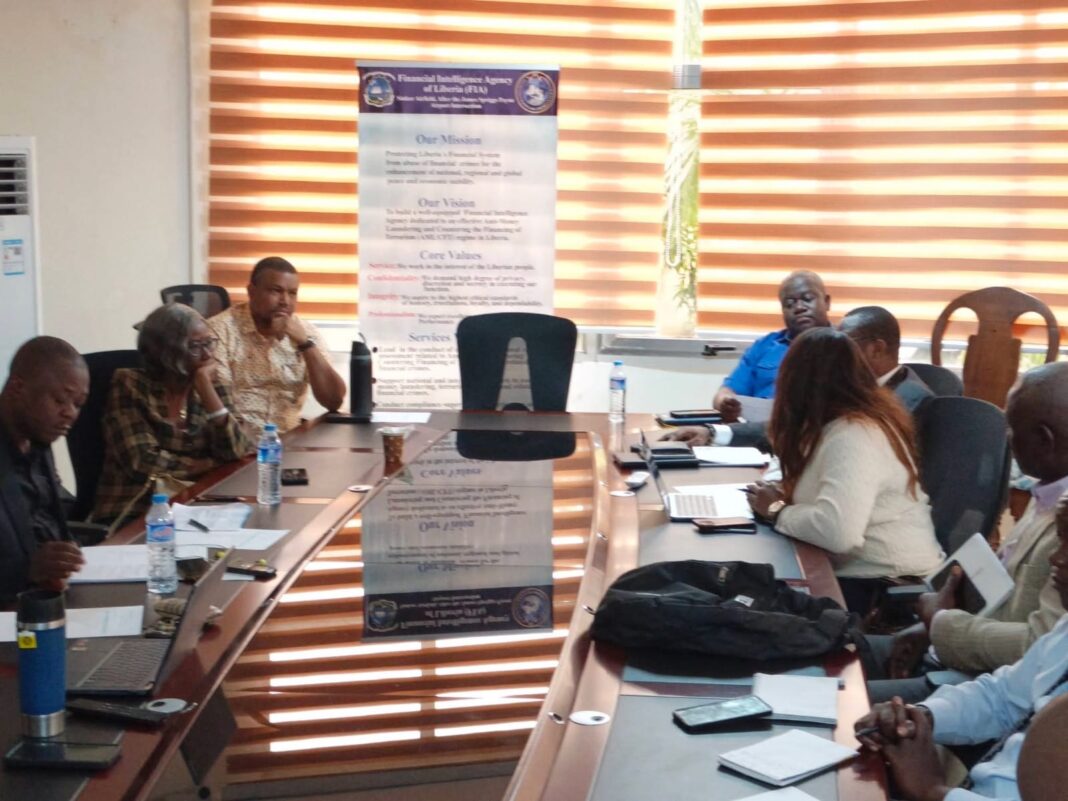
Ten specialized working groups were formed following a five day pre risk assessment workshop held in Monrovia from March 23 to 27, 2026. The workshop was organized by GIABA in collaboration with the Financial Intelligence Agency and brought together representatives from Liberia’s public and private sectors.
Participants included the Central Bank of Liberia, Financial Intelligence Agency, Ministry of Justice, Liberia National Police, Liberia Drug Enforcement Agency, National Lottery Authority, Ministry of Mines and Energy, Liberia Revenue Authority and the Liberia Bank for Development and Investment, among other institutions.
The working groups are now expected to move from preparation into nationwide field data collection.
The exercise is being guided by the requirements of Financial Action Task Force Recommendation 1, which calls on jurisdictions to identify, assess and understand their money laundering and terrorist financing risks.
Liberia’s second assessment will also be structured around three key pillars identified as national ownership, sustainable capacity and actionable results.
The objective is not simply to produce another assessment report but to ensure that the findings become a practical tool for government institutions and other stakeholders when making decisions related to financial crime prevention.
The National Steering Committee wants the final NRA report to serve as a living document and a strategic compass capable of informing policies, guiding institutional priorities and helping competent authorities make decisions based on identified risks.
The nationwide exercise also comes at a time when criminals are increasingly using technology and sophisticated methods to move, conceal or disguise illicit funds. Liberia’s financial crime prevention system must therefore keep pace with changing methods if it is to effectively protect the country’s financial sector and national economy.
To support the exercise, enumerators involved in the data collection process have already received training on Kobo Collect software, which will be used to administer questionnaires and gather information from institutions and other relevant sectors.
The software can operate both online and offline and is expected to improve the speed, consistency and reliability of information collected during the nationwide exercise.
The data collected between September and November will form part of the evidence base for Liberia’s second National Risk Assessment.
For Liberia, the importance of the exercise extends beyond compliance with international standards. A clear understanding of the country’s financial crime risks could help institutions determine where resources are most needed, strengthen preventive measures and improve coordination among agencies responsible for detecting and responding to illicit financial activity.
The success of NRA 2 will therefore depend not only on the information collected but also on how effectively government institutions, financial sector actors and other stakeholders use the findings after the assessment is completed.