
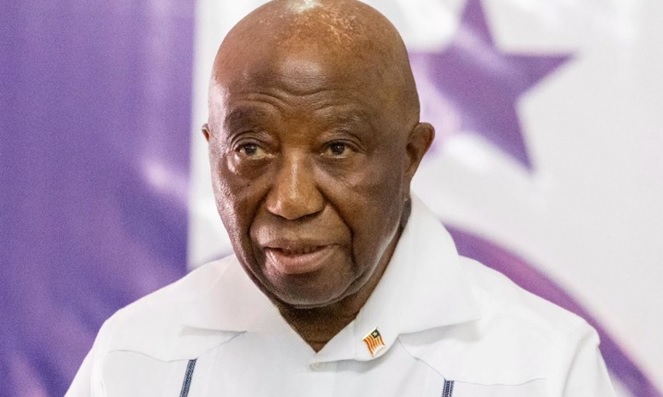
MONROVIA, LIBERIA — A lighthearted remark attributed to President Joseph Nyuma Boakai during his engagements around the 81st United Nations General Assembly has triggered a sharp response from former presidential candidate and lawyer Cllr. Tiawan Saye Gongloe, who argues that the joke risks sending the wrong message about the legal profession and the administration of justice.
The remark reportedly centered on the familiar saying: “A good lawyer knows the law, but a better lawyer knows the judge.” The expression has circulated for decades as a joke about lawyers and the importance of understanding how judges approach cases. Similar versions of the saying appear in legal commentary and professional publications.
But Gongloe, himself a lawyer and lecturer of law, reportedly took a more serious view of the President’s comment.
According to Gongloe’s response, the statement could be interpreted as suggesting that success in court depends not only on knowledge of the law, but also on a lawyer’s relationship or familiarity with the judge. He argued that such an idea can undermine public confidence in judicial independence and the principle that cases should be decided according to law and evidence.
Gongloe reportedly warned young lawyers against taking the joke as professional advice. He said that, as a professor of law, he would not want his students to embrace a message that could normalize the idea that knowing or having influence with a judge is more important than knowing the law.
The controversy is particularly significant in Liberia, where concerns about corruption, judicial independence and public confidence in institutions remain recurring issues in national debate. Gongloe has previously criticized the Boakai administration over governance and rule-of-law issues, including corruption concerns.
JOKE OR MESSAGE WITH CONSEQUENCES?
The central question is whether President Boakai’s comment should be understood simply as a joke or whether public officials—particularly a president—should be more cautious about humor involving the judiciary.
There is no indication from the available reporting that Boakai intended to advocate corruption or judicial influence. The saying itself is an established lawyer joke and can also refer simply to understanding a judge’s judicial philosophy, courtroom procedures and approach to legal arguments rather than having a personal relationship with the judge. Legal commentary has made that distinction explicitly.
Gongloe, however, has focused on the possible message such a statement could send to younger members of the profession.
For him, the issue goes beyond humor. It touches the ethical foundation of legal practice: whether lawyers should succeed because they understand the law and present evidence effectively, or because they have access to the people making judicial decisions.
That distinction matters in a country where the credibility of courts depends heavily on public perception of fairness and independence.
WHY GONGLOE’S RESPONSE MATTERS
Gongloe is not simply a political commentator. He is a veteran Liberian lawyer, former Solicitor General and former presidential candidate who has repeatedly positioned himself as a critic of government accountability and rule-of-law practices. Recent reporting shows him challenging the administration on issues ranging from public finances to the cocaine crisis and judicial accountability.
His response therefore transforms what might otherwise have remained a presidential joke into a broader discussion about legal ethics, judicial independence and the responsibility of public officials when speaking about the justice system.
The President’s remark may have been intended as humor. But Gongloe’s response raises a legitimate institutional question: In a country seeking to strengthen public confidence in the courts, what lessons should leaders communicate—especially to young lawyers who will inherit the justice system?
That question is likely to remain more consequential than the joke itself.