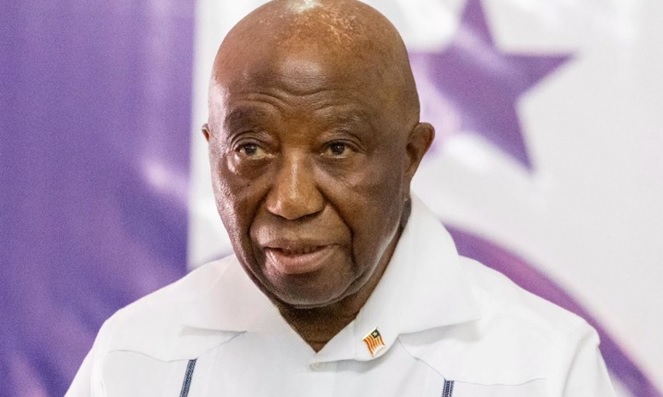
MONROVIA — President Joseph Nyuma Boakai’s possible return to the 2029 presidential ballot is rapidly becoming one of Liberia’s most consequential political questions—not simply because of his age, but because it raises questions about political promises, presidential succession, public accountability and the demands of leading a country into an additional six-year term.
Boakai, born November 30, 1944, would be 84 years old during the 2029 presidential election period and would turn 85 shortly afterward. If elected and inaugurated for another term in January 2030, he would begin that term at 85 and, if he completed the full six years, leave office at approximately 91.
His age is not a constitutional barrier.
Article 50 of the Liberian Constitution provides for a six-year presidential term and says no person may serve as president for more than two terms. Article 52 establishes a minimum age of 35 for the presidency but does not establish a maximum age. Boakai, having served only one presidential term, is therefore constitutionally eligible to seek another term.
But constitutional eligibility is only one part of the debate.
The more politically sensitive question is whether Boakai, who previously pledged to serve only one term if elected, should now seek to extend his presidency beyond 2030.
THE ONE-TERM PROMISE
The issue is not merely being manufactured by opposition politicians.
In a 2021 interview reported by FrontPage Africa, then-presidential aspirant Boakai pledged to serve only one term if elected president.
The significance of that statement is considerable because it was made before he became president.
It therefore formed part of the political expectations surrounding his candidacy.
Boakai’s argument at the time was essentially that Liberia needed leadership capable of producing results without becoming consumed by the pursuit of political power.
If he now decides to seek another six-year mandate, the legal question would be straightforward: the Constitution allows it.
The political question is considerably more complicated:
What happened to the one-term commitment?
That question would not necessarily mean that a second-term bid was unconstitutional. It would instead put the President under pressure to explain whether circumstances have changed, whether his earlier commitment was conditional, and why Liberians should interpret the new position differently.
“I AM STILL ENTITLED TO ONE TERM”
The speculation intensified in September 2026 following remarks attributed to President Boakai during an engagement with Liberians in the United States.
According to Liberia Public Radio, when asked about another presidential bid, Boakai asked the audience whether they would support another term. After receiving an affirmative response, he reportedly said: “I am still entitled to one term.”
That statement is important—but it should not be exaggerated.
Boakai has not formally declared his candidacy for 2029.
The remark can therefore be treated as an indication that another term remains an option, rather than as an official campaign announcement. Liberia Public Radio likewise reported that the President had neither formally launched a campaign nor explicitly announced that he would seek re-election.
Nevertheless, the timing has opened the political conversation.
And once a sitting president begins publicly discussing another term, the question of succession inevitably becomes part of the national political debate.
THE AGE QUESTION CANNOT SIMPLY BE IGNORED
Boakai’s age is neither a crime nor a constitutional disqualification.
He was already 79 when he took office in January 2024, making him Liberia’s oldest president at inauguration.
But the age question becomes more significant when considered against the length of another presidential term.
A president beginning another term at 85 would potentially be responsible for Liberia’s executive branch until approximately age 91.
That does not establish that he would be unable to govern.
Nor does age alone establish incapacity.
But it makes presidential succession, continuity of government, delegation of authority and medical transparency legitimate matters of public interest.
The Liberian public is entitled to know whether its president can continue carrying out the constitutional responsibilities of the office. At the same time, legitimate public scrutiny should not become speculation about private medical conditions for which there is no verified evidence.
That distinction is particularly important in Liberia, where political opponents have previously made claims about Boakai’s health.
THE 2024 INAUGURATION INCIDENT
The most prominent publicly documented health-related episode involving Boakai occurred during his inauguration on January 22, 2024.
During his address, the newly inaugurated president appeared physically distressed and had to be assisted away from the podium. Reuters reported that his party spokesperson attributed the episode to heat exhaustion during the outdoor ceremony. The President subsequently recovered.
The incident generated political controversy, including calls from opposition figures for greater disclosure about the President’s medical condition.
But the available public evidence does not establish that the episode represented a chronic illness or permanent incapacity.
An episode of heat exhaustion is a documented event.
A claim that the President is medically incapable of serving another term would require substantially different evidence.
WHAT IS KNOWN ABOUT HIS WELL-BEING TODAY?
There is also evidence of Boakai continuing to perform the public duties of the presidency.
In September 2026, he addressed the 81st United Nations General Assembly in New York.
And on September 29, 2026, Liberia’s state news agency reported that Boakai had proclaimed a recurring National Exercise and Wellness Day, citing the country’s growing burden of hypertension, diabetes, obesity and cardiovascular disease.
These public appearances demonstrate that he continues to carry out presidential functions.
They do not, however, constitute a medical examination and should not be presented as proof of his overall health.
That is precisely why the health component of the 2029 debate should be handled differently from ordinary political attacks.
If questions about the President’s health become central to the election, the most responsible approach would be verified medical information and institutional transparency—not rumors, photographs, isolated incidents or political speculation.
THE SUCCESSION PROBLEM
Perhaps the more profound issue is not whether an 84-year-old man can legally contest.
It is what happens to Liberia’s political succession if he does.
A second-term campaign could fundamentally reshape the Unity Party’s internal politics.
If Boakai decides not to seek another term, the ruling party would have to begin the difficult process of identifying and consolidating around a successor.
If he runs, potential successors could remain politically dormant or be forced to organize around a sitting president seeking another mandate.
That could produce tensions within the governing coalition.
It could also affect the country’s political landscape beyond 2029.
Liberia’s democracy depends not only on elections but on the ability of political parties to develop new leadership.
A presidency should therefore not become a permanent personality-centered institution.
THE COST OF A PRESIDENTIAL SUCCESSION DELAY
There is another potential consequence.
If a second-term campaign begins early, government policy could increasingly be interpreted through the prism of electoral politics.
Infrastructure projects, appointments, public spending, government communications and legislative priorities would inevitably face greater scrutiny.
The critical question would be whether government decisions are being made primarily because they serve Liberia’s long-term interests—or because they strengthen an incumbent’s political position.
That is not unique to Boakai. It is a recurring challenge in presidential democracies.
Liberia’s institutions would therefore need to provide the safeguards.
THE SIRLEAF PRECEDENT
Liberia has already experienced a president seeking a second term after initially serving a first.
Ellen Johnson Sirleaf contested and won a second term in 2011.
But the current situation has a distinctive feature: Boakai’s own earlier one-term pledge.
That makes the political debate less about whether Liberia permits two terms—it clearly does—and more about whether political promises made before an election should continue to carry weight after victory.
There is no constitutional mechanism that transforms a campaign promise into a constitutional prohibition.
But democratic accountability is broader than constitutional law.
A politician can legally change his position while still being required to explain that change to voters.
WHAT WOULD ANOTHER BOAKAI TERM MEAN FOR LIBERIA?
If Boakai eventually decides to run, the country would face several questions that should be answered through evidence rather than political slogans.
First: What would be the justification for abandoning the earlier one-term commitment?
Second: What measurable objectives from the first term would require another six years?
Third: What would be the President’s succession plan?
Fourth: What mechanisms would ensure continuity of government as the President advances in age?
Fifth: Would the ruling party allow a genuine internal debate about succession, or would the incumbent’s position dominate the political process?
Sixth: What safeguards would prevent government resources and institutions from being used to advantage an incumbent campaign?
Seventh: If health becomes an election issue, what level of medical disclosure would be appropriate while respecting the President’s legitimate privacy?
These questions should not be dismissed as attacks on Boakai.
They are questions that any incumbent seeking an additional six-year mandate should expect.
THE HEALTH ISSUE REQUIRES RESPONSIBILITY
There is a particularly important line that Liberia’s journalists and politicians should not cross.
It is legitimate to report that Boakai is 81 now, that he would be 84 during the 2029 election period, and that he experienced a publicly documented episode of heat-related physical distress during his 2024 inauguration.
It is legitimate to ask whether the President intends to disclose sufficient medical information if his health becomes an issue in the 2029 campaign.
It is not responsible to diagnose him from public appearances, speculate about his cognitive or physical condition, or present unverified allegations as medical facts.
The same standard should apply to supporters and opponents.
The question should be:
What verified evidence exists about the President’s capacity to perform the constitutional duties of his office?
Not:
What does someone’s age or appearance supposedly tell us about his health?
THE BIGGER QUESTION FOR LIBERIA
Ultimately, the Boakai 2029 debate should be bigger than Joseph Boakai.
It should force Liberia to examine the country’s approach to presidential succession.
A constitutional democracy cannot depend upon the personal decision of one leader to determine when a generation of political leadership changes.
The Constitution permits two presidential terms.
But constitutional permission does not settle every political or institutional question.
If Boakai runs, Liberians will have to consider his record, his policies, his promises, his proposed agenda for another term and the broader implications of another six years under his leadership.
If he does not run, Liberia will confront a different challenge: whether the Unity Party can successfully produce a successor without fracturing.
Either way, the 2029 question has already arrived.
And perhaps the most important issue is not simply whether Joseph Boakai wants another term.
It is whether Liberia’s political institutions are strong enough to make the transition—or continuation—of presidential power depend on institutions, evidence and the voters rather than on the wishes of any individual president.