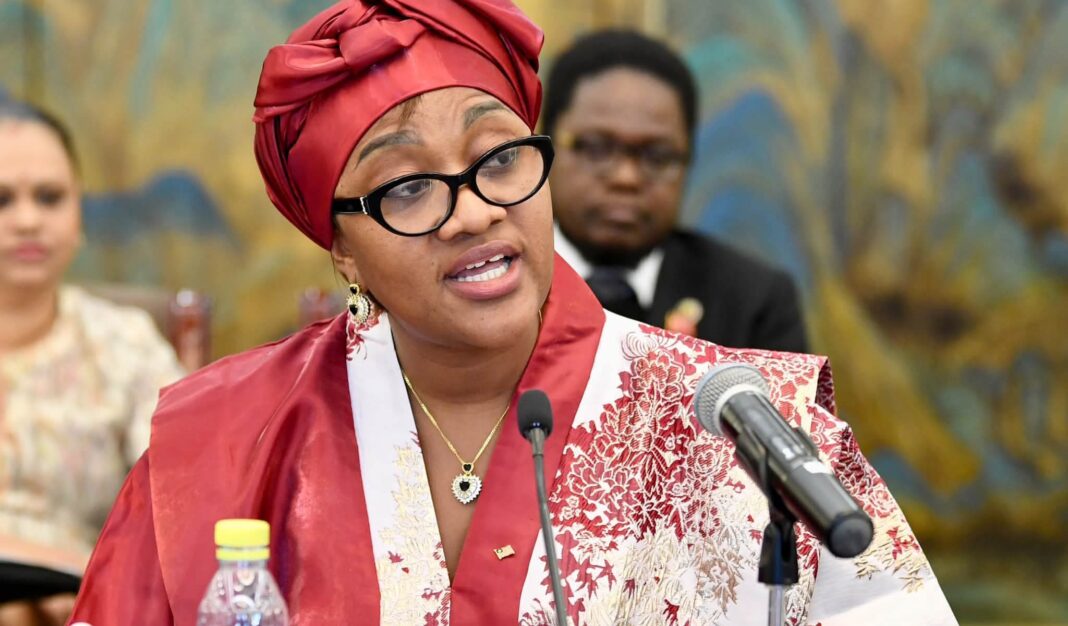
BEIJING, CHINA – Presidential Press Secretary, Atty. Kula Bonah Nyei Fofana, has represented fellow scholars from 54 countries at China’s Ministry of Foreign Affairs, delivering remarks that highlighted the value of international educational exchange, cross-cultural understanding, historical preservation, and cooperation among nations.
Fofana delivered the address on November 18, 2026, at the Ministry of Foreign Affairs of the People’s Republic of China, on behalf of participants of the 14th Cohort of the 2026 Dongfang Scholars Program at Peking University, following a 33-day learning experience that brought together scholars from across the Global South.
The gathering provided an opportunity for participants to reflect on their academic experience, institutional engagements, cultural exposure, and the knowledge acquired during their stay in China, while expressing appreciation to the Chinese Government, the Ministry of Foreign Affairs, Peking University, supporting embassies, and the Dongfang Scholars Program Secretariat for facilitating the program.
Addressing Vice Minister Miao Deyu, officials of the Chinese Foreign Ministry, university professors, program coordinators, distinguished guests, and fellow scholars, Fofana said the experience had broadened their perspectives, introduced them to new knowledge, and fostered lasting friendships among participants representing different countries and cultures.
She noted that although the scholars came from diverse national backgrounds, they shared common aspirations for peace, development, stronger institutions, and improved living conditions for their respective populations.
According to her, the program offered participants an opportunity not only to understand China’s development experience but also to learn from one another through academic discussions, institutional engagements, cultural activities, and interactions with officials, scholars, and ordinary citizens.
Fofana described the 33-day experience as a journey that extended beyond classroom learning, explaining that participants had gained deeper appreciation for China’s history, culture, governance, development trajectory, and institutional arrangements.
She said the scholars’ experience with Chinese language instruction also reflected the commitment and patience of their teachers, noting that participants had progressed from basic expressions to greater confidence in communicating in Chinese.
The Liberian Presidential Press Secretary emphasized that understanding a country requires evidence, thoughtful questions, direct experience, and appreciation of the historical circumstances that have shaped its development.
She cited the scholars’ visits to the Forbidden City, the Terracotta Army in Xi’an, and several historical and cultural sites in Guizhou as important experiences that brought China’s history and civilization to life.
The visits, she said, exposed participants to the importance of protecting national heritage and ensuring that historical knowledge remains accessible to future generations.
Fofana particularly highlighted the Guizhou Long March Culture Digital Art Museum, describing its use of modern technology to preserve historical records and make the past accessible to younger generations as an example of how innovation can strengthen cultural preservation.
Reflecting on Liberia and other countries represented in the program, she stressed that nations must preserve their histories of struggle, sacrifice, resilience, and recovery so future generations can understand their origins and draw lessons from the past.
She maintained that national development should not be disconnected from historical consciousness, emphasizing the need for countries to understand their past while pursuing their future aspirations.
The program also exposed participants to discussions on political leadership, institutional capacity, discipline, anti-corruption, oversight, accountability, and governance, providing insights into China’s approach to public administration and institutional development.
Fofana said the experience was particularly meaningful because it brought together scholars from 54 countries at a time when international cooperation, dialogue, and collaboration remain important to addressing shared global challenges.
She also referenced the ongoing APEC meeting during her remarks, expressing hope that its outcome would contribute to international coordination, global peace, and stronger collaboration among nations.
Beyond formal academic engagements, she recounted the cultural and social experiences that shaped the scholars’ stay in Beijing, including their adjustment to navigating the Peking University campus, exploring Chinese cuisine, and building friendships through shared experiences.
She said those moments transformed an unfamiliar environment into a place of learning, friendship, and appreciation, with participants expected to carry the memories and relationships established during the program long after returning to their respective countries.
As the scholars prepare to return home, Fofana said they leave China with a deeper understanding of its history, culture, development experience, and institutions, as well as friendships spanning continents.
She cautioned, however, that learning from another country should not be confused with blindly replicating its policies or development model, emphasizing that the responsibility of participants is to carefully examine the lessons acquired and determine how relevant experiences can be adapted to their own national development priorities.
She urged fellow scholars to share the knowledge gained with their respective institutions and communities and apply it thoughtfully in their professional responsibilities.
Fofana expressed gratitude to the program’s professors, host institutions, communities, organizers, and the Chinese Ministry of Foreign Affairs for facilitating the experience, while acknowledging Peking University for providing an academic environment that fostered learning and friendship.
She encouraged participants to maintain the relationships established during the program, describing the international friendships as bridges capable of strengthening connections among their respective nations.
In closing, the Liberian official said the experience had strengthened their capacity for reflection, dialogue, and international engagement, expressing hope that the knowledge acquired would contribute meaningfully to the lives of the people they serve.
The Dongfang Scholars Program brought together participants from 54 countries across the Global South, providing an avenue for academic exchange, cultural engagement, and international dialogue on development, governance, history, and cooperation.