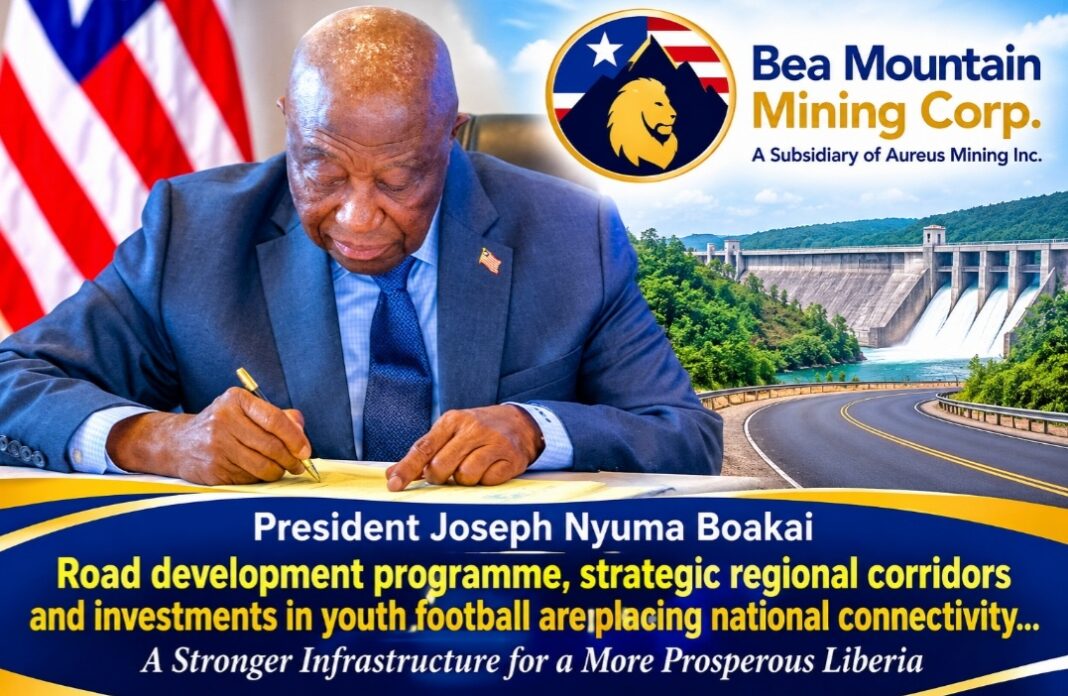

Former President Ellen Johnson Sirleaf calls for international scrutiny; public interest shifts to Walter McCarthy’s alleged campaign support, consultancy engagements and reported involvement in the controversial agreement.
Smart News Room Analysis
Monrovia — Walter McCarthy’s recent declaration that he “honorably resigned” from the administration of former President Ellen Johnson Sirleaf has reopened public discussion about his departure from government. However, his clarification has not addressed several questions surrounding his subsequent consultancy activities and reported involvement in the proposed US$5.7 billion Bea Mountain Master Infrastructure Development Agreement.
McCarthy, a former Deputy Minister for Administration at the Ministry of Lands, Mines and Energy, has defended his professional reputation, maintaining that he voluntarily resigned at the end of Sirleaf’s first presidential term before transitioning into private consultancy.
He has also urged Liberians to concentrate on the proposed agreement’s infrastructure benefits rather than the controversy surrounding his past government service.
His explanation deserves consideration. However, the public discussion should not end with the circumstances of his resignation.
The more substantive issues concern the nature of his professional engagements after leaving government, his reported relationship with the Boakai administration and the capacity in which he may have participated in discussions surrounding the Bea Mountain arrangement.
These are legitimate matters of public interest, particularly because the proposed agreement involves Liberia’s mineral revenues and substantial long-term infrastructure commitments.
Campaign financing and questions about government access
A December 2023 publication by FrontPage Africa discussed McCarthy’s reported financial support for President Joseph Boakai’s presidential campaign.
That reporting raises questions worth clarifying, particularly now that the Boakai administration is negotiating and considering major economic arrangements involving private companies.
Did McCarthy provide financial support to the 2023 presidential campaign? If so, was the contribution formally declared in accordance with applicable campaign-financing requirements?
Has he subsequently received consultancy engagements from government ministries or agencies?
Is there any documented relationship between his reported campaign support and the professional opportunities he may have received since the current administration took office?
These questions should not be interpreted as evidence that campaign contributions were exchanged for government contracts or political favors. No such conclusion should be drawn without supporting evidence.
Nevertheless, transparency in political financing is important because campaign contributors, public officials and private-sector interests may interact after elections.
Liberians deserve assurance that government contracts and access to public decision-making are determined by lawful procedures, professional qualifications and the national interest rather than political relationships.
McCarthy’s consultancy engagements deserve clarification
Another area requiring transparency is McCarthy’s reported consultancy work involving government institutions and private-sector interests.
The public would benefit from knowing which ministries, agencies or public institutions have retained his services since January 2024, the nature of the assignments and the contractual arrangements under which they were undertaken.
It is equally important to establish whether he has provided consultancy services to private companies operating in sectors where the government exercises regulatory, contractual or concession-granting authority.
If such engagements exist, what measures are in place to prevent actual or potential conflicts of interest?
Does McCarthy’s work for any government institution overlap with his professional relationships with mining, infrastructure or other multinational companies?
Were any relevant interests disclosed to the appropriate authorities?
There is nothing inherently unlawful about a former government official operating a consultancy business or providing professional services to private companies.
However, where public institutions and private commercial interests intersect, transparency and compliance with applicable conflict-of-interest and procurement requirements become essential.
The relevant authorities should establish whether the arrangements, if any, comply with Liberian law.
What role did McCarthy play in the Bea Mountain negotiations?
The question of McCarthy’s involvement in the Bea Mountain agreement deserves a clear explanation from both him and the government.
Information attributed to unnamed government sources has raised claims about his alleged central role in facilitating or advancing the arrangement. Those claims have not been independently established by this publication and should not be treated as proven facts.
Nevertheless, they warrant further inquiry.
What capacity, if any, did McCarthy occupy during discussions leading to the agreement?
Was he engaged as a consultant by the Liberian government, Bea Mountain Mining Corporation, the proposed construction contractor or another private entity?
Did he participate in negotiations, provide technical or commercial advice, or assist in coordinating discussions among the parties?
Was he compensated for any services connected to the arrangement?
If so, who engaged him and what was the contractual scope of his work?
These questions are important because the public should know who participated in developing an agreement that could have significant implications for Liberia’s mineral revenues and public finances.
McCarthy should be afforded the opportunity to provide a detailed account of his role.
What the agreement says about Liberia’s financial obligations
Beyond the personalities involved, the actual provisions of the Master Infrastructure Development Agreement deserve independent examination.
A review of the agreement identifies several provisions that lawmakers, financial experts and the public should carefully assess.
1. Recovery of infrastructure costs
Article 9 provides for approved infrastructure costs to be recovered through set-offs against qualifying payments owed by Bea Mountain to the Liberian government, including taxes, royalties and dividends.
The financial implication is that certain government revenues could be used to settle approved project costs rather than being paid directly into the Consolidated Fund.
The public deserves a clear projection of how this arrangement could affect government revenue over the agreement’s lifespan.
2. Interest on outstanding costs
Article 9.4 provides for interest calculated at three-month SOFR plus 2 percent annually on outstanding approved costs.
The government should explain how interest will be calculated, how long costs may remain outstanding and what safeguards exist against excessive financial exposure.
3. Auditing and verification
Article 20.5 provides for the General Auditing Commission to audit records relating to approved costs, payment certificates and set-offs, while excluding the actual costs incurred by the EPC contractor or Bea Mountain from that particular audit provision.
This raises an important question about how independent verification of underlying construction costs will be conducted.
The government should explain what alternative auditing and verification mechanisms will ensure that Liberia receives value for money.
4. The appointment of the construction contractor
Article 31.3 addresses legislative ratification of the appointment of the engineering, procurement and construction contractor and the EPC contracts, with provisions excluding them from the Public Procurement and Concessions Act and other public procurement and concessions laws.
Lawmakers should obtain independent legal advice on the implications of this provision and its relationship with Liberia’s existing procurement and concession framework.
These concerns arise from the agreement’s provisions and should be examined independently of allegations concerning any individual.
Sirleaf’s call for international scrutiny
Former President Ellen Johnson Sirleaf recently urged President Boakai to exercise caution over the Bea Mountain arrangement and called for international scrutiny of the proposed deal.
Her intervention has added another dimension to the national discussion, particularly given her remarks concerning McCarthy’s departure from her administration.
However, the most important part of her intervention is the recommendation that the agreement undergo independent technical and financial examination.
The African Development Bank or another internationally recognized institution could potentially assist in assessing the financial model, projected mineral revenues, infrastructure costs, engineering feasibility and long-term fiscal implications.
The government should explain whether it is prepared to consider such an independent assessment.
An internationally credible review could help establish whether the projected infrastructure benefits are realistic and whether the financial arrangements adequately protect Liberia.
Infrastructure promises must be independently verified
In defending the proposed agreement, McCarthy highlighted its projected infrastructure components, including approximately 10 billion cubic meters of reservoir capacity, 270 megawatts of electricity generation from four power plants, more than 300 kilometers of transmission lines, roads, bridges, highways and substation upgrades.
These are important development objectives.
Liberia needs reliable electricity, improved roads and infrastructure that can support economic growth and improve living conditions.
However, projected benefits should be distinguished from completed infrastructure.
The government should publish detailed implementation schedules, independently verified construction estimates, financing arrangements, maintenance responsibilities and penalties for non-performance.
It should also explain how the projects will be monitored and how the public will know whether the promised infrastructure has actually been delivered.
Questions requiring official clarification
To advance public understanding, Smart News is seeking clarification from McCarthy and the relevant government institutions on the following matters:
1. Did McCarthy provide financial support to President Boakai’s 2023 presidential campaign, and were any contributions formally declared?
2. Has McCarthy or any consultancy associated with him received government contracts since January 2024?
3. Which government institutions have engaged his professional services, and what were the purposes and values of those engagements?
4. Does he have consultancy or advisory relationships with private companies operating in sectors in which he also provides services to government institutions?
5. What was his precise professional role, if any, in the development or negotiations of the Bea Mountain agreement?
6. Which party, if any, engaged or compensated him for services connected to the agreement?
7. What disclosure or conflict-of-interest safeguards were applied to any relevant engagements?
The Ministry of Justice, Liberia Anti-Corruption Commission, General Auditing Commission and the Legislature should also examine matters falling within their respective legal mandates.
The national interest must come first
The Bea Mountain discussion should not become a personal dispute between Walter McCarthy and Ellen Johnson Sirleaf.
Neither should McCarthy’s explanation about his resignation be treated as a complete response to questions about his subsequent professional activities.
The central issue is whether the proposed agreement provides Liberia with a fair, transparent and financially sustainable arrangement.
Political campaign financing, private consultancy and government access are not automatically unlawful. But where they intersect with decisions involving public resources, the public has a legitimate right to demand transparency and accountability.
McCarthy should be given a fair opportunity to explain his professional relationships and involvement. The government should equally provide the relevant documents and financial explanations needed to assess the arrangement.
President Boakai also has an opportunity to demonstrate that his administration is committed to transparent management of Liberia’s natural resources by welcoming independent scrutiny of the agreement.
Liberia needs development, but the country also needs guarantees that the cost of development will not undermine its future revenues or burden generations yet unborn.
The ultimate test of the Bea Mountain agreement should not be the number of billions announced or the political personalities associated with it. It should be whether the agreement delivers measurable benefits to Liberia while protecting the country’s financial and national interests.
The public deserves answers, not assumptions; documents, not political assurances; and development arrangements that can withstand independent scrutiny.