MONROVIA, LIBERIA — “A THIEF IS NOTHING BUT A THIEF,” asserts former Unity Party chairman Wilmot J. M. Paye, raising a provocative question: Has Thomas Fallah changed, or has Liberia’s political landscape shifted around him?
Paye is re-entering the political arena, and this time, he’s targeting one of President Joseph Nyuma Boakai’s most prominent allies.
The former Unity Party chairman and ousted Minister of Mines and Energy has launched a fierce social media assault on Deputy Speaker Thomas P. Fallah, stating that “a thief is nothing but a thief” and accusing his unnamed target of being molded by “thievery,” “greed,” and “corruption.”
Paye’s remarks were clearly political. “A thief is nothing but a thief,” he reiterated.
“No fundamental change has occurred simply by a shift in position,” the sacked Mines and Energy Minister added.
Then came the statement that could be most troubling for the Unity Party: “After all, a thief six years ago is still a thief today. Even my Unity Party people know this simple truth.”
While Paye did not explicitly name Fallah in his Facebook post, the highly charged political atmosphere in Liberia has led many to interpret his target’s identity through the lens of Fallah’s notable political evolution—from a key figure in the former ruling Coalition for Democratic Change to one of President Boakai’s most fervent political strategists. And therein lies the true political bombshell.
THE “THIEF” WHO CROSSED THE AISLE
Fallah’s relationship with the Unity Party has not always been friendly. For many years, he was closely linked to the CDC political establishment and was considered one of its key figures in Montserrado County.
Howbeit, during the intense political conflicts of the George Weah administration, Fallah found himself facing harsh criticism from Unity Party supporters.
One of the most notable insults directed at him was the infamous “Thief Five” label, which became a significant part of the heated exchanges between CDC and UP supporters.
It’s important to note that these accusations were political in nature and not based on any judicial findings.
Nevertheless, the political history in Liberia is quite enduring. Paye’s recent comments seem aimed at rekindling those memories.
The same Thomas Fallah, who was once depicted in a negative light by UP supporters, is now working within President Boakai’s political circle.
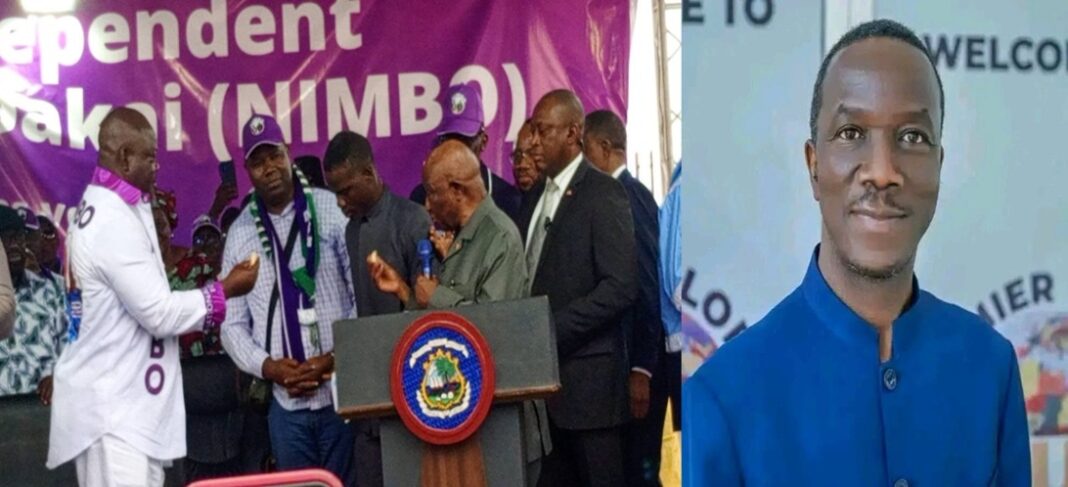
In May 2026, Boakai himself joined Fallah for the launch and groundbreaking of the National Independent Movement for Boakai, or NIMBO, a political initiative aimed at rallying grassroots support for the President’s expected reelection campaign in 2029.
The symbolism of this partnership is hard to overlook; a former heavyweight of the CDC has transformed into a key organizer for the individual who unseated the CDC’s political establishment.
FROM CDC INSIDER TO BOAKAI’S SOLDIER
Fallah’s political split with the CDC became more visible as he aligned himself with the legislative majority backing Boakai.
The CDC eventually expelled him, and Fallah quickly became one of the most vocal advocates against allowing former President Weah to regain power.
By April 2026, he was actively promoting NIMBO and gearing up to rally support for Boakai’s 2029 campaign.
Then came the NIMBO launch, with President Boakai appearing alongside Fallah as the movement kicked off its political activities.
Reports indicated that the event drew in government officials, lawmakers, and supporters, while Fallah framed the movement as a crucial platform for Boakai’s political aspirations.
The transformation was complete; the former CDC member was no longer just a supporter of Boakai but was now instrumental in organizing the President’s re-election campaign’s efforts.
This is exactly where Paye’s “thief” accusation becomes a politically charged issue.
PAYE: “A THIEF IS STILL A THIEF”
Paye’s message revolves around a key point: Changing political loyalty does not alter one’s character.
He wrote: “A character shaped in thievery, perfected in greed, and wrapped up in corruption,” and added, “even if embellished with the most ecstatic outward ornaments… is still what it is: THIEF.”
He then argued that shifting political positions cannot erase one’s past.
The sacked Mines and Energy minister’s choice of words is notable—not just for its harshness, but also for the identity of the deputy speaker.
Paye is not just any opposition figure; he was previously the chairman of the Unity Party. After the UP’s victory in 2023, he became Minister of Mines and Energy, serving as a senior political ally to Boakai.
Howbeit, on October 27, 2025, President Boakai dismissed him and appointed former Nimba County Representative R. Matenokay Tingban as his successor.
The Executive Mansion stated at the time that this change aimed to enhance governance, institutional performance, accountability, and efficiency.
Suddenly, Paye found himself outside the government he had helped build.
THE “BORROWED COAT” MOMENT
At his farewell ceremony from the Ministry of Mines and Energy, Paye made a memorable comparison, likening government service to wearing a borrowed coat.
He pointed out that the coat does not truly belong to the person who wears it.
Many interpreted this message as a dignified acknowledgment of his dismissal.
However, Paye did not fade into the background. Instead, he became more vocal in criticizing certain aspects of the administration.
His political break with the government has now opened a new chapter, and Fallah appears to be in the line of fire.
BUT IS FALLAH REALLY A THIEF?
Paye’s words bring a critical question to the forefront of our national discussion. To this, we cannot find an answer in a Facebook post.
There is however, no legal ruling that labels Fallah as a thief based on the information gathered for this story.
Thus, Paye’s remarks serve as an accusation and a political strike rather than a judicial conclusion.
Liberia has seen politicians use allegations as political tools, only for those same claims to vanish when political alliances shift.
So, if Fallah was once labeled “Thief Five” by supporters of the UP, what has changed?
Did Fallah himself change? Did the nature of the allegations change? Or did the political motivations of those making the claims shift? That is the troubling question we must confront.
THE UNITY PARTY’S OWN POLITICAL MIRROR
Paye’s criticism may ultimately focus less on Fallah and more on the Unity Party itself.
If the UP once deemed Fallah unacceptable but now embraces his support for Boakai, Liberians have every right to question the criteria for political rehabilitation.
Furthermore, if Paye is now bringing up past accusations against Fallah, he is essentially asking: Was the old “thief” label incorrect back then, or is the current alliance misguided? The answer cannot simply hinge on party loyalty.
Additionally, accusations of corruption should not be accepted just because they serve political interests.
If Paye has evidence of any criminal activity, it should be presented to the appropriate investigative and judicial bodies.
If he lacks such evidence, then the “thief” label tagging Fallah remains a serious political charge that demands substantiation.
THE BIGGER 2029 BATTLE
The timing of this confrontation adds to its significance. NIMBO has already made its mark in the political landscape as a movement backing Boakai’s expected reelection in 2029.
Fallah has placed himself at the forefront of this initiative. The Unity Party has embraced NIMBO’s rise and praised Fallah for his backing of Boakai.
However, Fallah’s political engagement has sparked controversy, particularly regarding the involvement of government officials in NIMBO events.
Now, Paye, once a prominent figure in the UP, is reintroducing the term “THIEF” into the political discourse.
This situation has escalated beyond a mere dispute between two politicians; it has evolved into a struggle over political memory and identity.
It’s a battle over who gets to shape the narrative of the past and, increasingly, a contest for who will dictate the future.
THE QUESTION LIBERIANS MUST ASK
Liberia’s political landscape is marked by a history of shifting alliances, where yesterday’s adversaries can become today’s partners.
Howbeit, the existence of political alliances should not influence the credibility of corruption allegations.
If Thomas Fallah is indeed guilty of corruption, it is essential that evidence—not mere political statements—be the basis for that determination.
Conversely, if he is innocent, then the label of “thief” should not serve as a replacement for actual proof.
Furthermore, if the Unity Party previously condemned Fallah but now regards him as a key ally of the President, they too must confront the difficult question: What has changed?
For Wilmot Paye, the answer seems clear: “A thief is nothing but a thief,” he wrote.
Yet, for Liberia’s political elite, a more pressing question looms: When yesterday’s “thief” becomes today’s political ally, has the individual changed, or has the political landscape shifted?