MONROVIA – Vice President Jeremiah Kpan Koung has placed reliable and affordable electricity at the center of Liberia’s economic transformation agenda, emphasizing that a dependable power supply is essential to attracting investment, expanding local industries, creating employment opportunities, and improving the delivery of essential public services.
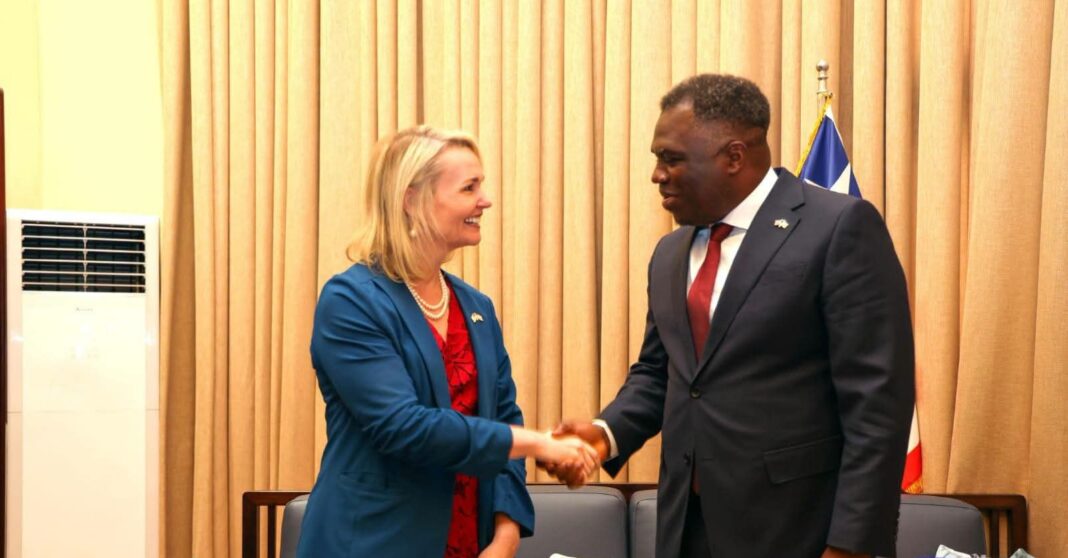
Koung made the remarks Monday, November 23, 2026, when he received United States Chargé d’Affaires Kristin Gilmore during a courtesy visit at his Capitol Building office in Monrovia, where both officials discussed electricity, trade and investment, public health, school feeding, and security cooperation.
During the engagement, the Vice President stressed that Liberia’s ability to generate sustainable economic opportunities depends considerably on the availability of reliable electricity to support businesses, agricultural production, industrial processing, and public institutions.
He pointed to the practical consequences of inadequate electricity supply, particularly for farmers who require dependable power to operate cold storage facilities, hospitals that depend on uninterrupted electricity to deliver essential medical services, and businesses seeking to process more Liberian products locally.
Koung explained that dependable electricity would enable farmers to preserve perishable agricultural products for longer periods, reduce post-harvest losses, and improve their ability to supply markets without losing substantial portions of their production.
For Liberia’s agricultural sector, improved access to electricity could support the development of storage facilities, food processing operations, and other value-adding activities that would strengthen local production and reduce dependence on imported finished products.
The Vice President also emphasized the importance of reliable power for hospitals and healthcare facilities, where interruptions in electricity can affect medical equipment, laboratory operations, refrigeration of essential medical supplies, and other critical services.
He maintained that businesses would be better positioned to expand their operations, increase productivity, and create employment opportunities if electricity became more affordable and dependable.
His position reflects the growing importance of energy infrastructure in Liberia’s efforts to attract private investment and establish a stronger productive economy.
A major aspect of the discussions involved opportunities for greater private-sector participation in Liberia’s electricity industry, particularly in electricity distribution.
Koung expressed support for exploring arrangements that would encourage private investment in the sector, recognizing that improving the country’s electricity system requires investment, technical capacity, operational efficiency, and sustainable financing.
The discussions also examined options for increasing electricity supply in the near term while advancing longer-term reforms being considered under Liberia’s proposed second Millennium Challenge Corporation (MCC) compact.
The proposed reforms include attracting private investment in electricity generation and distribution, alongside efforts to reduce losses across the power system.
Reducing electricity losses is particularly important because inefficiencies in power distribution can undermine the financial sustainability of electricity providers, limit the resources available for infrastructure expansion, and weaken the ability of the sector to serve a growing customer base.
The Vice President and the U.S. Chargé d’Affaires discussed the importance of addressing these challenges through investment and institutional improvements capable of strengthening electricity supply and supporting economic growth.
The proposed second MCC compact was discussed as part of the broader framework for addressing Liberia’s infrastructure and investment challenges.
During the meeting, Chargé d’Affaires Gilmore said attracting American investment capable of creating lasting employment opportunities in Liberia remains a priority of her diplomatic mission.
Her position reinforces the importance of developing an investment environment in which American businesses and other international investors can identify opportunities, establish operations, and contribute to Liberia’s productive sectors.
Koung welcomed a proposal for regular dialogue between the Government of Liberia and the business community to identify and address obstacles affecting investment.
Such engagement could provide an avenue for businesses to communicate operational difficulties, discuss regulatory and infrastructure challenges, and propose practical measures to improve the investment climate.
The Vice President’s support for the proposed dialogue reflects the importance of maintaining direct communication between policymakers and private-sector operators as Liberia seeks to attract investment and expand economic opportunities.
The meeting also addressed the upcoming U.S.–Africa Business Summit scheduled for December 6–9, 2026, in Mauritius.
Chargé d’Affaires Gilmore extended an invitation to Vice President Koung to attend the summit, which provides an opportunity for engagement on commercial partnerships and investment opportunities between the United States and African countries.
Koung welcomed the invitation and indicated that he would consult President Joseph Nyuma Boakai Sr. regarding Liberia’s representation.
The discussions come at a time when Liberia continues to face the challenge of strengthening its electricity infrastructure to meet the needs of households, businesses, industries, and public institutions.
Reliable power remains important not only for lighting homes and offices but also for expanding agricultural production, supporting manufacturing, improving healthcare delivery, and making Liberian businesses more competitive.
The Vice President’s emphasis on electricity therefore places energy infrastructure within a wider economic development framework that connects investment, employment, industrialization, and public service delivery.
For farmers, improved electricity could strengthen food preservation and processing. For hospitals, it could support more dependable medical services. For businesses, it could reduce operational constraints and encourage expansion. For investors, it could improve the conditions necessary for establishing sustainable commercial operations.
The engagement between Koung and Gilmore also highlights the importance of cooperation between Liberia and the United States in addressing infrastructure and investment challenges.
As Liberia explores reforms under a proposed second MCC compact and seeks greater private-sector participation in its electricity industry, the challenge will be translating policy discussions into practical investments, improved power supply, stronger distribution systems, and measurable economic benefits.
The Vice President’s position highlights a central development priority. Liberia’s ability to create more jobs, strengthen local industries, and improve the livelihoods of its citizens will depend partly on its success in making reliable and affordable electricity more accessible across the country.