NEW YORK — Liberia has urged the international community to preserve human control over decisions to use lethal force, warning that advances in autonomous weapons could create a new and dangerous dimension of warfare in which machines determine life and death without direct human judgment.
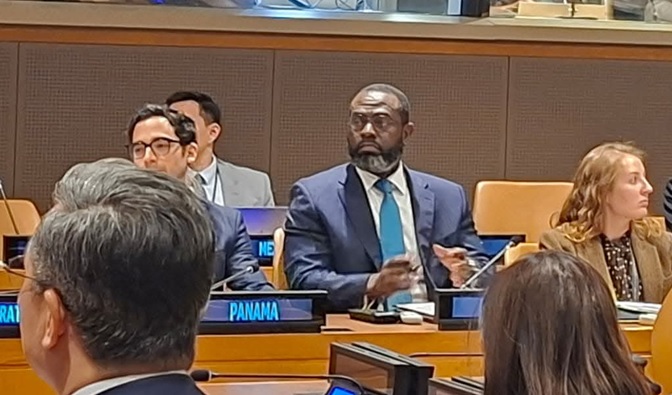
Speaking at the Arria-Formula meeting on upholding international law in situations of armed conflict on September 16, 2026, Liberia’s Minister Plenipotentiary and Deputy Permanent Representative to the United Nations, H.E. Baba Sillah, drew on Liberia’s own experience of civil war to make the case for stronger international safeguards as military technology rapidly evolves.
“Liberia does not come to this debate with theory. We come with memory,” Sillah told the meeting, invoking Liberia’s experience of state collapse and armed conflict as a basis for its position on protecting civilians and maintaining accountability during war.
He said Liberia’s history demonstrates what happens when the rules intended to protect human life are disregarded, arguing that violations of the laws of war in one conflict ultimately raise concerns for humanity beyond the battlefield where they occur.
Sillah said modern conflicts increasingly take place in densely populated towns and villages, where the use of heavy explosive weapons can produce devastating consequences for civilians.
He then turned to what Liberia considers an emerging challenge with potentially far-reaching consequences, the increasing use of automated systems in warfare.
The Liberian diplomat warned against allowing autonomous systems to make lethal decisions without meaningful human control, arguing that machines cannot exercise the moral judgment required when human lives are at stake.
His argument comes as international discussions on autonomous weapons continue to intensify.
The International Committee of the Red Cross has warned that autonomous weapon systems can create humanitarian, legal and ethical challenges because they may select and apply force without human intervention. The ICRC has called for new legally binding international rules, including prohibitions on unpredictable autonomous weapons and systems designed or used to apply force directly against people.
In August 2026, UN Secretary-General António Guterres and ICRC President Mirjana Spoljaric renewed their call for states to establish international rules governing autonomous weapons, warning about the risks associated with machines autonomously targeting humans.
Liberia’s intervention therefore places the country within a wider international debate over how existing international humanitarian law should apply to rapidly developing military technologies.
Sillah proposed three areas of action, beginning with maintaining human control over weapons technology while protecting humanitarian engagement in conflict situations.
He called on the Security Council to support a legally binding prohibition on fully autonomous weapons systems.
At the same time, he urged member states to implement Resolution 2664, which established a humanitarian exemption to certain UN sanctions asset-freeze measures to prevent sanctions from obstructing humanitarian assistance and activities supporting basic human needs.
The Security Council adopted Resolution 2664 in December 2022 by a vote of 14 in favor, with one abstention. The resolution permits specified humanitarian transactions and services necessary for delivering humanitarian assistance without violating applicable asset-freeze measures.
Sillah argued that counter-terrorism measures should not prevent humanitarian actors from engaging in necessary dialogue with non-state armed groups when such engagement is aimed at protecting civilians and securing humanitarian access.
For Liberia, the two issues are connected by a common principle, that international law must remain capable of protecting human beings in the actual conditions of modern conflict.
The Liberian diplomat also warned against selective application of international law.
He argued that international law loses credibility when rules are applied differently depending on the actors involved, saying accountability should be based on universal standards rather than political convenience.
Sillah referenced the Kampala Convention and the Fourth Geneva Convention in addressing forced displacement and demographic changes during conflict.
The Kampala Convention, formally the African Union Convention for the Protection and Assistance of Internally Displaced Persons in Africa, was adopted in 2009 and entered into force in 2012. It provides an African legal framework addressing internal displacement.
Sillah connected Liberia’s international position to its own domestic efforts, saying the Liberian Government remains committed to establishing a War and Economic Crimes Court.
That reference gave Liberia’s intervention a domestic accountability dimension, with the government presenting its own transitional justice agenda as part of the broader principle that international law must be accompanied by accountability at the national level.
The Minister said international law should not remain confined to treaties and diplomatic declarations.
Instead, he argued, the rules governing armed conflict must reach combatants, military technologies, peacekeepers and national courts.
His remarks placed particular emphasis on the emerging relationship between law and technology.
As autonomous systems become increasingly capable of identifying and responding to targets, the question of responsibility becomes more complicated. The ICRC has similarly noted that legal responsibility for attacks cannot simply be transferred to a machine and has emphasized the need for human control over the use of force.
For Liberia, the answer is to ensure that human judgment remains central to decisions involving lethal force.
Sillah’s intervention consequently presented Liberia’s own experience of war as a reason to strengthen, rather than weaken, international safeguards.
The country’s message to the international community was that technological progress should not remove human responsibility from warfare.
Liberia is calling for international rules capable of keeping pace with weapons technology, protecting humanitarian action and ensuring that accountability remains attached to human decision-makers.
At the heart of the intervention was a simple proposition: international law must remain effective not only in treaties and diplomatic chambers, but also at the precise moment when decisions are made on the battlefield.
For Liberia, preserving that human responsibility is essential to ensuring that technological advancement does not outpace the legal and moral protections designed to preserve human life.