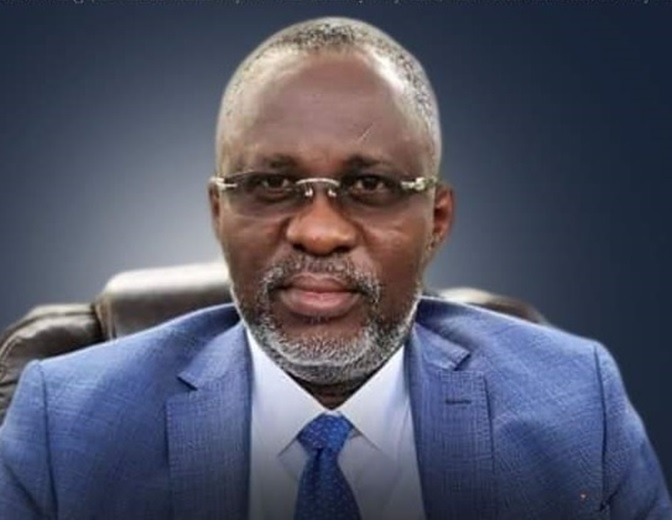
As Nathaniel McGill reportedly eyes another term as CDC National Chairman, critics question whether the party is prepared to confront the political and diplomatic consequences of bringing back a sanctioned former official.
MONROVIA — The reported ambition of former Presidential Affairs Minister Nathaniel McGill to reclaim the chairmanship of the Congress for Democratic Change (CDC) is reopening an uncomfortable debate within the opposition party: Is leadership simply about political loyalty and influence, or should character, public accountability and international credibility also matter?
McGill’s reported interest in returning to the party’s top leadership position comes with considerable political baggage, particularly his designation under United States sanctions during the administration of former President George Weah.
The question facing the CDC is not merely whether McGill has the political connections or organizational experience to lead the party. It is whether his return to such a prominent position would send the wrong message about the party’s commitment to accountability, institutional renewal and its relationship with Liberia’s international partners.
SANCTIONS ARE NOT THE SAME AS CRIMINAL CONVICTION
One important distinction must be made: being sanctioned by the United States does not automatically amount to a criminal conviction in Liberia. Similarly, the absence of a criminal prosecution or conviction does not erase an existing sanctions designation.
McGill’s case therefore raises two separate questions: the legal status of the sanctions and the political judgment involved in selecting someone carrying that designation for a major party leadership position.
The CDC must consider that distinction carefully rather than treating the absence of a criminal conviction as proof that all public concerns have been settled.
THE UNITED STATES HAS NOT LIFTED THE SANCTIONS
The issue becomes even more significant when the history of McGill’s attempt to have the sanctions removed is considered.
On August 15, 2022, the U.S. Treasury Department designated McGill under Executive Order 13818, which implements the Global Magnitsky sanctions framework. Treasury alleged that he engaged in public corruption, including manipulating procurement processes to benefit companies in which he had ownership interests.
These were allegations made by the U.S. government, not a criminal conviction by a Liberian court. However, they remain the stated basis for his sanctions designation.
More importantly, in August 2026, reports indicated that the U.S. Treasury had rejected McGill’s request to be removed from its sanctions list. According to the reported April 11, 2025 determination, the Office of Foreign Assets Control (OFAC) found that his return to public office as a senator, coupled with his failure to provide promised business records, did not establish that the circumstances supporting his designation had changed.
OFAC also rejected the argument that the absence of a Liberian prosecution was sufficient to justify removing the sanctions. McGill was informed that he would remain on the sanctions list. THE LIBERIAN INVESTIGATOR
This is where the CDC leadership debate becomes particularly sensitive. A decision by the party to elevate McGill could be interpreted as political rehabilitation at a time when the United States has not withdrawn its designation.
THE LACC CLEARANCE DOES NOT SETTLE THE U.S. SANCTIONS ISSUE
The Liberia Anti-Corruption Commission’s March 2026 decision to clear McGill in a separate investigation involving alleged payroll irregularities should also be understood in its proper context.
LACC Chairperson Cllr. Alexandra Zoe explained that investigators did not establish sufficient documentary evidence to prosecute him in that particular case. She also made clear that the clearance did not address the separate allegations underlying the U.S. sanctions.
In other words, being cleared in one investigation does not automatically resolve a different set of allegations or cancel sanctions imposed by another government. allAfrica.com +1
For a political party seeking to restore public confidence, that distinction cannot simply be ignored.
A WARNING FROM WITHIN THE CDC
Interestingly, concerns about McGill’s political influence and character are not new, nor are they coming exclusively from outside the CDC.
In July 2023, Dr. Lester Zomatic Tenny, a prominent CDC stalwart, publicly criticized the party’s decision to nominate McGill for the Margibi senatorial race despite his U.S. sanctions designation.
Tenny said he and members of the party’s National Executive Committee were uncomfortable with the decision, claiming the nomination was made to appease former President George Weah.
His criticism is significant because it demonstrates that concerns about McGill’s place in the party existed even among its own supporters.
In a further criticism attributed to Dr. Tenny, he questioned the judgment of a political movement considering McGill for its top leadership position, describing him as a sanctioned figure whose political history could become a liability for the party.
He was quoted as saying:
“Imagine a documented sanctioned criminal publicly announced that the election would be rigged to maintain the cabal of thieves in power. This is the clown that a major opposition cult wants to make chairman. I pray he becomes chairman.”
The characterization in that statement is Dr. Tenny’s opinion, not a judicial finding. Nevertheless, it reflects the intensity of the internal disagreement surrounding McGill’s political future.
IS THE CDC PREPARED TO RISK ANOTHER CONFRONTATION WITH WASHINGTON?
The United States is not an ordinary international partner whose concerns can be dismissed without consequences. Its sanctions carry financial and diplomatic implications, particularly for individuals and entities operating within the reach of the American financial system.
There is a popular expression worth remembering: If you fall on a rock, you hurt; if the rock falls on you, you also hurt.
The CDC should therefore consider the implications of its leadership decisions beyond the excitement of its internal political contest.
Making McGill chairman would not automatically constitute a violation of U.S. sanctions. However, it could create a serious diplomatic perception problem and raise questions about whether the party understands the implications of elevating someone whose sanctions removal has been rejected.
The party must also consider whether its leadership choices could complicate its engagement with American institutions, international partners and potential supporters.
CDC HAS OTHER POLITICAL FIGURES TO CONSIDER
The CDC is not short of experienced politicians, organizers and loyal partisans who could be considered for its national chairmanship.
Why should the party’s leadership debate become so heavily centered on one individual whose political record continues to attract controversy?
The party has an opportunity to demonstrate institutional renewal by considering leadership based on organizational experience, public credibility, integrity and the ability to unite its membership.
It is also worth remembering that internal disagreements involving McGill were among the issues publicly raised by some CDC stalwarts during the Weah administration. Dr. Tenny’s earlier criticism is a reminder that the debate over McGill’s influence did not begin with the party’s transition into opposition.
A COMEBACK OR A POLITICAL LIABILITY?
McGill’s latest comments have also reignited the question of CDC leadership. He reportedly argued that the Unity Party would not have won the 2023 presidential election had he remained in government, while pointing to his subsequent election as senator as evidence of his political support.
However, political popularity and suitability for party leadership are two different questions.
There is also an important clarification: CDC Secretary-General Jefferson T. Koijee recently dismissed reports that McGill had already been appointed to a party leadership position, insisting that Janga Kowo remains the duly elected national chairman.
Therefore, McGill’s reported interest should not be confused with an official appointment or a completed leadership decision.
As the CDC looks toward the 2029 elections, its leadership must confront a bigger question than who has the strongest political connections or financial influence.
Can the party convince Liberians that it has learned from its past, understands the importance of accountability and is prepared to offer a credible alternative?
The question is not whether McGill has the right to participate in CDC politics. He does. The question is whether making him national chairman is the message the party wants to send to Liberians and its international partners.
The CDC must decide whether its next chapter will be defined by institutional renewal or by the return of personalities whose previous political roles remain controversial.
The 2029 political contest will demand more than slogans, rallies and criticism of the Boakai administration.
It will also demand public confidence, credible leadership and a clear commitment to accountability.