
By Ben TC Brooks with Rural Reporters News Network
RIVER GEE COUNTY, LIBERIA — Sarbo Chiefdom in River Gee County and the Cavalla Rubber Corporation (CRC), acting on behalf of SIPH/SIFCA, have signed a 15-year Memorandum of Understanding (MoU) to establish the Sarbo Nature Reserve.
The agreement, which runs from 2026 to 2041, will be reviewed every five years.
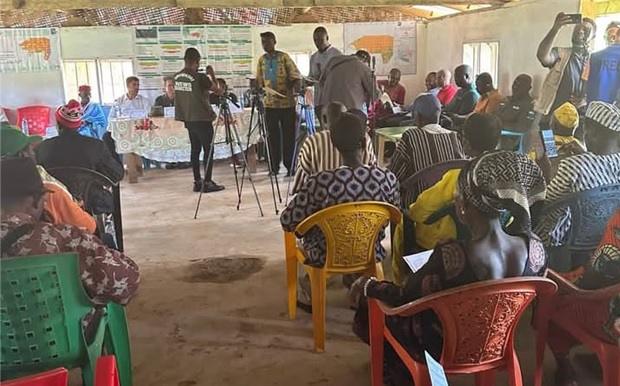
The signing ceremony was held on April 13, 2026, in Sarbo Woffiken Town and brought together representatives from Sarbo Chiefdom, the Ministry of Agriculture, civil society organizations (CSOs), the superintendents of River Gee and Maryland counties, members of the media, and the general public.
The agreement marks a significant shift from commercial rubber expansion to long-term forest conservation, in line with international zero-deforestation commitments and Liberia’s environmental sustainability goals.
Under the agreement, approximately 2,123.94 hectares of forest land, including high-carbon stock and degraded forest areas, will be formally protected.
The Sarbo Nature Reserve is expected to conserve biodiversity and critical ecosystems, restore degraded forest landscapes, promote sustainable forest management, prevent illegal logging, farming, hunting, and encroachment, and support climate change mitigation efforts.
According to the agreement, the project will be supervised by the newly established Sarbo Nature Reserve Committee (SNRC), which will ensure transparency, accountability, and joint decision-making.
The SNRC will comprise five representatives from the Sarbo communities, five representatives from CRC/SIPH, one representative from the Forestry Development Authority (FDA), and the River Gee County Agriculture Coordinator.
The committee will hold three meetings annually to monitor compliance with conservation regulations and oversee implementation activities. It is also expected to transition into an independent legal entity within three years.
As part of the agreement, a specialized security unit known as the Community-Based Forest Guards (CBFG) will be established to protect the reserve.
The guards will patrol forest areas to prevent illegal hunting, farming, and encroachment; maintain buffer zones between agricultural and protected lands; monitor and control access points; restrict unauthorized entry; and support biodiversity conservation initiatives.
The MoU also introduces strict environmental safeguards, including a ban on farming, hunting, and land clearing within the reserve, as well as the prohibition of bush burning and agrochemical use. Additional measures include the installation of warning signs and monitoring systems, along with community awareness and environmental education programs.
To reduce dependence on forest resources, the agreement includes several livelihood and social support initiatives for affected communities.
The MoU provides an annual compensation of US$5 per hectare to support the production of rice, cassava, bananas, pineapples, and vegetables. It also includes market access support for agricultural products, as well as assistance for livestock, poultry, fish farming, beekeeping, cattle, and piggery projects.
Additionally, the agreement allocates an annual budget of US$30,000 for community development initiatives. Of this amount, US$5,000 will support volunteer teachers in Maaken, Woffiken, Geeken, Saykliken, and Sweaken.
The remaining US$25,000 will fund livelihood and development projects, with allocations distributed as follows: the host community will receive US$12,000, Sweaken US$3,500, Geeken US$3,500, Maaken US$3,000, and Saykliken US$3,000.
The MoU also provides for the construction and equipping of a health post in Sarbo Woffiken, which will later be turned over to the community and the Ministry of Health for management.
Speaking during the signing ceremony, FDA Region Five Coordinator Evans Momodu Kiatamba called on both parties to uphold their responsibilities to ensure a successful partnership.
“The FDA owns the forest, while the community serves as custodians. Having this agreement with a renowned plantation company, we expect both the community and CRC to fulfill their responsibilities. Our offices remain open,” Kiatamba said.
CRC/SIPH/SIFCA Executive Director John Lootvoet also pledged the company’s commitment to fully implementing the terms of the agreement.
For his part, River Gee County Superintendent Mike Tarpeh Swengbe praised the people of Sarbo Chiefdom for choosing conservation over destructive exploitation of forest resources.
He urged other communities across River Gee County to emulate Sarbo Chiefdom’s example by embracing sustainable environmental practices.
The agreement was officially signed by representatives of the five Sarbo communities, including youth leaders, women representatives, chiefs, and elders, alongside CRC Managing Director, Mr. “Marc Genot signed behalf of the CRC.
The partnership traces its roots to earlier arrangements made in 2012 following a national concession granted to CRC in 2011.
At the time, Sarbo Chiefdom allocated land for rubber cultivation, with plans to develop nearly 4,000 hectares. However, only 2,481 hectares were later confirmed suitable for cultivation.
A 2016 environmental assessment subsequently identified significant portions of high-carbon-stock (HCS) forest within the concession area, prompting both parties to reconsider the future use of the land.
With growing international restrictions on deforestation and increasing global demand for sustainable land management, the parties eventually agreed to convert the unplanted concession land into a protected forest reserve.