
By Socrates Smythe Saywon
MONROVIA, LIBERIA — Liberia’s ambition to attract more foreign investment and transform its natural resources into sustainable economic growth is facing serious institutional challenges, with the United States Department of State warning that corruption, judicial inefficiency, land ownership disputes, weak infrastructure, and an unpredictable regulatory environment continue to undermine investor confidence.
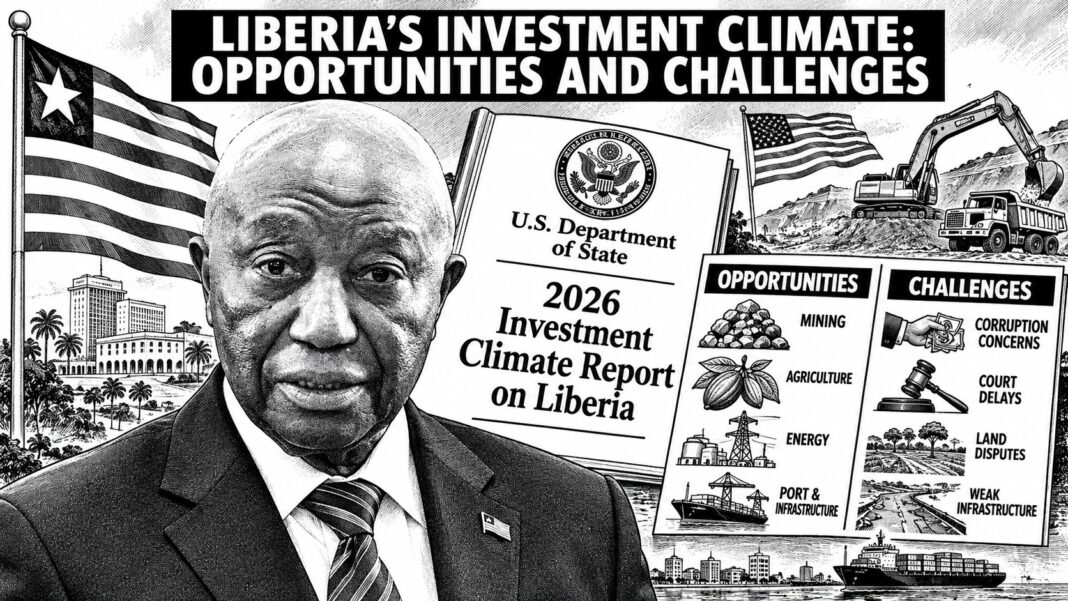
The findings are contained in the 2026 Investment Climate Report on Liberia, which recognizes the country’s considerable economic potential but raises difficult questions about whether its existing institutions can provide the transparency, security, and operational efficiency required to attract and retain international investors.
The report offers a mixed assessment of Liberia’s investment environment, acknowledging improvements in economic performance while warning that persistent governance and structural weaknesses could prevent the country from fully benefiting from growing international interest in its mining, agricultural, energy, forestry, and infrastructure sectors.
According to the report, Liberia’s economy expanded by 5.1 percent in 2025, supported by activities in agriculture, services, and extractive industries. Export volumes increased by 31.5 percent, while inflation declined to 8.5 percent by December 2025. These indicators suggest an economy experiencing renewed activity and opportunities for expansion.
However, the report cautions that positive macroeconomic indicators alone are insufficient to convince international businesses to commit substantial capital. Investors also consider the reliability of public institutions, the predictability of government policies, the protection of property rights, the efficiency of commercial courts, and the cost of doing business.
Its assessment identifies corruption as one of the most serious obstacles to Liberia’s economic advancement. The report states that stakeholders widely regard corruption as a primary brake on democratic consolidation and economic growth because it discourages investment, limits employment opportunities, and sustains conditions that undermine national stability.
More concerning are allegations that multinational companies have been charged fees not contained in their investment agreements and that some government officials demand unauthorized payments from businesses operating in the country.
Such practices, if established and left unaddressed, threaten more than the reputation of individual institutions. They increase operating expenses, create uncertainty for investors, discourage new business ventures, and weaken the government’s ability to present Liberia as a dependable destination for international capital.
For American companies considering investments in Liberia, the report indicates that corruption remains a major consideration in determining whether to enter the market, expand existing operations, or redirect capital toward countries with more predictable business environments.
This presents a direct challenge for the administration of President Joseph Nyuma Boakai, which has made governance reform, accountability, and economic transformation central elements of its development agenda.
The report acknowledges emerging reform efforts, including asset declaration requirements, investigations into allegedly irregularly awarded contracts, and initiatives to establish a specialized criminal court for corruption cases. These measures could strengthen public accountability if they are implemented consistently, independently, and without political discrimination.
Nevertheless, the difference between announcing reforms and delivering results remains important. Investors require evidence that public officials who violate procurement rules, solicit unauthorized payments, or abuse their positions will face credible consequences.
Judicial Delays Undermine Commercial Confidence
The condition of Liberia’s judicial system represents another major concern identified in the assessment. A functional justice system is essential to investment because companies need confidence that commercial agreements will be respected, disputes will be resolved fairly, and court decisions will be enforced.
The report says Liberia’s Commercial Court, which handles disputes involving amounts exceeding US$15,000, faces a severely backlogged docket, with some cases taking between two and five years to reach resolution.
For businesses operating in competitive international markets, such delays can become financially damaging. Companies may have millions of dollars tied up in disputed transactions, unpaid obligations, contractual disagreements, or unresolved property matters while waiting for judicial decisions.
The report also raises concerns about judicial independence and the enforcement of judgments, particularly when government entities are involved. It further references widespread reports of court officials soliciting bribes to influence the handling of cases.
These allegations require serious institutional attention because confidence in the courts is inseparable from confidence in the investment environment.
An investor who cannot reasonably expect an impartial hearing or timely enforcement of a judgment may reconsider committing substantial resources to a country, regardless of its mineral deposits, agricultural potential, or commercial opportunities.
The reported concerns about executive interference in judicial and legislative matters also raise questions about the separation of powers and the institutional safeguards necessary to protect commercial decisions from political influence.
Land Ownership Disputes Create Long-Term Investment Risks
Land ownership remains another fundamental obstacle to investment, particularly in mining, agriculture, forestry, manufacturing, and infrastructure development.
The report notes that Liberia’s constitutional restrictions limit land ownership to citizens who can establish the required constitutional qualification, meaning foreign investors generally depend on long-term lease arrangements rather than direct ownership.
More troubling is the report’s finding that less than 25 percent of Liberia’s total land is formally registered. Conflicting ownership records and competing claims create uncertainty for businesses seeking land for long-term operations.
The report also warns that land may be allocated to companies without the knowledge or consent of affected local communities.
This situation presents serious risks for investors and communities alike. A company may negotiate an agreement with the government, secure the necessary documentation, and commit substantial capital before discovering that another individual, family, or community claims ownership of the same property.
Such disputes can result in expensive litigation, operational interruptions, community resistance, delayed projects, and damage to corporate reputations.
For Liberia, the consequences extend beyond individual investment agreements. Unresolved land disputes can discourage agricultural expansion, complicate infrastructure development, and undermine the country’s ability to attract responsible investors interested in long-term operations.
A credible national land registration system, transparent concession procedures, accessible land records, and meaningful community consultations are therefore essential to reducing uncertainty.
Expensive Financing And Weak Infrastructure Add To Business Costs
Liberia’s financial sector also presents considerable challenges for businesses seeking affordable capital.
The report describes the country’s capital markets as highly underdeveloped, with no domestic stock exchange. It places the banking sector’s non-performing loan ratio at 16 percent and indicates that commercial lending interest rates generally range between 18 and 25 percent.
Collateral requirements reportedly reach 150 to 200 percent of the loan value, creating additional difficulties for local entrepreneurs and businesses seeking to expand their operations.
These conditions can discourage domestic investment and limit the ability of Liberian businesses to participate meaningfully in large commercial projects.
Small and medium-sized enterprises, which have the potential to create employment and strengthen local production, are particularly vulnerable when access to affordable financing remains limited.
The report also identifies limited U.S. dollar liquidity and the withdrawal or reduction of correspondent banking relationships by international financial institutions as additional constraints.
Infrastructure deficiencies further increase the cost of doing business. Unreliable electricity, inadequate roads, limited logistics capacity, and weaknesses in telecommunications can make production and distribution more expensive, particularly for businesses operating outside major commercial centers.
For investors, the decision to establish operations in Liberia involves more than calculating the cost of acquiring land or employing workers. They must also consider the expenses associated with transporting goods, generating electricity, maintaining equipment, securing financing, and moving products to international markets.
Skills Shortage And Labor Protection Require Attention
The report identifies weaknesses in workforce development as another obstacle to investment.
Although Liberia offers relatively low labor costs, the assessment points to a functional literacy rate of just under 50 percent and an acute shortage of specialized skills in medicine, information and communications technology, science, technology, engineering, and mathematics.
This means investors may find it difficult to recruit adequately trained personnel for specialized operations without first investing in extensive training or bringing in foreign expertise.
The report also raises concerns about child labor, particularly in extractive industries, and describes the Ministry of Labor’s inspection capacity as inadequate.
These issues have economic and social implications. A country seeking responsible foreign investment must ensure that its workforce is adequately educated, properly trained, and protected under enforceable labor standards.
Weak labor inspection systems can expose workers to exploitation while also creating legal, reputational, and operational risks for responsible companies.
A Test Of Liberia’s Economic Governance
The overall message of the U.S. Department of State assessment is that Liberia’s investment challenges cannot be solved through promotional campaigns alone.
The country must demonstrate that its institutions can protect investors, enforce contracts, manage public resources transparently, resolve disputes efficiently, and provide predictable rules for doing business.
The Boakai administration has an opportunity to use the report as an institutional reform guide rather than dismissing its findings or treating them solely as criticism of the country.
Progress will require stronger procurement oversight, transparent concession agreements, effective anti-corruption enforcement, improved commercial justice, land registration reforms, better infrastructure, and sustained investment in technical and vocational education.
The government must also recognize that investor protection and public interest are not competing objectives. Transparent agreements, environmental safeguards, fair compensation, and meaningful community participation can help prevent disputes while ensuring that investment produces lasting national benefits.
Liberia needs foreign investment, but it also needs investment that creates decent jobs, develops local businesses, expands government revenue, transfers technology, and improves living conditions.
The central challenge, therefore, is not simply attracting more investors. It is building an environment in which responsible investors can operate confidently while Liberians receive a fair share of the economic benefits.
The 2026 U.S. Investment Climate Report places these institutional questions firmly before the country. Whether its warnings translate into meaningful reforms will help determine how effectively Liberia converts its economic potential into sustainable national development.