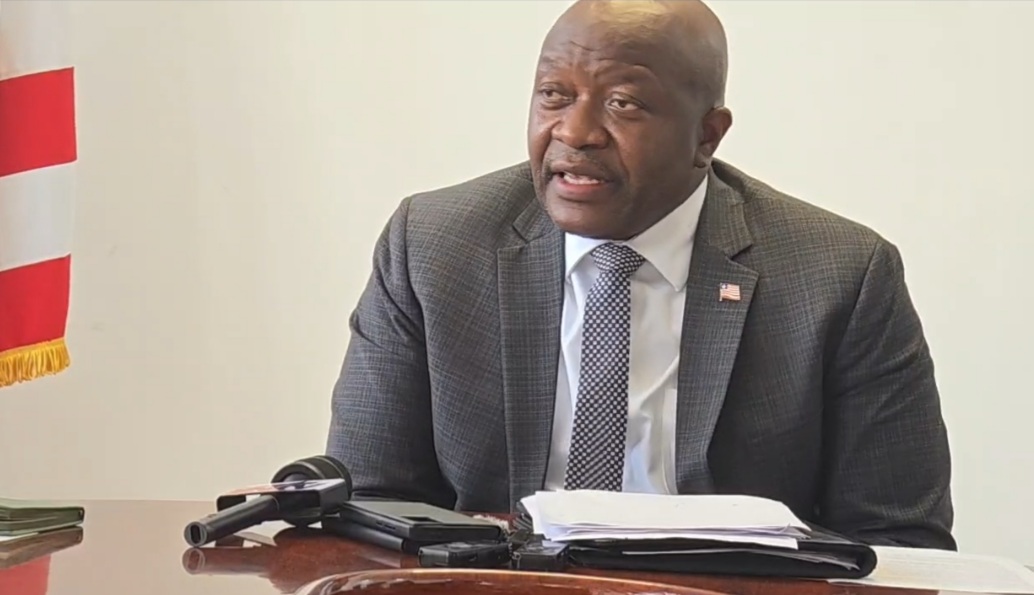
MONROVIA – Former Finance and Development Planning Minister Samuel D. Tweah has pushed back forcefully against Finance Minister Augustine Kpehe Ngafuan following public remarks by the minister claiming that salary harmonization has already been reversed across key government institutions, including integrity bodies and the judiciary.
Tweah’s response was triggered by Ngafuan’s comments earlier Tuesday during the government’s Class Reloaded program, where the Finance Minister outlined what he described as policy reversals and salary adjustments under the current budget. “We have reversed harmonization at LACC. This year, in this budget, we have reversed harmonization at the GAC. For the Supreme Court bench and judges, we have also reversed harmonization,” Ngafuan said.
The Finance Minister further stated that workers of the Drug Enforcement Agency (DEA) would receive pay increases this year, adding that the government was proceeding cautiously. “In this budget, we are moving gingerly,” Ngafuan noted, while also claiming broader economic expansion, including a shift “from a 12-hour economy to an over 18-hour economy.”
Ngafuan also highlighted government priorities beyond wages, stating that “energy is one of the sectors that is going to take all the Millennium Challenge Corporation (MCC) money,” framing the administration’s approach as one that balances compensation reforms with infrastructure investment.
In a detailed written counterargument issued later the same day, Tweah rejected Ngafuan’s assertions, arguing that the Finance Minister had fundamentally misrepresented what harmonization is and how it operates. According to Tweah, institutions such as the Liberia Anti-Corruption Commission (LACC) and the General Auditing Commission (GAC) were never harmonized in the manner being described.
“These institutions already had one pay system,” Tweah wrote, explaining that harmonization merely applied a standard pay grade to enforce a rule-based, equity-driven system. He stressed that LACC and GAC were not subjected to the centralized controls imposed on more than 100 government entities and therefore could not have had harmonization “reversed” as claimed.
Tweah further challenged Ngafuan’s framing of salary adjustments, stating that reversing harmonization is not the same as increasing salaries. He pointed out that harmonization itself led to pay increases for about 15,000 workers in its first year, with roughly 45,000 government employees benefiting over the following three years.
He cited University of Liberia instructors as a key example, noting that their salaries increased by more than 60 percent under harmonization, reinforcing his argument that the reform was designed to improve compensation while maintaining pay equity across government.
To clarify the technical implications of harmonization, Tweah presented a comparative analysis of a hypothetical government worker, “John Peter,” illustrating salary and tax outcomes before and after the reform. Before harmonization, John earned a basic salary and a separate general allowance, both taxed independently, resulting in a lower overall personal income tax burden.
After harmonization, Tweah explained, the two income streams were combined into a single salary, taxed once under the Personal Income Tax table. Although John’s gross annual income remained unchanged, his annual tax obligation increased due to what Tweah described as the “harmonization combined tax effect.”
“This deduction is not a pay cut,” Tweah asserted, emphasizing that the increased tax liability resulted from eliminating the dual pay system, a core objective of harmonization. He argued that thousands of government workers previously benefited from lower taxes because their income was split, a practice harmonization was meant to end.
According to Tweah, reversing harmonization would require reinstating the abolished Basic Salary and General Allowance system, including its tax implications. Without returning to that framework, he maintained, claims of reversing harmonization are misleading and unsustainable under the current pay structure.
Tweah also noted that harmonization ended exemptions that allowed portions of judicial salaries to go untaxed, adding that the government cannot selectively undo these reforms while maintaining a unified salary and tax system.
Concluding his response, Tweah accused the current administration of politicizing harmonization while knowing it cannot be reversed in practice. He cited the National Remuneration and Standardization Act, which mandates regular salary increases while preserving pay equity, arguing that any pay raises implemented under Minister Ngafuan would reinforce harmonization rather than dismantle it.