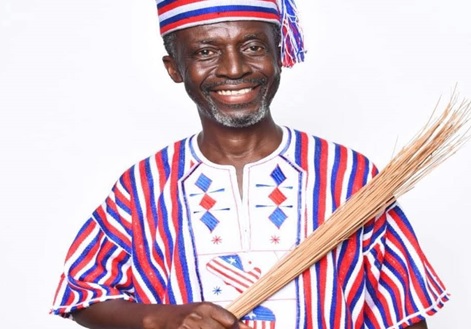
In Liberian politics, symbolism often speaks louder than official statements, and Cllr. Tiawan Saye Gongloe’s decision to gift President Joseph Nyuma Boakai a broom for Christmas is one of the most telling political gestures in recent memory. Far from a joke or casual symbolism, the broom represents a pointed reminder to the President about the unfinished business of corruption cleanup, an issue that defined his campaign and continues to shape public judgment of his administration.
Cllr. Gongloe, political leader of the Liberian People Party (LPP), made it clear that the gift was intentional. The broom, he explained, was meant to symbolically encourage President Boakai to do better in confronting corruption. Notably, this gesture was not unsolicited. Gongloe revealed that the President had first sent him a Christmas card accompanied by a gift basket of supermarket items, making the broom a deliberate and thoughtful response rather than an act of political provocation.
In Liberia’s political culture, gestures often carry deeper meaning than words. This exchange lands at a critical moment for President Boakai, who assumed office on the strength of a public desire to end impunity, restore integrity, and break with years of unchecked graft. The broom now stands as a public mirror, reflecting growing impatience and forcing a national conversation about whether the promised cleanup has truly begun.
More than a year into the Boakai administration, many Liberians remain unconvinced that the anti-corruption fight has produced concrete results. While audits have been announced and investigations referenced, accountability at the highest levels remains elusive. There have been few high-profile prosecutions and limited public recovery of stolen assets, creating a widening gap between campaign rhetoric and governance reality.
The symbolism of Gongloe’s gift carries added weight because of who delivered it. As a seasoned lawyer, former presidential candidate, and long-standing advocate for rule of law, Gongloe commands credibility across political lines. His use of symbolism rather than direct accusation suggests frustration with a system that appears slow, cautious, and overly protective of those within the ruling circle.
President Boakai’s personal image as a modest and disciplined leader remains largely intact. Many Liberians still believe in his personal integrity. However, governance is measured not by character alone but by courage, especially the courage to confront allies, dismiss compromised officials, and allow institutions to operate without political interference.
The ruling establishment must recognize that the anti-corruption fight cannot be selective. Targeting former officials or political opponents while shielding current insiders undermines the very foundation of reform. The broom, in this sense, is not meant to sweep only the opposition’s doorstep; it is meant to reach deep into ministries, state-owned enterprises, and the Executive Mansion itself.
Gongloe’s disclosure on the February 3, 2026 edition of OK Conversation with Julius Jeh resonated because it captured a broader national mood. Liberians are weary of promises unaccompanied by decisive action. They want to see consequences, transparency, and a clear signal that no one is untouchable.
For President Boakai, this moment should be treated as a warning and an opportunity. If he responds with bold, impartial action, the broom may come to symbolize the turning point in Liberia’s anti-corruption struggle. If ignored, it risks becoming a lasting emblem of hesitation and missed opportunity.
Gongloe’s broom is not an insult to the President. It is a challenge. It represents the expectations of a people who voted for change and now demand proof. Whether President Boakai chooses to wield that broom with resolve or leave it as a forgotten symbol will define not only his presidency, but Liberia’s ongoing battle for accountable governance.