
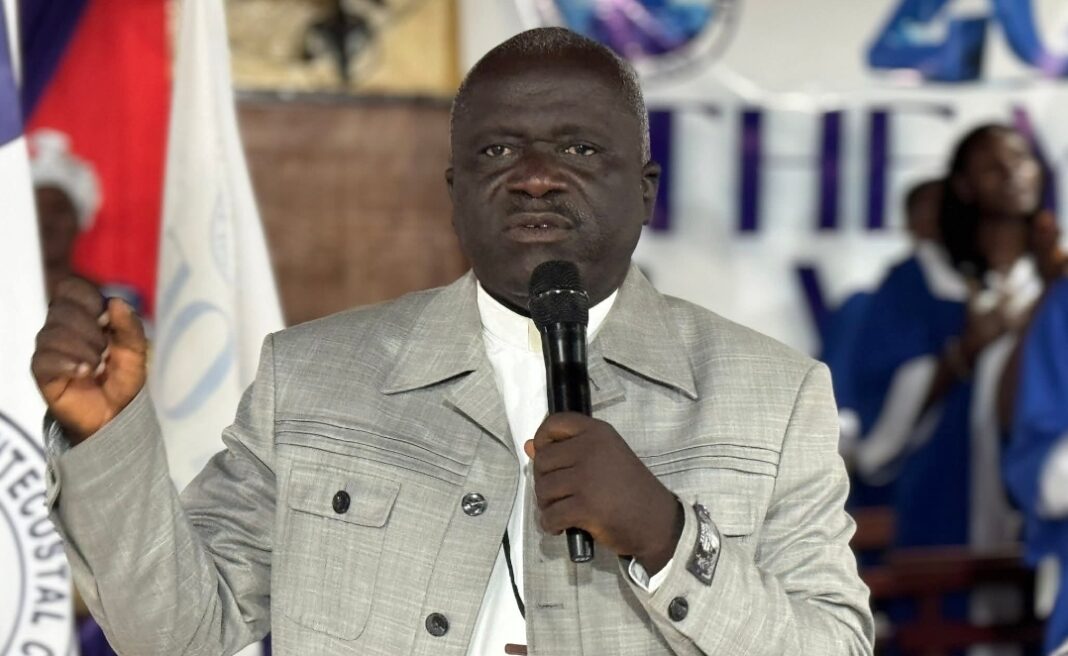
MONROVIA – Bishop Kortu Brown has expressed shock over the level of response from government officials to a reported prophecy made by a Nigerian cleric concerning the Liberian Government, arguing that the reaction was surprising given Liberia’s Christian foundation.
“Given Liberia’s claims to being established on Christian principles, I am shocked about the level of response from government’s functionaries about a reported Nigerian primate’s prophecy concerning the Liberian Government,” Bishop Brown said.
He added, “I didn’t expect that the functionaries of government will give such credence to a prophecy they don’t believe in, given that they considered him a ‘fake’ prophet.”
Brown emphasized that no Liberian desires harm to come to the country and rejected any suggestion of a change of government outside the democratic process.
“No Liberian, not even me, want to see any bad thing happened to Liberia,” he stated. “Any inference to any change of government outside the democratic process is not only unwelcome but outrightly rejected because Liberia has paid the price with her blood, tears and sweat, for the sustenance of democracy, rule of law, free speech, human rights, etc. So there’s no turning. This country, Liberia must march forward.”
At the same time, Brown stressed the importance of openness to differing viewpoints.
“Nonetheless, the country must be open to all shades of opinions whether good or bad,” he said. “For a country like ours with the reported sophistication we have in government to be distracted from the affairs of the State by a foreign pastor’s spiritual assessment of the country, and to diplomatically engage a foreign country on such intervention, surprises me.”
Addressing the biblical understanding of prophecy, Brown noted that prophecy is considered in two forms: forth-telling and foretelling.
“Prophecy is biblically considered in twofold: forth-telling and foretelling, with the former dealing with declarations or proclamations in the present while the latter deals with prediction of future events,” he explained. “Unlike predicting the future, forthtelling focuses on speaking God’s will into a present situation to bring comfort, correction, or encouragement.”
He further argued that Scripture provides a clear standard for judging the accuracy of prophecy.
“Secondly, biblical instructions on prophecy accuracy are clear. A true prophecy is determined by its fulfillment,” Brown said before quoting Deuteronomy 18:21-22: “You may say to yourselves, ‘How can we know when a message has not been spoken by the Lord?’ If what a prophet proclaims in the name of the Lord does not take place or come true, that is a message the Lord has not spoken. That prophet has spoken presumptuously, so do not be alarmed.”
Questioning the intensity of the government’s response, Brown asked: “If we believe in God’s word and also believe that the prophecy is not true, why then worry? Why all the curses and condemnations? Why go to the extent of complaining about a private citizen to their government for remarks made in the public?”
He concluded by urging national focus on Liberia’s pressing challenges and advocating tolerance toward differing opinions.
“I believe that Liberia has very serious challenges before us and we must focus therefore on finding solutions to our myriad of challenges,” Brown stated. “We must also be tolerant of the assertions of other people however distasteful. We must also approach any prophecy whether forth-telling or foretelling through the biblical lens.”