By Socrates Smythe Saywon | Smart News Liberia
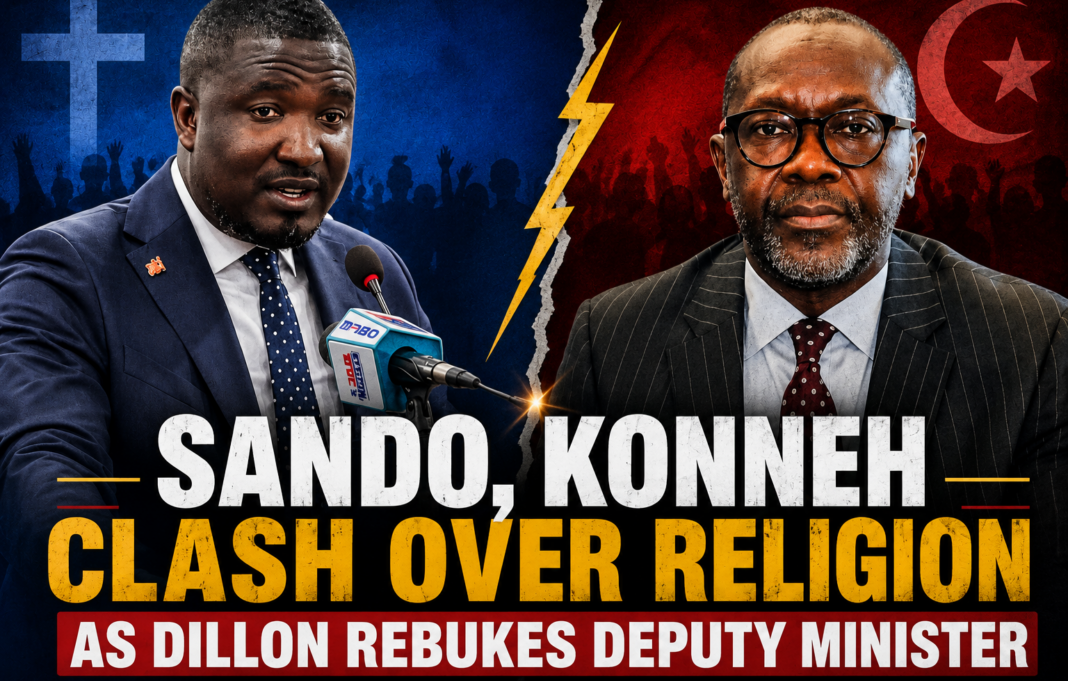
MONROVIA – A political dispute over Liberia’s response to the narcotics crisis has escalated into a public exchange involving Deputy Information Minister Daniel Sando, Gbarpolu County Senator Amara Konneh and Montserrado County Senator Abraham Darius Dillon, after Sando invoked Konneh’s religious faith while criticizing his role as a government critic.
The confrontation began Tuesday on the government-run program “The Class Reloaded,” where Sando questioned Konneh’s credibility as a critical voice in Liberia and accused him of bearing responsibility for reversing gains made by the country in the past.
Sando also accused Konneh of having “connived” to rig the election that brought former President George Weah to power.
More controversially, Sando referenced Konneh’s Muslim faith and urged him to return to the mosque to seek forgiveness for what he described as his past political sins.
The remarks immediately drew a sharp response from Konneh, who rejected Sando’s criticism and defended his right to speak publicly about Liberia’s drug crisis.
“I don’t need an unskilled sycophant riding on the back of an aging President to tell me to go to the mosques and pray,” Konneh responded.
Konneh later expanded his response, saying his criticism of the government’s handling of the narcotics crisis was motivated by patriotism and his commitment to the promise of a drug-free Liberia.
He described himself as a practicing Muslim who prays five times daily, fasts and gives charity to the poor, while also emphasizing his respect for Christianity and the Christian devotions conducted at the Senate.
“I don’t need an unskilled sycophant riding on the back of an aging President to tell me to go to the mosques and pray,” Konneh reiterated.
Konneh Defends Drug Criticism
Konneh said his decision to speak out about the country’s cocaine crisis was not an attempt to undermine the Boakai administration but an expression of his responsibility as a national leader.
He said he supported efforts that helped bring the Unity Party government to power because of its promise to confront the narcotics problem.
“I speak out against this cocaine scheme because I love my country and worked hard to bring in this UP government with the promise to rid our nation of drugs,” Konneh said.
He acknowledged that the government has struggled to fulfill that promise but insisted that he has a responsibility to raise concerns rather than remain silent.
“So far, we are struggling to fulfill that promise,” Konneh said. “I have earned the right to speak up, especially as a national leader and a voice for those affected by illicit drugs whose voices may not be heard. Silence would be complicity.”
Konneh urged Sando to focus on his own responsibilities as a government official, arguing that both men could contribute to efforts to make Liberia safer.
“You do your job, too, so we can make Liberia a drug-free country and a better country than it was two and a half years ago,” he said.
Dillon Rebukes Sando
The dispute drew intervention from Senator Abraham Darius Dillon, who publicly criticized Sando’s decision to invoke Konneh’s religion during a political disagreement.
Dillon said he was not necessarily the best person to offer moral advice but drew on his more than two decades of experience in public service to caution the Deputy Information Minister.
He said Sando’s remarks concerning Konneh’s religious beliefs were inappropriate and unnecessary.
“Your recent comments directed at Sen. Amara Konneh essentially referencing his religion and religious belief was inappropriate and out of order, from my viewpoint,” Dillon said.
According to Dillon, political disagreements can be addressed without crossing into matters of personal faith.
“There are many other ways to respond to issues than the manner and path you have chosen,” he said, urging Sando to reach out to Konneh and make amends.
Dillon also warned the younger official against allowing political praise and public applause to influence his conduct.
He recalled advice from his mother during his childhood, telling him to take his time because he had a long road ahead.
Dillon said the same advice applied to Sando, cautioning him not to be carried away by political supporters whose loyalty could change.
“Do not follow some of these political clapping and cheers,” Dillon said. “They may be temporary and can shift.”
Political Disagreement Takes Personal Turn
The exchange has exposed a widening divide over how members of the governing establishment should respond to criticism, particularly as the Boakai administration faces intense pressure over Liberia’s drug crisis.
Konneh has increasingly positioned himself as a critical voice within the political camp that helped bring the Unity Party government to power, while Sando, as a senior administration official, has defended the government and challenged critics questioning its record.
The dispute, however, has moved beyond policy differences into questions of religion, political loyalty and personal conduct.
Sando’s reference to Konneh’s Muslim faith has drawn particular attention because religious identity is constitutionally protected in Liberia and because the disagreement began over political accountability rather than religious practice.
Dillon’s intervention effectively shifted the argument from the government’s record on narcotics to the standards expected of public officials when responding to political criticism.
Drug Crisis Remains at Center
Despite the personal exchanges, the underlying issue remains Liberia’s worsening concern over narcotics trafficking and the government’s response.
President Joseph Nyuma Boakai has repeatedly described drug trafficking as a serious threat to national security, public health and Liberia’s future.
The administration has recently taken a series of actions involving the Liberia Drug Enforcement Agency and security officials as it seeks to strengthen the government’s response to narcotics trafficking.
Konneh has welcomed some of those actions while demanding deeper investigations, transparency and accountability.
The latest political clash therefore raises a question about whether Liberia’s drug debate will remain focused on evidence, institutional reform and accountability or increasingly become entangled in partisan and personal attacks.
For Dillon, the immediate lesson is that political disagreement should not come at the expense of respect for personal faith.
For Konneh, the drug crisis remains too important to remain silent.
And for Sando and the administration he represents, the controversy highlights the challenge of defending government policy without allowing political criticism to become a personal confrontation.