By Socrates Smythe Saywon | Smart News Liberia
MONROVIA – While the Liberia Drug Enforcement Agency (LDEA) is celebrating what it describes as one of the largest cocaine seizures in Liberia’s recent history, mounting public concern is shifting attention from the drugs themselves to what many citizens see as an unusual level of secrecy surrounding the investigation.
Days after the LDEA intercepted 198 compressed plates of cocaine valued at approximately US$19.2 million at Roberts International Airport (RIA), the identities of six individuals arrested in connection with the case remain undisclosed, raising questions about transparency, equal treatment under the law, and whether influential figures may be linked to the trafficking network.
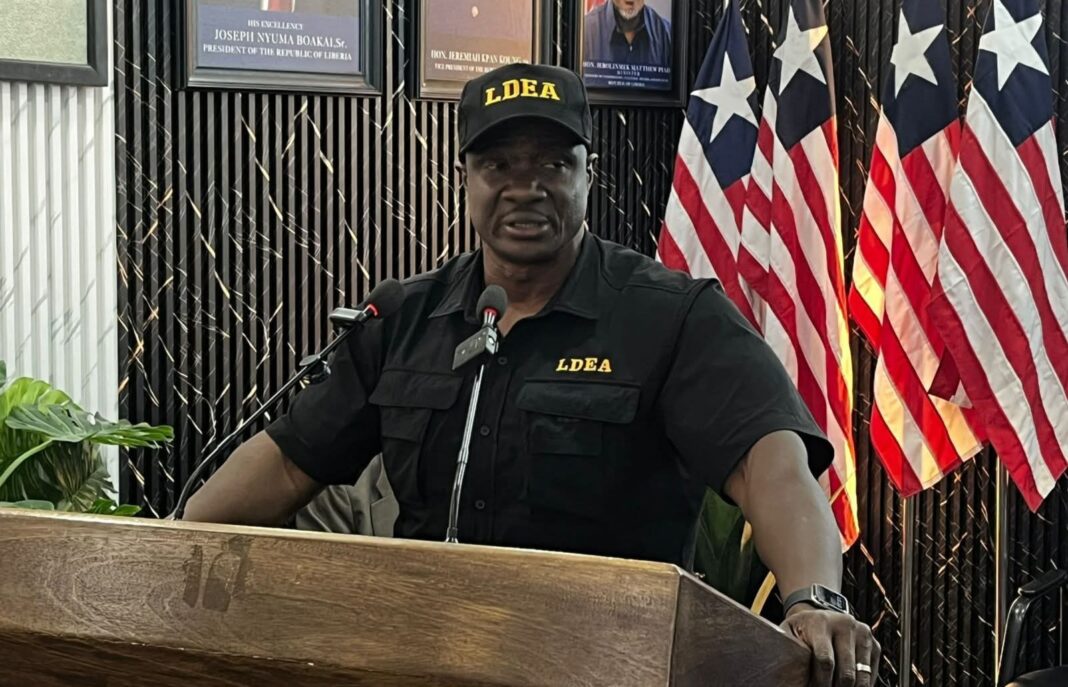
Addressing journalists during the Ministry of Information’s regular press briefing on Thursday, June 11, LDEA Officer-In-Charge and Deputy Commissioner of Police Fitzgerald T.M. Biago confirmed that six suspects are currently in the Agency’s custody. However, he insisted that investigators are intentionally withholding their identities to avoid jeopardizing the ongoing probe.
“This is an ongoing active investigation. Disclosure of any information will compromise the investigation,” Biago said. “We are asking the public to remain calm. We are putting pieces of information and evidence together and will soon revert to you all accordingly.”
The explanation, however, has done little to silence public debate.
Across social media platforms, particularly Facebook, many Liberians have questioned why suspects in this case are being shielded from public exposure when individuals accused of far less significant drug offenses were swiftly identified and publicly displayed by law enforcement authorities in the past.
Several commentators pointed to previous high-profile arrests, including that of Liberian rapper Bucky Raw and other suspects who were publicly handcuffed, photographed, and paraded shortly after their arrests. Social media critics of the LDEA argue that the apparent difference in treatment raises concerns about consistency and fairness in the administration of justice.
The controversy comes against the backdrop of what the LDEA has described as a major breakthrough in the country’s anti-narcotics campaign.
Announcing the seizure on Monday, June 8, the Agency revealed that the cocaine had been concealed in six cargo boxes and was allegedly being prepared for export aboard a Brussels Airlines flight. Authorities said the operation was launched following credible intelligence, leading investigators to intercept the shipment before it could leave the country.
Biago characterized the operation as a significant success for Liberia’s security sector.
“This seizure represents one of the most significant narcotics interceptions in recent times and demonstrates the effectiveness of the ongoing reforms, intelligence-driven operations, and strengthened interagency cooperation within Liberia’s security sector,” he declared.
The confiscated drugs have an estimated street value of approximately US$19,226,000, equivalent to more than L$3.65 billion, making it one of the most valuable narcotics seizures ever recorded in Liberia.
Yet, despite the scale of the operation, public attention has increasingly focused on what remains unknown rather than what has already been disclosed.
Many observers note that while authorities have publicly confirmed the existence of suspects and persons of interest, no names, photographs, or detailed information have been released. The silence has fueled speculation that the investigation could involve individuals with significant influence or connections.
Nevertheless, the LDEA maintains that the decision is based strictly on investigative considerations.
According to Biago, investigators have already identified several persons of interest and are working to dismantle what authorities believe is a larger criminal enterprise operating behind the attempted shipment.
“The LDEA remains fully committed to ensuring that every individual connected to this criminal network is identified, investigated, and prosecuted in accordance with the law,” he stated.
The Agency has also emphasized that the airport seizure is part of a broader anti-drug strategy that has intensified in recent years. During the first quarter of 2026 alone, the LDEA reported the arrest of 233 suspects across Liberia and the confiscation of more than 422 kilograms of narcotics, including Kush, marijuana, Tramadol, and cocaine.
Officials have further highlighted institutional reforms aimed at improving professionalism within the Agency, including enhanced training programs, mandatory drug testing for personnel, and investigations into allegations of misconduct and evidence tampering.
The LDEA also points to previous operations, including the seizure of approximately US$1.337 million at the Bo-Waterside border crossing, which authorities believe was linked to transnational drug trafficking activities.
Despite these achievements, growing commentary on social media suggests that the handling of the current airport case could become a defining test of public confidence in Liberia’s anti-drug campaign.
For many citizens, the issue is no longer whether the drugs were seized, but whether everyone connected to the trafficking network, regardless of status, wealth, or influence, will be subjected to the same level of accountability that has been applied to other suspects in the past.
As investigators continue their work, pressure is likely to increase on authorities to demonstrate that transparency and equal justice remain central to Liberia’s fight against narcotics trafficking.
Meanwhile, the LDEA remains adamant that patience is required.
“This operation sends an unequivocal message: Liberia is not a transit point, marketplace, or haven for drug traffickers,” Biago emphasized. “The LDEA will continue to relentlessly pursue criminal networks, secure our borders, and protect our citizens from the devastating effects of illicit drugs.”
Whether the Agency’s commitment to accountability will ultimately satisfy public demands for openness may depend on what investigators reveal in the days and weeks ahead.