UNITED NATIONS — Liberia has issued one of its strongest warnings yet on the Israeli-Palestinian conflict, telling the United Nations Security Council that continued occupation, settlement expansion, displacement and violence are steadily destroying the possibility of a viable two-state solution.
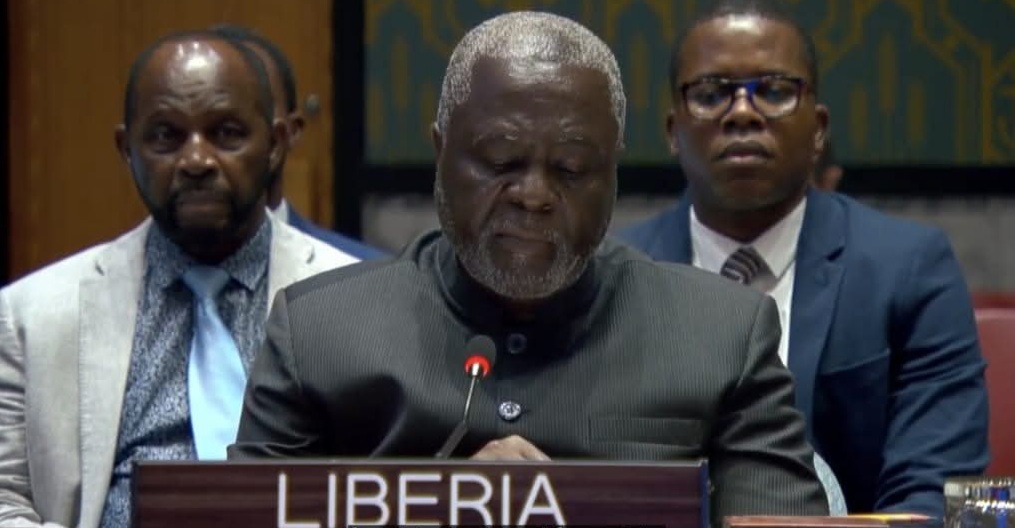
Speaking at the Security Council’s 10,207th meeting on August 11, 2026, Liberia’s Permanent Representative to the United Nations, Ambassador Lewis G. Brown II, challenged the international community to move beyond repeated diplomatic statements and take concrete action to preserve the prospect of two sovereign states living in peace.
Brown invoked Liberia’s own historical role in the conflict, recalling that the country voted for UN Resolution 181 in 1947, which envisioned the creation of separate Arab and Jewish states.
“Liberia has never withdrawn that vote,” Brown told the Council, stressing that the country continues to support the principle of two states despite decades of conflict.
But Brown warned that the international community is now treating the two-state solution as a diplomatic slogan rather than a political objective backed by meaningful action.
“Today, this Council treats the two-state solution like a permanent destination we describe in briefings rather than a political decision we actually enforce,” he said.
His remarks came as Liberia pointed to what it described as a rapidly deteriorating situation in the occupied West Bank, where displacement, settlement expansion and land seizures are threatening to make a contiguous Palestinian state increasingly difficult to achieve.
According to Brown, more than 33,000 Palestinians remain forcibly displaced from Jenin, Tulkarm and Nur Shams, with their homes emptied and their right of return denied.
He also raised alarm over the acceleration of the E1 settlement project and continued land seizures, warning that such developments could effectively divide the West Bank and undermine the territorial foundation required for an independent Palestinian state.
“These are not administrative adjustments. They are the systematic burial of peace,” Brown declared.
Liberia’s position, however, was not framed as one-sided condemnation.
Brown emphasized that Liberia considers the security of Israelis and the rights and dignity of Palestinians to be inseparable elements of any sustainable peace.
“Security is indivisible,” he said, insisting that no durable peace can take root while Israelis remain exposed to attacks.
Liberia unequivocally condemned violence against Israeli civilians while simultaneously condemning what Brown described as the “unbearable suffering” inflicted on Palestinian civilians, particularly women and children.
The Liberian envoy also sharply criticized Hamas, arguing that the armed group’s continued existence as a non-state military force undermines the Palestinian quest for legitimate statehood.
“Hamas, an armed faction that holds a population’s statehood hostage to its own survival, paradoxically undermines the very liberation and much-needed statehood it claims to pursue,” Brown said.
He called for the full implementation of UN Security Council Resolution 2803 and the decommissioning of non-state weapons as necessary steps toward establishing what Liberia described as one legitimate government, one legal system and one accountable security authority.
At the same time, Brown insisted that the same standard must apply to Israel, particularly concerning settlement expansion and violence associated with settlements in the West Bank.
Liberia’s intervention placed human dignity at the center of its argument, with Brown warning that children across the region continue to pay the highest price for political failures and military confrontation.
“Human dignity cannot be conditional,” he told the Council.
Citing UN reports documenting widespread violence and violations against children, Brown said no political objective could justify allowing children to become victims of a conflict they did not create.
“No child should ever become collateral damage to the political failures of adults,” he said.
Perhaps the strongest part of Liberia’s intervention came when Brown proposed four tests by which the international community should measure its credibility on the Israeli-Palestinian question: protection, return, accountability and viability.
He warned that failure on those four fronts would expose the international community’s repeated diplomatic commitments to the two-state solution as little more than rhetoric.
“If we fail these four tests, let us then drop the diplomatic pretense,” Brown said.
“We are not preserving a two-state solution. We are presiding over its slow-motion disappearance.”
Brown’s remarks amounted to a direct challenge to the Security Council, which has repeatedly reaffirmed support for a two-state solution while conditions on the ground continue to change.
He argued that history would judge the international community not by the number of statements issued or debates held, but by whether it acted when the opportunity for peace was still available.
“History will not ask whether this Council issued enough press statements or debated the Middle East and Palestinian question time without number,” Brown said.
“It will ask whether when the window for peace was being sealed shut beneath concrete and violence, we had the courage to act.”
Liberia concluded its intervention by reaffirming the position it adopted nearly eight decades ago: support for the security, dignity and political rights of both Israelis and Palestinians.
Brown said Liberia remains committed to a future in which both peoples can live with security and dignity, and in which children on both sides inherit a future defined by peace rather than perpetual conflict.