Multi-Tonne Seizures in Liberia and Ghana Highlight a Transnational Trade Stretching from Latin America to Europe
MONROVIA, LIBERIA — West Africa’s cocaine crisis is increasingly revealing the region’s role in a sophisticated international drug economy linking Latin America, West Africa and European markets.
Liberia’s seizure of nearly four tonnes of cocaine in Duazon, valued at approximately US$317 million, Ghana’s interception of almost 3.9 tonnes worth an estimated €225 million, and growing European investigations involving fugitive Dutch trafficker Jos Leijdekkers, alias “Bolle Jos,” demonstrate the scale and complexity of the threat.
These cases are not publicly established as parts of one criminal organization. But taken together, they show that West Africa has become an important operating environment for international cocaine trafficking networks.
In this investigation, Liberian investigative journalist Lyndon Ponnie examines the expanding intricacies of the cocaine trade across West Africa and its growing European connection.
Ghana’s €225 Million Shipment
The latest major development came after French customs authorities seized nearly 3.9 tonnes of cocaine at the port of Dunkirk.
The cocaine was concealed in a container carrying plastic waste that had arrived from Ghana. French authorities estimated the shipment’s street value at approximately €225 million, or about US$261 million, with part of the cargo reportedly destined for Antwerp, Belgium.
Ghana’s Narcotics Control Commission, NACOC, subsequently announced the arrest of three suspects allegedly connected to activities involving Jos Leijdekkers in Ghana.
The arrests have added another layer to the investigation because Leijdekkers is one of Europe’s most wanted drug traffickers and has been the subject of extensive international law-enforcement efforts.
Ghanaian authorities have also reportedly moved to examine vulnerabilities at ports, airports and land borders, highlighting the growing recognition that cocaine trafficking is not simply a policing problem but a national-security and institutional challenge.
Liberia’s US$317 Million Seizure
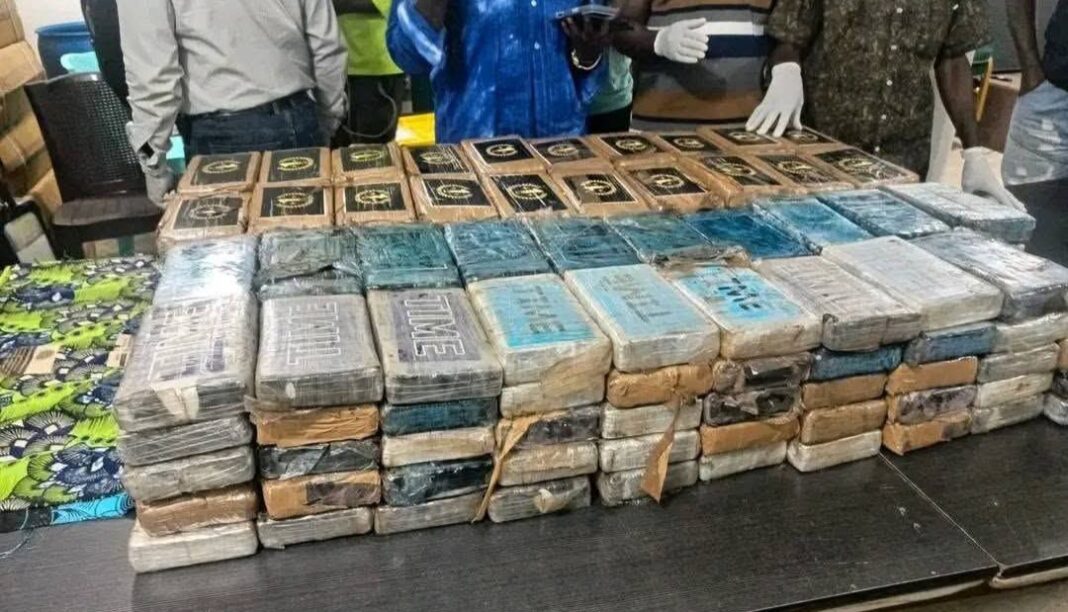
Liberia faces a similar challenge following the seizure of approximately 3,971 kilograms of cocaine in Duazon, outside Monrovia.
The shipment was valued at approximately US$317 million.
The sheer volume demonstrates that the operation required more than individuals physically handling the drugs. A shipment of this magnitude necessarily involves financing, transportation, storage, communications and an established receiving network.
That makes the investigation much bigger than the cocaine itself.
Liberian authorities must ultimately establish where the shipment originated, who financed it, who organized its movement, where it was supposed to go and who was positioned to receive it.
Most importantly, investigators need to determine whether Liberian facilitators were involved and whether any legitimate businesses or logistical infrastructure were exploited.
Two Shipments, One Regional Threat
There is no publicly established evidence that the Liberian and Ghanaian seizures were controlled by the same cartel.
That distinction must remain clear.
Nevertheless, both cases demonstrate how international traffickers can use West African territory to move enormous quantities of cocaine toward lucrative European markets.
The emerging route is broadly understood as:
Latin America → West Africa → Europe.
West Africa’s Atlantic location, extensive coastline, commercial ports and expanding trade connections make the region attractive to international trafficking organizations.
The cocaine is increasingly being concealed within legitimate commercial cargo, making detection more difficult and allowing criminal networks to exploit ordinary shipping and logistics systems.
The seizures reveal what authorities have intercepted.
They cannot, by themselves, reveal what may have passed through undetected.
The “Bolle Jos” Connection
The European dimension becomes more significant with the continuing investigations surrounding Jos Leijdekkers.
Leijdekkers, a Dutch fugitive convicted in absentia in the Netherlands for major cocaine trafficking and other crimes, has been linked through European investigations to trafficking activities involving West Africa.
His alleged connections have drawn particular attention to Sierra Leone.
European investigations have reported allegations that major cocaine shipments were coordinated through networks associated with Leijdekkers, including operations reportedly linked to Sierra Leone.
Those allegations must be distinguished from established facts. The presence or alleged activities of a wanted trafficker in a country do not, by themselves, establish government complicity.
But they demonstrate how international criminal networks can establish relationships, move money and conduct operations across national borders.
That is why the Leijdekkers case matters beyond the Netherlands or Sierra Leone.
It illustrates the increasingly international character of West Africa’s cocaine problem.
The Money Behind the Cocaine
The most important evidence may ultimately be found not in the drugs but in the money.
A cocaine shipment worth hundreds of millions of dollars requires significant financing and a sophisticated financial structure.
Investigators therefore need to follow corporate ownership, banking transactions, international transfers, property purchases, shipping records, warehouse arrangements, vehicle acquisitions and communications connecting suspects across borders.
This is where a major drug investigation becomes a financial investigation.
The objective is not simply to arrest couriers or seize containers.
It is to identify the people financing the trade, the brokers coordinating it, the businesses being exploited and the networks receiving the proceeds.
Liberia’s Warning Signs
Liberia’s Duazon seizure is particularly significant because it followed the earlier seizure of approximately 237.6 kilograms of cocaine at Roberts International Airport, valued at more than US$19 million.
Two major seizures within a relatively short period do not prove that Liberia has become a permanent trafficking hub.
They do, however, demonstrate that international narcotics networks have been capable of moving substantial quantities of cocaine through Liberian territory.
That should trigger a broader examination of the country’s ports, airport, coastline, warehouses, transportation networks, security systems and financial channels.
The objective should be prevention as much as prosecution.
The Regional Problem
The cocaine trade does not respect West Africa’s national borders.
Liberia borders Sierra Leone, Guinea and Côte d’Ivoire. Ghana is part of the same Atlantic-facing trafficking environment, while Senegal and Nigeria have also featured prominently in European and international investigations into cocaine trafficking.
When one route becomes difficult, criminal networks can search for another.
When one port becomes more heavily monitored, another can become attractive.
That makes cooperation between West African countries essential.
Intelligence sharing, coordinated customs operations, financial investigations and cross-border law enforcement must become central to the regional response.
European agencies also have a critical role because Europe remains a major destination market and because many of the networks operating between the two regions extend into European jurisdictions.
No Evidence Yet of One Regional Cartel
It would be irresponsible to declare that Liberia, Ghana, Sierra Leone and Senegal are all controlled by a single cocaine cartel.
There is insufficient public evidence to support such a conclusion.
But there is enough evidence to establish something more important: West Africa is being used by international cocaine trafficking networks connected to European markets.
The task now is to determine whether separate cases share common financiers, brokers, companies, vessels, logistics providers or European distributors.
That is the investigation that could reveal whether these are isolated operations or components of a broader criminal ecosystem.
Liberia’s Moment of Truth
For Liberia, the Duazon case represents more than a record-breaking seizure.
It is a test of whether the country can move from simply confiscating cocaine to dismantling the organization behind it.
The successful seizure is only the beginning.
Investigators must follow the drugs to their origin, follow the money behind the shipment, identify the logistics chain and determine who was waiting for the cocaine at the other end.
Where evidence points to officials, businesspeople or security personnel, those individuals should be investigated according to law.
Where allegations are disproved, that should also be made clear.
The standard must remain evidence—not political affiliation, association or speculation.
The Real Cocaine War
The greatest danger is not simply the quantity of cocaine entering West Africa.
It is the money attached to it.
Hundreds of millions of dollars can purchase property, businesses, influence and protection. In countries with vulnerable institutions, drug money can corrupt officials, compromise security systems, intimidate investigators and undermine public confidence in the state.
That makes the cocaine trade a governance and national-security threat as much as a criminal-justice problem.
Liberia and its neighbors therefore face a choice: treat each seizure as an isolated victory, or use every seizure as a gateway into the larger network.
The latter is the real test.
Liberia has already shown that it can seize cocaine.
Now it must show that it can follow the cocaine to the money, the money to the network, and the network to those who ultimately profit from the trade.
The West African cocaine pipeline is not simply about drugs moving across borders. It is about an international criminal economy exploiting geography, commerce, financial systems and institutional weaknesses.
And the central question that remains for investigators is no longer simply where the cocaine was found—but who was waiting for it, who paid for it, and who stands to profit.
Liberian investigative journalist Lyndon Ponnie reports on the intricacies of the cocaine trade in West Africa.