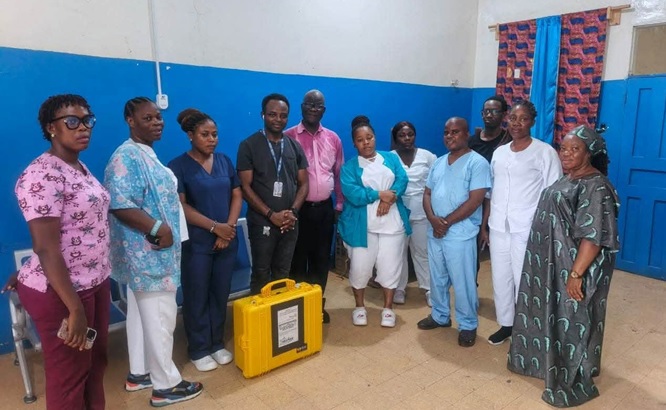
BUCHANAN, GRAND BASSA COUNTY – Church Aid Inc. has donated hearing screening equipment to the Liberia Government Hospital in Buchanan, expanding access to ear and hearing health services in Grand Bassa County while drawing attention to the continuing need for specialized diagnostic equipment across Liberia’s public healthcare system.
Church Aid Chairman and Chief Executive Officer Bishop Kortu K. Brown disclosed the donation in a statement, saying the equipment was provided to help promote hearing healthcare for residents of Grand Bassa, a county serving a population of more than 400,000 people. The donation adds Grand Bassa to a growing list of counties where Church Aid has provided equipment intended to strengthen the country’s capacity to identify hearing problems.
According to Brown, the latest donation brings to six the number of hospitals that have received hearing screening equipment from Church Aid. The facilities are located in six of Liberia’s 15 counties and include both public and private hospitals. He described the initiative as an effort to improve ear and hearing healthcare in a country where access to specialized services remains limited outside major population centers.
The Grand Bassa donation is particularly relevant because Buchanan serves as a major health and commercial center for the county and surrounding communities. For residents who previously had to travel elsewhere for hearing screening, the availability of equipment at the government hospital could reduce some of the barriers associated with distance, transportation costs and delayed diagnosis.
Hearing loss can affect children’s learning, communication and social development, while untreated hearing difficulties among adults can interfere with employment, family communication and participation in community life. Early screening can help identify problems before they become more difficult to manage, making the availability of appropriate equipment an important part of preventive healthcare.
However, the donation also raises a larger question about the capacity of Liberia’s healthcare system to provide specialized services on a sustained basis. Medical equipment alone does not guarantee improved healthcare outcomes. Hospitals also need trained personnel, maintenance arrangements, electricity, appropriate working spaces, replacement parts and systems that ensure patients identified with hearing problems receive the necessary follow-up care.
Brown’s own appeal reflects this concern. While celebrating the donation, he called for prayers that the instruments placed at the six hospitals would be properly utilized and cared for. That appeal places attention not only on the availability of equipment but also on what happens after donated items arrive at health facilities.
The situation presents an opportunity for the Ministry of Health and participating hospitals to establish clear systems for the use and maintenance of the equipment. Screening machines that remain unused, poorly maintained or inaccessible to patients would provide little benefit regardless of the value of the original donation.
The expansion to Grand Bassa therefore goes beyond the handover of another piece of medical equipment. It raises the importance of integrating hearing healthcare into routine public health services, particularly in counties where specialized medical services are less readily available.
The donation also demonstrates the role that religious organizations, charitable institutions and other non-state actors continue to play in supporting Liberia’s healthcare delivery system. Such contributions can help address immediate gaps, but they also point to areas where long-term public investment is needed.
With equipment now available in hospitals across six counties, the next challenge is ensuring that the facilities have the capacity to use them effectively and consistently. The success of the initiative will not be measured simply by the number of machines donated but by the number of people screened, diagnosed and connected to appropriate care.
For Grand Bassa residents, the arrival of hearing screening equipment at the Liberia Government Hospital in Buchanan could represent a practical improvement in access to healthcare. For Liberia’s health system, however, it should also serve as a reminder that specialized healthcare requires more than equipment. It requires trained professionals, reliable maintenance, adequate funding and a system capable of turning donated resources into lasting services.
Church Aid’s latest donation has therefore opened another door for hearing healthcare in Liberia. Whether that door remains open will depend on how responsibly the equipment is managed and whether patients can actually access the services it was intended to provide.