

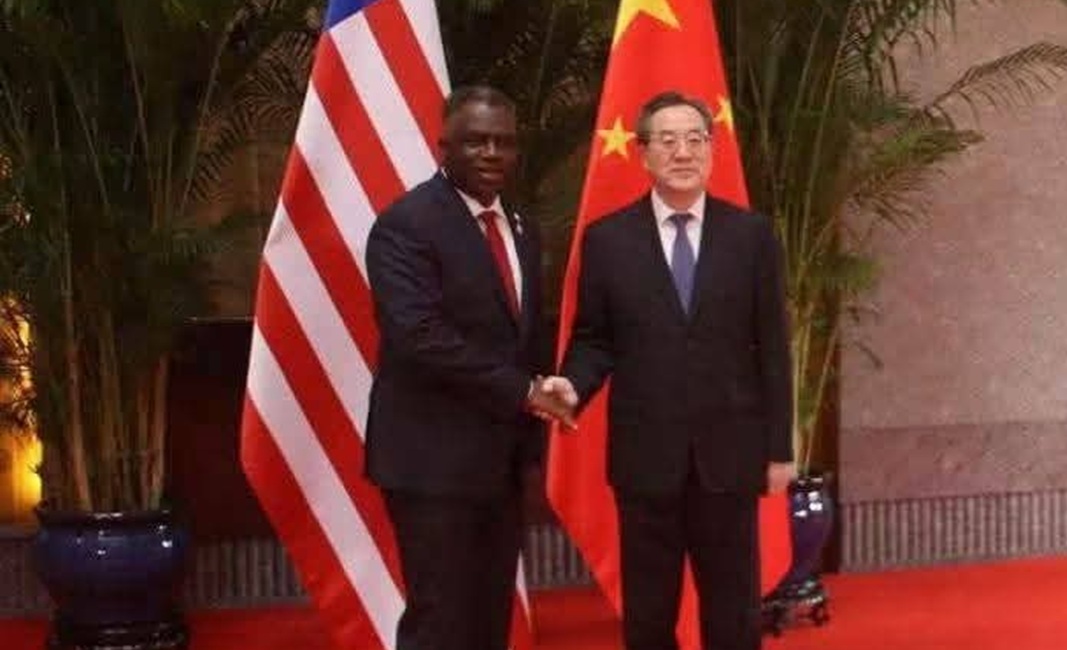
SHANGHAI, CHINA — Liberia’s engagement with China is taking on renewed development importance, following discussions in Shanghai in which Chinese Vice Premier Ding Xuexiang reaffirmed his country’s willingness to support key Liberian development priorities, including infrastructure, electricity, healthcare, agriculture, broadcasting and professional training.
The discussions, held Thursday at the Xijiao State Guest Hotel between Vice President Jeremiah Kpan Koung Sr. and Vice Premier Ding, focused on strengthening bilateral cooperation and advancing development initiatives that could improve public services, expand economic opportunities and support the government’s national development agenda.
For Liberia, where infrastructure deficits, unreliable electricity, limited access to essential services and shortages of technical capacity continue to affect economic productivity, the engagement offers an opportunity to deepen cooperation with China in areas directly connected to the country’s development needs.
Vice President Koung used the meeting to identify priority sectors requiring stronger technical and financial cooperation, emphasizing that development partnerships must produce practical benefits for ordinary Liberians, public institutions and businesses.
Among the issues receiving attention was the need for reliable and affordable electricity, which the Vice President described as a national priority.
Koung welcomed opportunities for expanded Chinese cooperation in solar energy, battery storage, hydropower and rural electrification, stressing that improved electricity access is essential to economic growth and the delivery of public services.
The emphasis reflects a fundamental challenge facing Liberia’s development efforts. Electricity shortages and high energy costs affect manufacturing, agricultural processing, commercial operations, healthcare facilities, educational institutions and households.
Without dependable and affordable power, efforts to attract industrial investment and expand domestic production could face persistent limitations.
The Vice President’s proposals therefore place energy cooperation within a wider economic development framework, recognizing that electricity is not simply a utility service but a necessary foundation for industrialisation, private-sector growth and improved living conditions.
Solar power and battery storage could offer opportunities for communities and institutions requiring dependable electricity, while hydropower development and rural electrification could support longer-term efforts to expand access.
However, translating these opportunities into national benefits will require careful project preparation, financing arrangements, technical assessments and sustainable maintenance systems.
The Liberian delegation also emphasized cooperation in clean water, healthcare, digital connectivity and vocational training, sectors that directly influence the quality of life and productive capacity of the population.
During the discussions, Vice President Koung expressed appreciation for China’s assistance and cooperation on several projects and development-related initiatives in Liberia.
These include the construction of two overpass bridges in Congo Town, the provision of agricultural machinery and government vehicles, support for the Liberia Broadcasting System and diagnostic laboratory assistance near the 14 Military Hospital.
The projects represent different dimensions of development cooperation, ranging from transportation infrastructure and agricultural productivity to public communication and healthcare services.
The Congo Town overpass bridges, in particular, form part of infrastructure efforts intended to improve transportation movement and address traffic challenges in a busy section of Greater Monrovia.
Agricultural machinery could strengthen mechanised farming and improve production capacity, provided equipment is distributed appropriately, maintained and made accessible to farmers who need it.
Support for diagnostic laboratory facilities could also strengthen the country’s healthcare infrastructure by improving diagnostic capabilities and supporting more effective medical services.
Koung emphasized that development assistance must be accompanied by technical support, professional training and adequate maintenance arrangements to ensure that completed projects continue delivering benefits over time.
That point is especially important for a country where infrastructure sustainability, equipment maintenance and the availability of trained personnel can determine whether development investments deliver lasting results.
Responding to the Liberian delegation, Vice Premier Ding reaffirmed China’s willingness to support Liberia’s development priorities and advance cooperation on the projects discussed.
He outlined continued engagement involving the Congo Town overpass bridges, diagnostic laboratory facilities, agricultural machinery, government vehicles and road-related assistance.
One of the notable aspects of the engagement was Ding’s indication that Chinese technical teams would undertake assessments relating to broadcasting facilities and the renovation of the Capitol Building.
The proposed assessments could provide an important opening for further cooperation involving two institutions with national significance.
The Liberia Broadcasting System plays an important role in public information, national communication and the dissemination of government and development-related information.
Technical improvements to broadcasting infrastructure could strengthen transmission capacity, modernise facilities and improve the institution’s ability to serve audiences across the country.
Similarly, the proposed technical assessment relating to the Capitol Building renovation introduces the possibility of further Chinese cooperation in preserving and improving an important national government facility.
However, the distinction between an assessment and an approved construction or renovation project remains important. The Vice Premier’s indication of technical assessments should not be interpreted as confirmation that all proposed works have already received final approval, financing or implementation schedules.
For the Liberian government, the next stage will involve defining the scope of the proposed work, establishing technical requirements and agreeing on implementation arrangements with the Chinese side.
Beyond physical infrastructure, the discussions also highlighted the importance of developing Liberia’s human resources.
Vice Premier Ding indicated that China would continue providing scholarships and professional training opportunities for Liberians.
This aspect of the relationship could have long-term implications for the country’s development, particularly in sectors requiring specialised knowledge, technical expertise and professional skills.
Scholarships and vocational training can help Liberian students and professionals acquire competencies in engineering, agriculture, energy, medicine, information technology, infrastructure management and other fields necessary for national development.
The value of such programmes, however, will depend on the extent to which beneficiaries are able to apply their acquired skills within Liberia.
A stronger connection between overseas training opportunities and domestic workforce requirements could help ensure that educational cooperation contributes directly to national development.
The Vice President also stressed the importance of vocational training and technical assistance as part of a development partnership that strengthens Liberian institutions rather than creating long-term dependence on external expertise.
The meeting comes at a time when Liberia is seeking stronger international partnerships to address longstanding infrastructure and service-delivery challenges.
Through its engagement with China, the government is exploring opportunities to support transportation infrastructure, agricultural modernisation, electricity access, healthcare services and institutional development.
The proposed areas of cooperation also complement the wider economic objectives of the Boakai administration, which has placed infrastructure, agricultural development, private-sector participation and improved public services among its national priorities.
Vice President Koung conveyed President Joseph Nyuma Boakai’s greetings and reaffirmed Liberia’s commitment to strengthening the partnership established under the leadership of President Boakai and Chinese President Xi Jinping.
He also expressed appreciation for China’s development assistance and welcomed continued cooperation through the Forum on China-Africa Cooperation and the Belt and Road Initiative.
Ding, for his part, described Liberia and China as friends that have supported each other during difficult periods and emphasized the importance of continued political trust and practical cooperation.
He also expressed China’s readiness to maintain communication with Liberia in multilateral institutions and support efforts to strengthen the representation and voice of developing countries.
The discussions extended beyond infrastructure and public services to include investment in Liberia’s mining industry.
Vice Premier Ding identified mining as an important area of bilateral cooperation and expressed support for stronger policy coordination to encourage additional Chinese enterprises to invest in Liberia.
While mining investment can contribute to employment, government revenue and infrastructure development, Liberia’s priority must remain ensuring that investment delivers sustainable national benefits.
This requires attention to responsible resource management, local employment, environmental safeguards, skills transfer and the development of domestic economic linkages.
The Vice President also reaffirmed Liberia’s adherence to the One-China policy and its respect for sovereignty, territorial integrity and noninterference in the internal affairs of states, reinforcing the diplomatic foundation of the relationship.
Perhaps one of the most important outcomes of the meeting was Vice President Koung’s proposal to identify designated focal persons and develop a concise list of priority projects to guide further technical discussions between the two governments.
The proposal provides a possible mechanism for moving from diplomatic expressions of goodwill to more structured cooperation.
Liberia’s Embassy in Beijing and relevant government institutions are expected to engage their Chinese counterparts to advance the issues discussed.
Such coordination will be essential in determining project priorities, identifying funding arrangements, conducting feasibility studies, establishing implementation schedules and monitoring progress.
For the government, the challenge will be to ensure that cooperation is not measured merely by the number of bilateral meetings or announcements but by completed projects, functioning facilities, reliable electricity, improved public services and opportunities created for Liberian citizens.
Earlier Thursday, Vice President Koung participated in the opening ceremony of the Ninth China International Import Expo in Shanghai, joining international leaders, government representatives, business executives and development partners.
His participation provided an additional platform for promoting Liberia’s investment potential and strengthening engagement with international commercial and development partners.
The Liberian delegation included Ambassador Dudley McKinley Thomas, Executive Chairman of the Liberia Special Economic Zones Authority Prince A. Wreh, Dr. Macdonald Metzger, Press Secretary Richmond Neufville and Minister Counselor for Press and Public Affairs J. Wesley Washington.
The Chinese delegation included Shanghai Mayor Zhu Zhongming, Vice Minister of Foreign Affairs Miao Deyu and other senior officials.
For Liberia, the significance of the Shanghai engagement extends beyond diplomatic relations. Its potential value lies in whether cooperation can help address the infrastructure and institutional weaknesses that continue to constrain national development.
The proposed technical assessments, continued project engagement, training opportunities and expanded development cooperation provide a basis for further action.
The responsibility now rests with both governments to translate the discussions into clearly defined programmes, credible financing arrangements and measurable results.
For the Boakai administration, a successful partnership will be one that improves the daily lives of Liberians through better infrastructure, more dependable electricity, stronger healthcare services, modern agricultural capacity and a skilled workforce capable of sustaining the country’s development ambitions.
