

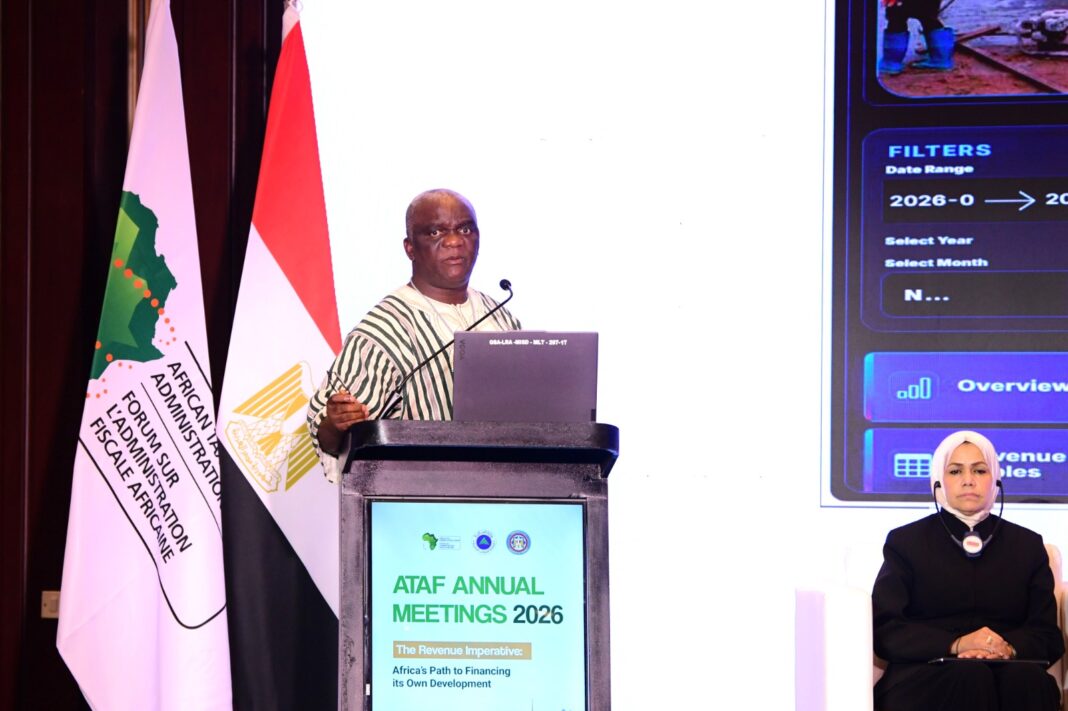
MONROVIA – Liberia’s progress in domestic revenue mobilization, institutional accountability, transparency, and digital transformation took center stage at the African Tax Administration Forum (ATAF) Annual Meetings 2026 and General Assembly in Cairo, where Liberia Revenue Authority (LRA) Commissioner General James Dorbor Jallah outlined reforms aimed at strengthening the country’s capacity to finance its development priorities.
Commissioner General Jallah highlighted the progress when he made a presentation during a panel discussion titled “Domestic Resource Mobilisation: Differentiated Pathways for a Diverse Continent.”
He traced Liberia’s revenue performance from a starting point of approximately US$612 million, which he said was the level inherited when the current leadership assumed office in 2023. At the time, development assistance was declining, while the country’s domestic revenue mobilization and corporate strategic plans had expired.
He reported that domestic revenue collections subsequently rose to US$699 million in 2024 and then to US$848 million in 2025. Collections have since reached approximately US$1.134 billion. He also cited US$5 million carried forward from the previous fiscal year, bringing the combined reported amount to approximately US$1.139 billion.
CG Jallah described the progress as a sign of Liberia’s growing capacity to finance national development through domestic resources, particularly in light of the country’s longstanding reliance on external assistance.
Five Priorities Guiding Institutional Reform
The LRA Commissioner General identified five priorities underpinning the LRA’s reform agenda: strategic leadership; technology and data; compliance and enforcement; customs and tax administration; and institutional integrity. He said the priorities are intended to strengthen institutional performance, improve revenue collection, enhance enforcement, and promote accountability across the revenue systems.
Highlighting the Authority’s focus on integrity, Commissioner General Jallah disclosed that the LRA dismissed 46 employees in 2025 over fraud and other misconduct. He said the actions demonstrated the Authority’s commitment to accountability and its zero-tolerance approach to corruption and unethical conduct. He added that institutional integrity is essential to building public confidence and encouraging voluntary tax compliance.
Revenue Dashboard Opens Collection Data to the Public
The LRA also demonstrated its public-facing revenue dashboard, a platform designed to give citizens and other stakeholders access to information on government revenue collections. Users can monitor reported revenue performance and download tables containing monthly summaries and breakdowns by revenue category and tax type.
CG Jallah said the dashboard currently provides near-real-time information, while the Authority is working to make updates fully real-time. He said wider access to revenue data would allow taxpayers and the public to follow collection performance and gain a clearer understanding of domestic revenue mobilization.
The initiative forms part of the LRA’s broader transparency agenda and complements efforts to expand electronic tax payments and other digital services.
Virtual Contact Center Demonstrates New Taxpayer Support
Commissioner General Jallah’s presentation also included a demonstration of the LRA’s virtual taxpayer contact center, which is being developed to improve communication with taxpayers and address delays in responding to public inquiries and questions about tax obligations.
During the demonstration, the virtual assistant, named Fatu, responded to a simulated inquiry from a small taxpayer seeking guidance on applicable tax obligations. The demonstration illustrated how the service could make tax information more accessible and provide an additional channel for taxpayer support.
When fully developed and operational, the contact center is expected to support taxpayer education and enable individuals and businesses to obtain guidance without necessarily visiting LRA offices.
Reforms Tailored to National Conditions
The LRA Commissioner emphasized that sustainable domestic resource mobilization involves more than increasing collections. He said effective revenue administration also depends on institutional reform, transparency, accountability, taxpayer engagement, and reliable service delivery.
He also pointed to efforts to modernize tax administration and simplify compliance for smaller enterprises, while maintaining operational continuity during the digital transformation process. He reaffirmed that the LRA’s objective is to build a transparent, accountable, and technology-driven institution capable of supporting Liberia’s long-term development.
About the ATAF Panel
The panel brought together tax administration leaders and development experts to examine how African countries can strengthen domestic resource mobilization in different economic and institutional settings.
Other panelists included Ms. Rasha Abdel Aal, Head of the Egyptian Tax Authority, Mr. Leonildo Joao Lourenco Manuel, President of the Board of Directors of Angola’s General Tax Authority, Mr. Yankuba Darboe, Commissioner General of the Gambia Revenue Authority, Mr. Rohit Ramnawaz, Director-General of the Mauritius Revenue Authority, and Richard Stern, Director of the Global Tax Program at Vienna University.
The discussion considered the distinct circumstances of countries with large informal sectors, emerging formal economies, expanding digitalization, and significant natural resource wealth. Panelists examined how reform strategies can be adapted to national economic conditions, development priorities, and institutional capacity rather than applied uniformly across countries with different needs.
