

A massive CDC gathering in Grand Cape Mount raises questions about the Boakai government’s declining political appeal, Bea Mountain’s mining responsibilities and the growing demand for economic justice among ordinary Liberians.
By the Investigative Desk
KINJOR, GRAND CAPE MOUNT COUNTY — In a community sitting atop enormous mineral wealth, where gold is extracted and exported, hundreds of people converged on November 7, 2026, for a political gathering that has raised questions extending far beyond party loyalty and ceremonial celebrations.
The Coalition for Democratic Change (CDC), the opposition party of former President George Manneh Weah, brought together supporters in Kinjor for its Martyrs’ Day commemoration, featuring singing, dancing, football activities and tributes to fallen partisans.
But beneath the celebrations was a bigger story: the intersection of political mobilization, economic frustration and the unresolved expectations of communities living around one of Liberia’s major gold-mining operations.
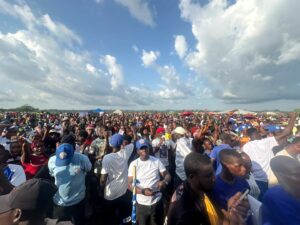
Why did hundreds of people converge on Kinjor? Where did they come from? What message did their presence communicate to the ruling Unity Party government? And what does the gathering mean for Bea Mountain Mining Corporation, whose operations have placed Grand Cape Mount at the centre of Liberia’s mineral economy?
These questions become particularly important when examined against the circumstances of the people living in the mining communities.
Kinjor is not simply a political location. It is part of an area where the extraction of gold has generated enormous economic activity, while questions about local employment, environmental protection, community development and the distribution of mining benefits continue to attract public attention.
The political gathering therefore provides an opportunity to examine a much larger national contradiction: Liberia possesses valuable natural resources, yet many communities hosting those resources continue to demand better infrastructure, employment opportunities and essential public services.
For the CDC, the gathering demonstrated its continuing ability to mobilize supporters outside Monrovia nearly three years after losing presidential power. For the Unity Party, it raises questions about whether the enthusiasm that brought Joseph Nyuma Boakai to the presidency in 2023 is being sustained by the government’s performance.
And for Bea Mountain, it places renewed attention on the relationship between mineral extraction and the welfare of the communities surrounding its operations.
This is where politics meets economic frustration.
THE CROWD: WHERE DID THE PEOPLE COME FROM?
The first question arising from the Kinjor gathering concerns the composition of the crowd.
Were the participants predominantly residents of Kinjor and surrounding communities? Did CDC supporters travel from other parts of Grand Cape Mount County? Were people transported from Monrovia and other counties?
These questions matter because establishing the geographical origins of participants would help determine the extent of local participation and the reach of the party’s mobilization.
The gathering demonstrated that the CDC remains capable of organizing supporters despite its defeat in the 2023 presidential election. However, the presence of a large crowd cannot independently establish the political preferences of the entire county.
For the opposition, the gathering offers an opportunity to demonstrate organizational strength. For the ruling party, it is a reminder that political support must continually be earned.
KINJOR’S GOLD: WHO REALLY BENEFITS?
Perhaps the most important dimension of this story is the presence of Bea Mountain Mining Corporation.
An investigation by the Associated Press and The Gecko Project, published in 2025, reported that Bea Mountain exported more than US$576 million in gold between July 2021 and December 2022, while spending approximately US$2 million on environmental and social programmes for local communities during that period.
The investigation also documented concerns about chemical spills, environmental oversight and the experiences of residents living around mining operations.
The reported export value is not company profit, nor does the reported community expenditure necessarily represent every contractual or statutory contribution. Nevertheless, the figures raise important questions about the distribution of mining wealth.
How much of the economic value generated from Liberia’s gold translates into lasting improvements for the people whose communities host the operations?
What opportunities exist for local workers? How much has been invested in schools, healthcare facilities, roads and other essential services? Are environmental concerns being addressed through independent monitoring and effective enforcement?
These questions deserve answers from Bea Mountain and the government.
THE ENVIRONMENTAL QUESTION
The concerns surrounding the company’s operations extend beyond economic benefits.
The 2025 Associated Press investigation documented chemical spills involving substances including cyanide, arsenic and copper, and raised questions about regulatory oversight and enforcement.
Separately, ActionAid Liberia’s January 2025 investigation examined mining’s effects on communities in Weajue, Grand Cape Mount County, including concerns about blasting, housing and relocation.
These reports make environmental protection an important part of the debate surrounding mining in the county.
The Environmental Protection Agency and Ministry of Mines and Energy should publicly explain what independent inspections have established, what corrective measures have been required and whether outstanding community complaints have been resolved.
Bea Mountain should also be given the opportunity to provide its environmental records, community-development expenditure and responses to the concerns raised.
THE BOAKAI GOVERNMENT’S POLITICAL CHALLENGE
The other side of the Kinjor story concerns the ruling Unity Party.
When President Boakai won the 2023 election, Liberians expected a different experience of government. They wanted improved economic opportunities, better infrastructure, stronger accountability and public services capable of responding to the needs of ordinary citizens.
Nearly three years into the administration, those expectations remain central to the national political conversation.
The government’s challenge is to demonstrate measurable improvements in the lives of citizens.
The questions are straightforward: What has changed for unemployed young people? Have rural communities received improved roads, electricity and healthcare? Are citizens experiencing meaningful economic relief? Are public resources producing visible development?
These questions cannot be answered by government announcements alone.
The administration’s ARREST Agenda provides its development framework, but the public must be able to measure progress against completed projects, improved services and verifiable economic outcomes.
The CDC gathering in Kinjor cannot, by itself, establish that the UP has lost nationwide support. But it provides a political moment in which the ruling party’s performance and the opposition’s mobilization can be examined.
THE 2029 POLITICAL CALCULATION
Although the next presidential election is still ahead, the political environment is already being shaped by the performance of the current government and the activities of opposition parties.
The CDC must demonstrate that its mobilization can be translated into a credible policy alternative. It must also answer questions about its own six-year governing record.
The UP, meanwhile, must demonstrate that its 2023 electoral mandate is producing tangible improvements.
Neither political organization can substitute crowd size, campaign slogans or political criticism for a convincing development programme.
THE QUESTIONS THAT REMAIN
The Kinjor gathering should open a broader investigation into the economic and political realities of Grand Cape Mount County.
How many people from mining-affected communities are employed by Bea Mountain? How much has the company spent on community development? What royalties and taxes have been paid? What environmental inspections have been conducted? Which communities have received compensation or relocation assistance?
And on the political side, what explains the CDC’s ability to mobilize supporters in Kinjor? How does the ruling Unity Party assess its relationship with voters outside Monrovia? What measurable improvements can the government point to in Grand Cape Mount since taking office?
These are questions that require documentary evidence, interviews with residents and responses from the relevant institutions.
THE BIGGER STORY
Ultimately, Kinjor is about more than the CDC, George Weah, President Boakai or Bea Mountain.
It is about the relationship between political power, natural resources and the people whose lives should improve from the country’s economic activities.
A government cannot rely indefinitely on the electoral mandate it received. A political opposition cannot assume that public frustration automatically translates into electoral support. And a multinational mining company must be prepared to demonstrate that its operations benefit more than its shareholders.
The people of Grand Cape Mount deserve answers about their land, their environment, their employment opportunities and their share of the wealth generated around them.
The political gathering has brought attention to Kinjor. What must follow is a serious examination of the economic conditions that define life in the mining communities.
Because the central question is no longer simply who can attract the largest crowd in Kinjor. It is who can explain why a community surrounded by gold continues to demand a fairer share of its own natural wealth.
That is where politics meets economic frustration. And that is the bigger story Liberia must confront.