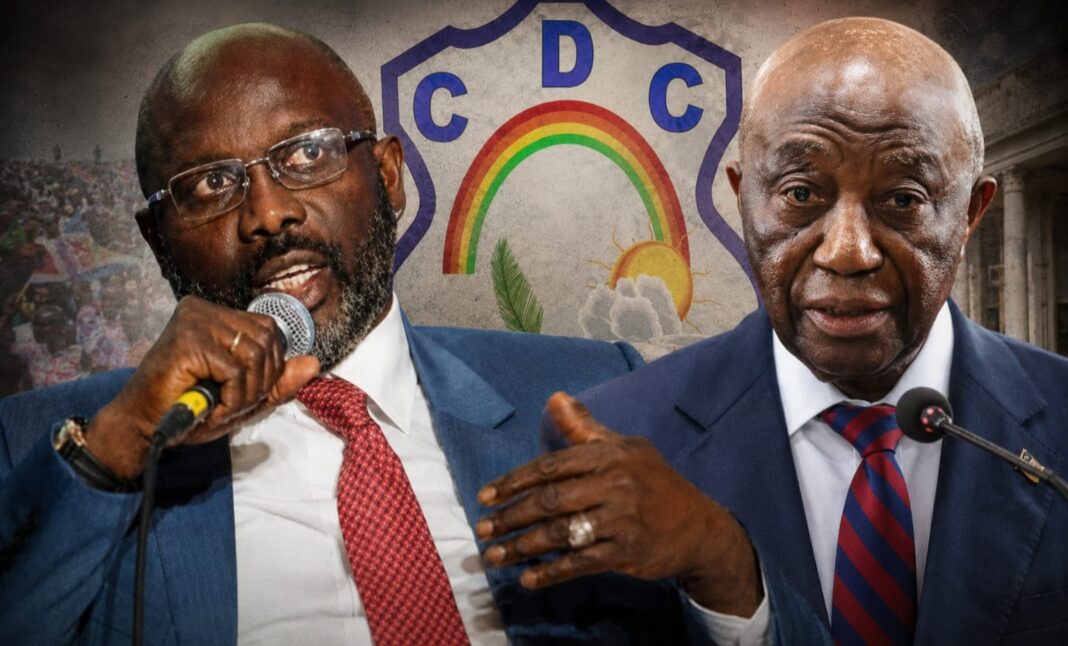
An investigative examination of the demolition of the CDC headquarters, the removal of public officials, the Capitol arson prosecution, the Samuel Tweah trial, drug-related investigations and fresh allegations of a possible invitation of former President George Weah.
MONROVIA, LIBERIA — Liberia is approaching a politically sensitive moment in its democratic history. Nearly three years after President Joseph Nyuma Boakai replaced George Manneh Weah, questions are growing over whether the country’s justice system is being used consistently or whether the former ruling Congress for Democratic Change (CDC) is experiencing a campaign of political persecution.
The question is not whether former government officials should be investigated. They should.
The question is whether the same investigative standards, prosecutorial determination and legal procedures are being applied to people associated with the current ruling establishment.
A government that promises to fight corruption cannot demand accountability from its predecessors while appearing reluctant to answer questions involving its own officials.
The latest development is an allegation by Montserrado County District #9 Representative Frank Saah Foko Jr. that the government intends to invite former President George Weah for questioning on November 25, 2026.
Foko claims he received the information from an individual within the government. He alleges that the administration has already prepared its case and is waiting for the appropriate time to embarrass the former President.
He has not produced documentary evidence of the alleged invitation, and the government has not confirmed it.
Nevertheless, his allegation has revived a much larger debate about the relationship between political power, criminal investigations and the rule of law in Liberia.
To understand why the allegation is generating concern, it is necessary to examine the sequence of events since the Boakai administration took office.
INVESTIGATIVE TIMELINE: THE MAJOR CONTROVERSIES
December 2024: The Koffa speakership crisis
The political confrontation began with the attempt by a majority bloc of lawmakers to remove Speaker J. Fonati Koffa and elect Representative Richard Koon as his replacement.
The dispute became a constitutional battle.
On December 6, 2024, the Supreme Court ruled that the election of Koon and certain actions taken by the majority bloc were unconstitutional.
This is an important distinction: the Supreme Court ruling addressed the rival speakership proceedings and did not simply declare every subsequent action concerning Koffa’s removal unlawful.
Nevertheless, the episode exposed serious divisions within the Legislature and raised questions about respect for constitutional procedures.
August 23, 2025: Demolition of CDC headquarters
CDC Fights to Keep Congo Town HQ in Final Legal Battle –
The demolition of the CDC headquarters in Congo Town became one of the most controversial events of the Boakai administration.
Police and court officials carried out an eviction operation on August 23, 2025, following an August 13 ruling by the Sixth Judicial Circuit Court awarding the disputed 4.23-acre property to the Intestate Estate of Martha Stubblefield Bernard.
The CDC argued that it had challenged the eviction and questioned the manner in which the operation was executed.
The Liberia National Police maintained that it was assisting the sheriff in enforcing a court order.
There is an important legal distinction here: the eviction was not simply an order issued by the President. It followed a property dispute and a court ruling.
However, the timing, heavy police presence and destruction of the headquarters of a major opposition party created a political controversy that went beyond the ownership dispute.
The question remains whether the authorities took sufficient measures to prevent an operation involving a major political institution from escalating into a national political confrontation.
January 2026: Capitol arson case and the disbandment of the jury
The prosecution of former Speaker Koffa and several other lawmakers over the December 2024 Capitol Building fire became another major test for Liberia’s justice system.
The accused were indicted on multiple charges, including arson, criminal mischief and criminal conspiracy.
On January 2, 2026, Criminal Court ‘A’ granted the prosecution’s request to disband the jury, citing alleged juror misconduct and concerns about the integrity of the proceedings.
The decision generated controversy because of the political importance of the defendants and the seriousness of the allegations.
But there was another significant development.
On August 28, 2026, the Supreme Court published a decision in the case of Koffa and several co-defendants against the Republic of Liberia, arising from the trial judge’s decision to disband the jury.
That appellate proceeding is important and deserves close examination of the Court’s full reasoning before conclusions are drawn about whether the jury’s disbandment was legally justified.
May 2026: Samuel Tweah’s acquittal and allegations of jury interference
Former Finance Minister Samuel Tweah and other defendants faced prosecution in a separate US$6.2 million corruption case.
On May 8, 2026, the jury acquitted Tweah and Moses Cooper, while finding two other defendants guilty and returning a hung verdict for another.
The acquittal became controversial when three jurors subsequently filed a complaint alleging misconduct and possible jury tampering.
The complaint alleged that some jurors had phones in restricted areas and communicated with associates of defendants.
Importantly, the complaint did not establish that money was exchanged for the verdict.
This distinction matters. An acquittal is a judicial outcome, while allegations of jury interference require investigation and proof.
It would therefore be inaccurate to describe the Tweah case as one in which the jury was disbanded before delivering its verdict. The jury disbandment in the Capitol arson proceedings was a separate case. Liberia Broadcasting System (LBS)
August–September 2026: Jewel Howard-Taylor’s arrest and drug-related charges
On August 19, 2026, former Vice President Jewel Howard-Taylor was detained after being stopped at Roberts International Airport.
The government subsequently charged her with multiple offenses connected to an alleged transnational narcotics trafficking network, including drug trafficking-related offenses and money laundering.
On September 24, Criminal Court ‘C’ denied her request for bail, citing allegations that the conduct under investigation extended into August 2026.
Howard-Taylor has the right to challenge the charges and defend herself in court. The allegations must not be treated as proof of guilt.
However, the political implications are significant because she served as Vice President under George Weah.
The prosecution has therefore become another major source of tension between the former ruling party and the current administration.
November 13–16, 2026: Kemayah sentenced to 10 years
The latest major development involves former Foreign Affairs Minister Dee-Maxwell Saah Kemayah.
On November 13, 2026, Criminal Court ‘C’ sentenced Kemayah and several former officials to 10 years’ imprisonment following guilty verdicts in the case involving 25,054 bags of Saudi-donated rice.
The court also ordered restitution of US$425,918.
Former Internal Affairs Minister Varney A. Sirleaf and several former disaster management officials were among those sentenced.
Two other defendants were ordered retried after the jury failed to reach unanimous verdicts.
This is no longer merely an allegation or indictment: the convicted defendants have received sentences following trial. However, their rights to appeal remain important.
The prosecution must also be distinguished from political accusations that the case was initiated to target the CDC. The existence of a conviction does not, by itself, establish political persecution or disprove concerns about selective prosecution.
November 16–17, 2026: Weah arrest rumors and the November 25 allegation
Liberia is now facing fresh political uncertainty following reports that former President George Weah could be invited for questioning or arrested in connection with the country’s drug investigations.
Representative Frank Saah Foko Jr. alleges that Weah will be invited on November 25.
Separately, a November 16 report by The New Dawn, republished by Liberia News Network, discussed speculation about a possible November 26 arrest.
These are two different dates and should not be confused.
The Information Minister, Jerolinmek Piah, has previously dismissed similar arrest reports as unfounded, according to the published report.
More importantly, no publicly confirmed evidence has established Weah’s involvement in the major cocaine seizures, and no confirmed arrest warrant or criminal charge against him has been established in the information reviewed. Liberia News Network
THE BIGGER QUESTION: IS THE DRUG WAR BEING APPLIED EQUALLY?
Liberia has experienced major cocaine seizures, including the reported 237.6 kilograms intercepted at Roberts International Airport and the approximately 3,971 kilograms discovered in Duazon.
These are serious national security matters.
The government has a responsibility to investigate every individual connected to the trafficking networks, irrespective of political position.
But there is an equally important question: Are investigators following the evidence wherever it leads?
The public has heard allegations involving individuals who claim connections to powerful international cocaine networks. Videos have also circulated in which individuals reportedly mention the name of President Boakai’s son.
Those allegations have not been independently established as proof of criminal involvement. Nevertheless, the relevant authorities should clarify whether the claims have been investigated and whether any individuals named in credible evidence have been interviewed.
The same standard should apply to George Weah, Jewel Howard-Taylor, former ministers and people connected to the current administration.
There must be no political exemptions and no political targets.
THE UNITED STATES SENATE’S HUMAN RIGHTS SCRUTINY
The timing of these controversies is particularly sensitive because the United States Senate has formally requested information about Liberia’s human rights practices.
On September 23, 2026, Senator Tim Kaine introduced Senate Resolution 886, requesting a report from the U.S. Secretary of State on alleged human rights violations in Liberia.
The resolution specifically raises concerns about arbitrary arrests, detention, due process, enforced disappearances and other human rights issues.
It also requests an assessment of whether American security assistance could be associated with human rights abuses.
The resolution was referred to the Senate Foreign Relations Committee. It is not a finding of wrongdoing against the Boakai administration, but it demonstrates that Liberia’s human rights record is receiving congressional scrutiny.
QUESTIONS THE BOAKAI ADMINISTRATION MUST ANSWER
For this investigation to move beyond political accusations, the following questions deserve clear answers from the relevant institutions:
- What is the legal justification for the removal of public officials appointed under the previous administration, and were all statutory procedures followed?
- What was the legal basis for enforcing the CDC headquarters eviction, and were all outstanding legal applications properly addressed?
- What were the precise reasons for disbanding the Capitol arson jury, and what did the Supreme Court ultimately determine?
- What evidence supports the drug-related charges against former Vice President Jewel Howard-Taylor?
- Have investigators examined the videos in which individuals claiming connections to Colombian cocaine networks reportedly mentioned President Boakai’s son?
- Has the Liberia National Police or the Liberia Drug Enforcement Agency investigated every person identified through credible intelligence, regardless of political affiliation?
- Has an official invitation been issued to former President George Weah? If so, what is its legal basis?
- What safeguards will prevent criminal investigations from being used to intimidate opposition leaders?
These questions should be directed to the Ministry of Justice, Liberia National Police, Liberia Drug Enforcement Agency, Executive Mansion and the relevant courts.
LIBERIA CANNOT AFFORD SELECTIVE JUSTICE
There is a dangerous misunderstanding in Liberian politics: that prosecuting members of the previous government automatically demonstrates a commitment to fighting corruption.
It does not.
A government demonstrates its commitment to justice when it investigates wrongdoing regardless of who is involved, respects court decisions, protects the rights of accused persons and accepts that even its own officials must answer difficult questions.
The CDC cannot claim that its members should be immune from prosecution simply because they served in government. Neither can the Unity Party administration claim that every prosecution of a former official is automatically evidence of accountability.
Both positions are wrong.
What is troubling is the growing perception that political affiliation is becoming a determining factor in how justice is pursued.
If that perception is allowed to deepen, Liberia risks returning to the dangerous politics of exclusion, retaliation and confrontation.
The CDC must reject violence. The government must reject political intimidation. The courts must remain independent.
President Boakai must remember that he is President of Liberia, not merely leader of the Unity Party.
And George Weah, like every other former President, is not above the law.
But neither is he beneath the protection of the law.
Liberia needs justice, not revenge. It needs accountability, not political cleansing. And above all, it needs a government that can prove through its actions that the rule of law applies equally to friends and opponents.
The ultimate question is not whether the CDC is being prosecuted. It is whether every Liberian can expect the same justice, regardless of which political party holds power.