
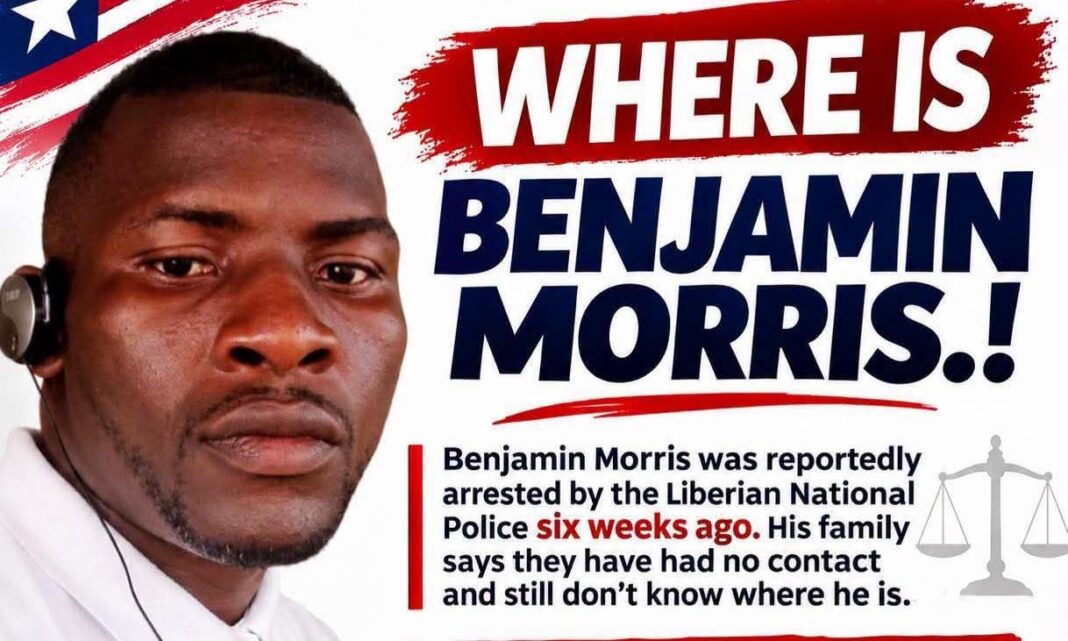
Nearly two months after his reported arrest in Paynesville, Benjamin Morris remains unaccounted for. His family’s account of seeing him taken away in a police pickup, conflicting information about his alleged transfers, and unanswered questions over a possible cocaine investigation raise serious concerns about police accountability.
MONROVIA — Nearly two months after taxi driver Benjamin Morris reportedly disappeared following his arrest in Paynesville, the Liberia National Police (LNP) continues to face mounting questions over his whereabouts, raising concerns about the country’s commitment to constitutional rights, due process and the protection of persons in state custody.
The case is becoming particularly significant as Liberia faces increased international scrutiny over its human rights record following the introduction of United States Senate Resolution 886, a measure sponsored by U.S. Senator Tim Kaine on September 23, 2026, requesting information about alleged human rights violations in Liberia.
Among the concerns specifically identified in the resolution are arbitrary arrests, unlawful detention, violations of due process, enforced disappearances and unlawful killings.
Although the resolution does not mention Morris or establish that Liberian authorities committed any violation in his case, his unexplained disappearance raises questions that fall directly within the human rights concerns identified by the U.S. Senate.
At the centre of the controversy is a troubling question: If Benjamin Morris was arrested by the police, where is he, who has custody of him, and why has the government failed to provide his family with a verifiable account of his whereabouts?
THE LAST SIGHTING: TAKEN AWAY IN A POLICE PICKUP
According to accounts published by Liberian media on November 2, Morris was reportedly arrested on September 22, 2026, around Neezoo Junction in Jacob Town, Paynesville.
His wife, Rich Kamara, said her husband called her on the day of his arrest and instructed her to meet him at the Jacob Town Police Depot.
When she arrived, she reportedly saw him inside a white police pickup leaving the police facility.
That was the last time she saw her husband.
The family’s subsequent efforts to locate him have reportedly produced conflicting information.
According to his brother, Kenneth Morris, police initially informed the family that Benjamin had been transferred from the Jacob Town depot to White Plains Police Station and subsequently to Liberia National Police headquarters in Monrovia.
However, relatives who visited the locations were reportedly unable to find him.
The family further claims that it sought legal assistance and had a sheriff accompany them to the facilities where police allegedly said Morris was being held. Those efforts reportedly failed to establish his location.
Even more troubling, the family says police assured them that Morris and the taxi he was driving were safe, but relatives have not been allowed to see either.
Two desk officers at the Jacob Town depot reportedly acknowledged the existence of records concerning his detention.
If these accounts are accurate, the case presents a serious accountability problem for the police institution.
How does a person reportedly taken into custody in a police vehicle, whose detention is allegedly reflected in station records, subsequently become unaccounted for?
WAS MORRIS ARRESTED OVER A COCAINE INVESTIGATION?
Another dimension requiring investigation is whether Morris’s reported arrest was connected to Liberia’s ongoing cocaine trafficking investigations.
Liberia has experienced major narcotics seizures in 2026, including the interception of approximately 237.6 kilograms of cocaine at Roberts International Airport in June and the discovery of nearly four tonnes of cocaine in the VOA Community warehouse investigation.
The investigations have exposed concerns about transportation networks, storage facilities and individuals suspected of facilitating the movement of narcotics.
There are also questions surrounding CCTV footage reportedly showing a driver transporting cocaine into a warehouse in Gardnersville.
Could the driver in that footage be Benjamin Morris?
At present, no independently verified evidence establishes that Morris was the person captured in the footage. Neither has an official police statement publicly established that his reported arrest was connected to the Gardnersville warehouse or any of the major cocaine investigations.
The distinction is important.
If Morris was arrested because investigators suspected him of transporting narcotics, the police should disclose the legal basis for his detention and whether he was formally charged.
Investigators should also establish whether the taxi he was driving was seized, whether its registration corresponds with any vehicle identified in the surveillance footage, and whether forensic or documentary evidence connects him to a drug-trafficking investigation.
The public deserves answers, but suspicion must not be substituted for evidence.
THE U.S. SENATE’S RESOLUTION 886: A HUMAN RIGHTS TEST FOR LIBERIA
The disappearance of Morris comes at a sensitive moment in Liberia’s relationship with the United States.
On September 23, 2026, U.S. Senator Tim Kaine introduced Senate Resolution 886, requesting that the U.S. Secretary of State provide information concerning Liberia’s human rights practices under Section 502B(c) of the Foreign Assistance Act of 1961.
The proposed measure asks for credible information concerning alleged human rights violations by the Liberian Government, including arbitrary and unlawful arrests and detention, violations of due process rights, torture and cruel or inhumane treatment, enforced disappearances and unlawful killings.
It also requests information about steps taken by the U.S. Government to promote human rights and discourage practices inconsistent with internationally recognized protections.
The resolution was referred to the Senate Foreign Relations Committee. It should not be misrepresented as an adopted resolution or as a formal finding against Liberia.
Nevertheless, its introduction sends an important message about the level of scrutiny being directed at Liberia’s human rights practices.
Morris’s case now presents a practical question for the Liberian authorities: Can the government account for a citizen reportedly taken into police custody?
If the family is correct, the matter goes beyond a missing-person complaint. It raises questions about detention procedures, institutional responsibility, the protection of fundamental rights and the ability of law enforcement to account for individuals in its custody.
For a government seeking to demonstrate its commitment to democratic governance and the rule of law, the failure to establish the whereabouts of a person reportedly arrested by state security officers would be a deeply troubling development.
WHAT DOES THE LIBERIAN CONSTITUTION SAY?
Article 21(f) of Liberia’s Constitution provides that a person arrested or detained must be formally charged and presented before a court of competent jurisdiction within 48 hours.
The Constitution also protects individuals against arbitrary detention and guarantees access to judicial remedies, including habeas corpus.
These protections do not disappear simply because someone is suspected of involvement in a serious criminal investigation.
If Morris was arrested on September 22 and remained in police custody without being presented before a court within the constitutionally prescribed period, the authorities must explain the circumstances and legal basis of his detention.
If he was transferred, the police should produce the relevant transfer records.
If he was released, the police should establish when, where and to whom he was released.
And if the police maintain that they do not have him in custody, they should explain the family’s account of seeing him being transported in a police pickup and the reported existence of detention records.
The seriousness of a suspected crime cannot justify abandoning constitutional protections.
THE POLICE LEADERSHIP MUST ANSWER
The public silence surrounding Morris’s whereabouts has placed the leadership of the Liberia National Police under increasing pressure.
During the family’s protest at the Jacob Town Police Depot, Deputy Inspector General of Police for Operations Nelson Freeman reportedly met with relatives and said he had provided his telephone number to arrange a meeting to address their concerns.
However, the public has yet to receive a detailed, verifiable account of Morris’s whereabouts.
Inspector General Gregory O.W. Coleman and Deputy Inspector General Freeman must answer several critical questions.
Did the LNP arrest Benjamin Morris on September 22, 2026? Which officers conducted the arrest, and which police unit authorized it? What was the specific reason for his arrest? Was his arrest connected to the cocaine investigations or the Gardnersville warehouse? Was the taxi he was driving impounded, and where is it now?
Does the Jacob Town Police Depot have an official detention record bearing his name? Was he transferred to White Plains Police Station or LNP headquarters? Which officers authorized and carried out the alleged transfers? Was he presented before a court within 48 hours? If he was released, when and where did that happen? Has the Police Professional Standards Division investigated the family’s allegations? Has the LNP established whether Morris is alive and safe?
These are not unreasonable demands. They are fundamental questions about the exercise of police authority and the protection of citizens.
A FAMILY LEFT IN DESPERATION
Behind the legal and political questions is a family struggling to understand what happened to its breadwinner.
Morris’s wife, Rich Kamara, has publicly appealed for information about her husband.
According to her account, their three children have been sent home from school because the family can no longer afford their school fees.
Her plea is simple: she wants to see her husband and know whether he is alive and safe.
The family has not publicly established that Morris was kidnapped, killed or unlawfully detained. But the inability to locate someone reportedly taken away by police has created circumstances that demand urgent investigation.
The government cannot ignore the human consequences of this uncertainty.
WHAT WENT WRONG?
There are several possibilities.
Morris may have been arrested as part of an ongoing criminal investigation. He may have been transferred between police facilities without proper communication with his family. He may have been released without his relatives being informed.
There is also the more serious possibility that something happened while he was in state custody.
None of these possibilities has been established.
But the longer the authorities remain unable to provide a verifiable account, the more difficult it becomes to dismiss the family’s concerns.
The LNP should immediately preserve the detention registers, vehicle movement records, station CCTV footage, transfer documents and all communications relating to Morris’s reported arrest.
An independent investigation would also help establish whether officers followed the law and whether any misconduct occurred.
THE BIGGER QUESTION: WHAT DOES THIS MEAN FOR LIBERIA?
The Benjamin Morris case is no longer just a family matter.
It has become a test of institutional accountability at a time when Liberia is facing renewed international attention over its human rights practices.
Senate Resolution 886 has placed arbitrary detention, due process and enforced disappearances among the issues the U.S. Government is being asked to examine in relation to Liberia.
The Morris case does not prove the allegations contemplated by the resolution. But it demonstrates why transparent investigations and credible official explanations matter.
Liberia cannot credibly defend its human rights record internationally while leaving unanswered questions about people reportedly taken into the custody of its own security institutions.
The government must demonstrate that the Constitution applies to everyone, including criminal suspects and persons under investigation.
If Benjamin Morris is a suspect, produce him before the court. If he has been released, explain when and how. If he was transferred, identify the institution holding him. And if something happened to him while in police custody, the country deserves the truth.
The central question remains:
WHERE IS BENJAMIN MORRIS?
Until the Liberia National Police answers that question with verifiable evidence, this case will remain a troubling test of Liberia’s justice system, its human rights commitments and the credibility of its security institutions.