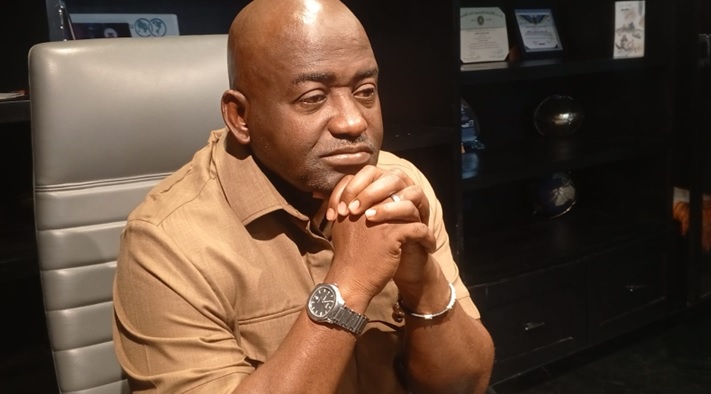

MONROVIA, LIBERIA — The National Port Authority (NPA), under the leadership of Managing Director Sekou A. M. Dukuly, has announced a series of emergency measures intended to ease congestion at the Freeport of Monrovia, suspend controversial surcharges and reduce the financial burden on importers.
The measures, announced on November 16 following a high-level meeting chaired by Finance Minister Augustine Kpehe Ngafuan, include a 30-day waiver of storage and demurrage charges for containers already at the port, suspension of vessel movement surcharges, elimination of unauthorized fees and the introduction of 24-hour port operations.
On the surface, these decisions represent a significant intervention in Liberia’s import and trade sector. But beyond the relief package lies a more fundamental question: Why did congestion, rising charges and delays become serious enough to require an emergency government intervention in the first place?
For a country heavily dependent on imported rice, petroleum products, construction materials, medicines, machinery and other essential commodities, the efficiency of the Freeport is not merely a maritime concern. It directly affects the cost of living, business operations and the broader economy.
DUKULY’S INTERVENTION: RELIEF OR ADMISSION OF A DEEPER PROBLEM?
The decision to grant importers 30 days of free storage and demurrage is perhaps the most immediate and visible component of the NPA’s intervention.
For importers whose containers have remained at the port, the waiver could prevent additional charges from accumulating and provide an opportunity to clear stranded cargo.
But the relief also raises an important question about responsibility.
Storage and demurrage charges generally accumulate when cargo remains beyond the permitted free period. While delays can result from importers’ failure to complete documentation or payments, they can also arise from customs disputes, inadequate storage capacity, terminal bottlenecks, limited operating hours and other institutional inefficiencies.
The NPA must therefore explain how much of the congestion resulted from importer-related delays and how much was caused by weaknesses within the port system.
If businesses were accumulating substantial charges because of operational bottlenecks beyond their control, the government must establish who bears responsibility for those failures.
A 30-day waiver may provide immediate relief, but it does not automatically resolve the conditions that caused containers to remain at the port.
THE SUSPENDED SURCHARGES: WHO AUTHORIZED THEM AND WHO BENEFITED?
Another important aspect of Dukuly’s announcement is the suspension of the 30 percent and 100 percent surcharges imposed on vessel movements.
The decision raises questions about the justification for these charges, the authority under which they were introduced and the financial institutions or operators that benefited from them.
The NPA is the statutory authority responsible for administering Liberia’s public ports and overseeing important aspects of port operations. Its decision to suspend the surcharges suggests that the authority is exercising its regulatory responsibilities to address charges it now considers necessary to review or suspend.
But the public deserves more than an announcement of suspension.
What was the original justification for imposing the surcharges? Were shipping companies consulted? Were the charges approved under the applicable regulatory framework? How much revenue did they generate, and where did that money go?
The NPA should publish the relevant fee schedules and explain the financial implications of the decision.
Importers should not be left guessing which charges are legitimate and which are subject to suspension.
UNAUTHORIZED FEES: A QUESTION OF REGULATORY OVERSIGHT
The government’s directive against unauthorized charges, including payments associated with GTMS and CTN, is another important development.
The prohibition of overnight and processing fees also raises questions about how such charges became part of the port clearance environment.
If these payments were unauthorized, who permitted them to be demanded from importers? Were complaints previously submitted to the NPA? Were investigations conducted? Were any officials, agents or private operators held accountable?
The government must identify the institutions and individuals responsible for enforcing the rules.
Simply instructing consignees to report unauthorized payments is not enough. Importers need a transparent complaint mechanism, protection against retaliation and a clear process for recovering money collected unlawfully, where applicable.
The NPA should also publish an official list of all approved charges so that businesses can distinguish legitimate payments from unauthorized demands.
24-HOUR OPERATIONS: A SOLUTION THAT SHOULD HAVE BEEN PLANNED
The decision to operate the Freeport 24 hours a day, seven days a week, including public holidays, is potentially one of the most consequential measures.
A port that operates around the clock can process more cargo, reduce truck waiting times and make better use of available infrastructure.
However, extending operating hours does not automatically translate into greater efficiency.
For the arrangement to work, the NPA, APM Terminals, Liberia Revenue Authority, customs brokers, security agencies, shipping companies and other service providers must maintain adequate staffing and coordinated operations throughout the day and night.
The government must explain whether the port has sufficient equipment, personnel, electricity, security and digital infrastructure to support continuous operations.
Otherwise, the 24-hour policy could become an announcement without the operational capacity needed to deliver its intended results.
More importantly, why were limited operating hours allowed to contribute to congestion for so long before this intervention?
LRA’S THREE-DAY PROTEST RESOLUTION: AN IMPORTANT TEST
The instruction to the Liberia Revenue Authority to resolve consignees’ protests within three days is another measure deserving attention.
Customs disputes can keep cargo at the port while businesses continue to face storage expenses and other financial obligations.
A three-day resolution target could improve predictability and reduce unnecessary delays.
But the LRA must demonstrate that it has the staffing, administrative capacity and digital systems to meet the deadline.
The introduction of a digital payment platform is also welcome, provided that it is secure, accessible and supported by reliable transaction records.
The public should be informed about how many customs protests are currently outstanding, how long they have remained unresolved and how many are successfully settled within the new deadline.
Without measurable performance indicators, the three-day directive risks becoming another government promise without a clear accountability mechanism.
FIRST-COME, FIRST-SERVED: ENDING PREFERENTIAL BERTHING?
The government’s decision to enforce a first-come, first-served vessel berthing arrangement is particularly significant.
If consistently implemented, it could improve transparency and reduce concerns about preferential treatment in allocating berthing space.
The decision to assign bulk and general cargo vessels to the LMC and BMC piers could also reduce pressure on container-handling facilities.
However, the NPA must explain the criteria for determining vessel arrival times, handling operational emergencies and resolving disputes over berthing priority.
A transparent vessel scheduling system should be publicly accessible to shipping companies and relevant stakeholders.
This would allow the public to assess whether the new policy is being implemented fairly.
THE BIGGER QUESTION: WHAT HAS THE NPA BEEN DOING?
The involvement of Finance Minister Augustine Kpehe Ngafuan, Commerce Minister Stephen Yekeson, LRA Commissioner General Dorbor Jallah, the Liberia National Police and private-sector representatives demonstrates that the government recognizes the seriousness of the congestion problem.
But it also raises questions about institutional responsibility.
The NPA is not a new institution. It has statutory responsibilities for port administration, infrastructure management and the regulation of port operations.
Why did the situation require such a high-level government meeting before these measures were announced?
Were previous complaints from importers ignored? Did the NPA conduct an operational assessment before the congestion escalated? Were there internal reports identifying the causes of delays? What corrective actions had management taken before November 16?
These are not accusations against the current NPA management. They are accountability questions that must be answered if the public is to understand how the crisis developed and whether the new leadership is correcting inherited weaknesses or addressing problems that emerged under its watch.
Dukuly’s management should publish a comprehensive assessment of the congestion, including the number of containers awaiting clearance, average vessel waiting times, available storage capacity, container-handling performance and the principal causes of delays.
The public should also know whether the NPA has established measurable targets for reducing congestion.
WILL IMPORTERS AND ORDINARY LIBERIANS BENEFIT?
Ultimately, the success of the intervention should be measured by its impact on businesses and consumers.
Liberia imports substantial quantities of essential goods. When shipping costs, port charges and clearance delays increase, businesses face higher expenses. Those expenses can eventually be transferred to consumers through higher prices.
The government therefore has a responsibility to ensure that the relief measures produce actual reductions in the cost of doing business.
However, the 30-day waiver must be carefully administered. The NPA and APM Terminals should publish clear eligibility conditions, explain how containers qualify and disclose whether any charges remain payable during the waiver period.
They should also explain what happens after the 30 days expire. If the underlying congestion remains unresolved, importers could find themselves facing the same financial pressures again.
CONCLUSION: THE ANNOUNCEMENT MUST BE FOLLOWED BY ACCOUNTABILITY
Managing Director Sekou A. M. Dukuly’s announcement presents an opportunity to restore confidence in the Freeport of Monrovia and improve Liberia’s trading environment.
The measures address several longstanding concerns involving cargo clearance, vessel movement, unauthorized charges and operating hours.
But temporary relief cannot substitute for structural reform.
The NPA must demonstrate that it can manage the port efficiently, enforce transparent charges, coordinate private operators and prevent congestion from becoming a recurring national economic problem.
The government should also make public the performance targets against which the new measures will be evaluated.
Liberians do not simply need a 30-day free clearance window. They need a port system that works efficiently every day without requiring an emergency government intervention to protect importers from mounting costs.
The real test of Dukuly’s leadership will not be how many relief measures the NPA announces, but whether the Freeport becomes more efficient, transparent and affordable after the announcement.