
By Socrates Smythe Saywon | Smart News Liberia
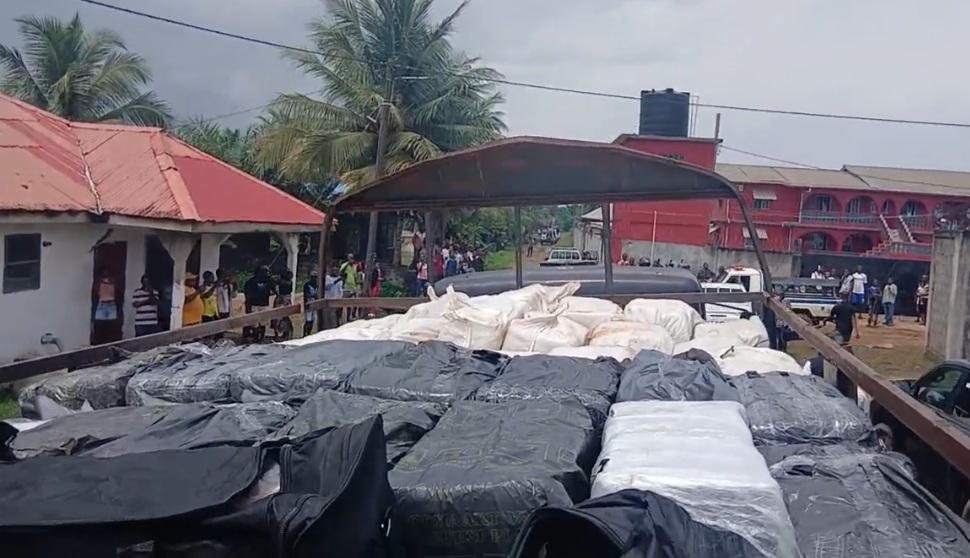
The Government of Liberia’s announcement on Wednesday, July 22, 2026, that security forces have seized 3,971 kilograms of suspected cocaine with an estimated street value of US$317.68 million should be remembered as one of the most significant anti-narcotics operations in the country’s history. If laboratory tests confirm the substance is cocaine, the seizure represents not only a major victory for law enforcement but also one of the most disturbing revelations about Liberia’s security landscape in recent years.
The Ministry of Justice says preliminary investigations point to a sophisticated transnational drug trafficking network that may have been operating in Liberia for more than six years. If that assessment is accurate, then this case is no longer simply about narcotics. It is about national security, border protection, institutional accountability, and Liberia’s international reputation.
The successful operation deserves commendation. The Joint National Security Investigative Task Force, acting on intelligence and a court authorized search warrant, recovered the suspected drugs from a property in the VOA Community along the Roberts International Airport Highway in Duazon, Margibi County. The operation also led to the arrest of two foreign nationals, a Serbian citizen and a dual Colombian Spanish citizen, as investigations continue.
Yet while Liberians should applaud the seizure, they must also ask the difficult questions that naturally arise from the government’s own disclosures.
How could nearly four metric tons of suspected cocaine become connected to a network that allegedly operated in Liberia for more than six years without attracting sustained attention from the country’s security institutions?
That question is not an attack on the officers who conducted the operation. Instead, it is a legitimate question about whether Liberia’s security architecture has been sufficiently equipped, coordinated, and vigilant to confront increasingly sophisticated international criminal organizations.
Nearly four tons of suspected cocaine do not simply appear overnight.
Such a quantity must be transported.
It must be financed.
It must be stored.
It must be guarded.
It must move through logistics networks.
It must involve communications, transportation, and, almost certainly, local facilitators.
This raises another critical question.
How did such an enormous quantity of suspected narcotics enter Liberia without repeatedly triggering security red flags?
Did it arrive through one of Liberia’s seaports?
Did it pass through Roberts International Airport?
Was it smuggled across Liberia’s porous land borders?
Did it enter through coastal routes?
Or was Liberia serving as a storage and redistribution point for international drug trafficking organizations?
Every possible answer demands serious investigation.
Equally important is another question that many Liberians are asking.
Could any part of this operation have involved drug processing inside Liberia?
At present, there is no public evidence that the suspected cocaine was manufactured in Liberia. Government officials have described the seizure as processed plates of suspected cocaine, but they have not publicly disclosed where the drugs originated, whether they arrived in finished form, or whether any processing facilities have been identified within the country.
That uncertainty makes transparency even more important.
The public deserves clear answers.
Where did the suspected cocaine originate?
How long had it been stored in Liberia?
How many shipments may have entered before this one?
How many may have left the country undetected?
Was Liberia merely a transit point, or was it becoming an operational hub for transnational drug traffickers?
Who financed the operation?
Who provided protection?
Who handled transportation?
Were any Liberian citizens involved?
Have any public officials or security personnel come under investigation?
Were there warning signs that were ignored?
If the government believes this network operated for six years, then another difficult question follows.
What happened during those six years?
Were intelligence reports generated but not acted upon?
Did corruption undermine enforcement?
Were criminal networks simply more sophisticated than the country’s detection systems?
Or does this case expose significant weaknesses within Liberia’s border security, customs inspections, immigration controls, maritime surveillance, and intelligence coordination?
These are not accusations. They are questions that naturally arise from the scale of the seizure and the government’s own description of the alleged criminal network.
This case also extends far beyond Liberia’s borders.
International drug trafficking organizations do not choose countries randomly. They exploit jurisdictions they perceive as vulnerable because of weak border controls, corruption, inadequate surveillance, or limited law enforcement capacity.
If international traffickers believed Liberia provided such an opportunity, then that perception itself poses a national security challenge that demands urgent attention.
The international consequences could also be significant.
Foreign governments, development partners, airlines, shipping companies, investors, and financial institutions carefully monitor countries linked to transnational organized crime.
If Liberia develops a reputation as a preferred transit route for cocaine trafficking, increased scrutiny could follow.
Cargo entering and leaving Liberia may face tighter inspections.
Travelers could experience heightened security screening.
Financial transactions may receive greater monitoring.
Foreign investment decisions could become more cautious.
Liberia’s reputation, painstakingly rebuilt over the years, could suffer if decisive reforms do not accompany successful law enforcement operations.
This is why accountability must not stop with the seizure itself.
The investigation must follow every lead.
Authorities must identify every individual involved.
They must trace financial transactions.
They must determine whether money laundering occurred.
They must examine whether shell companies, businesses, or financial institutions were used to conceal illicit proceeds.
Most importantly, investigators must establish whether any public officials abused their positions to facilitate or protect the alleged network.
If corruption played any role, accountability must reach every level, regardless of rank, title, or political affiliation.
This is also an opportunity for institutional reform.
Liberia should review the effectiveness of cargo screening systems at its ports and airport.
Border surveillance technologies should be strengthened.
Intelligence sharing among security agencies should be improved.
Anti-money laundering enforcement should be intensified.
International cooperation with regional and global anti-narcotics agencies should be expanded.
A seizure of this magnitude should become a turning point, not merely another headline.
The Government of Liberia deserves recognition for disrupting what it describes as a sophisticated international trafficking operation.
However, success will ultimately be measured not only by the quantity of drugs seized but also by whether the entire criminal enterprise is dismantled, those responsible are successfully prosecuted, illicit assets are confiscated, and the institutional weaknesses that allowed such an operation to flourish are permanently addressed.
One operation has answered one question: Liberia’s security agencies can strike when intelligence is effectively gathered and coordinated.
But many more questions remain unanswered.
How did this alleged network survive for six years?
Who enabled it?
Who profited from it?
How many previous shipments escaped detection?
What reforms will now be implemented to prevent another operation of this scale?
These are the questions that every Liberian deserves answered.
Because the true significance of this US$317.68 million cocaine seizure lies not only in what was discovered in Duazon, but in what the investigation may yet reveal about the strength or vulnerability of Liberia’s national security system.
History will judge this moment not simply by the amount of cocaine seized, but by whether Liberia confronts the deeper institutional questions this unprecedented case has brought into the national spotlight.