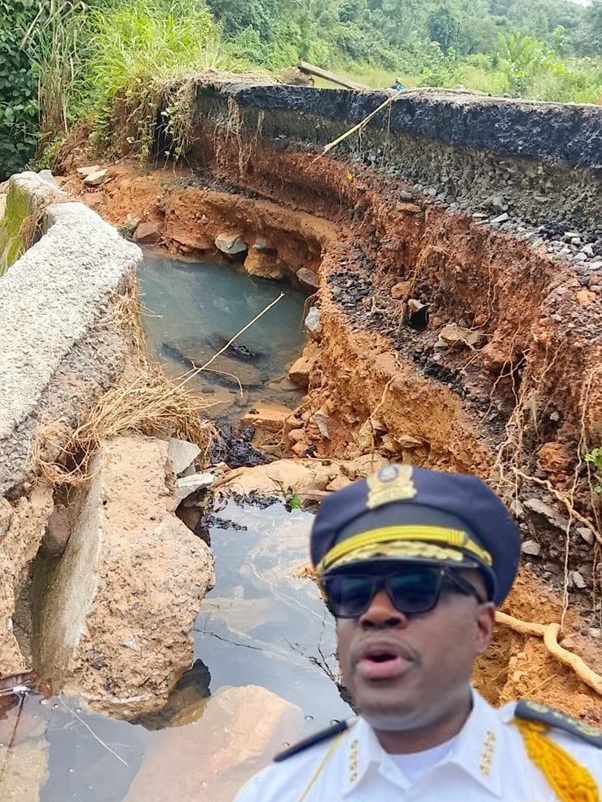
The Liberia National Police (LNP) is correct in alerting drivers about the worsening state of the road near Kpakor Hill in Lower Bong County. Their public notice comes at a crucial time, especially since erosion and damaged road surfaces can quickly lead to serious traffic dangers.
However, a more pressing question arises: How long can the police keep warning the public about hazardous roads without taking a stronger stance on addressing the underlying issues that cause these dangers in the first place?
The LNP’s recent statement advises motorists to slow down, stay alert, and exercise extreme caution. While this is essential, it represents just the initial step in ensuring road safety.
A truly proactive strategy demands that the police go beyond merely issuing press releases and collaborate directly with the government agencies responsible for maintaining the roads.
The Ministry of Public Works should be an immediate ally in this effort. Liberia’s road safety challenges cannot be resolved simply by urging drivers to navigate around hazards that persist for weeks or even months.
When a road begins to deteriorate, the response should not stop at a warning to motorists. There needs to be a system in place where the police, Public Works, the Ministry of Transport, the National Road Fund, and, when necessary, local authorities work together to identify the hazards, secure the area, and ensure that repairs are made in a timely manner.
In Monrovia and its environs, the issue of dangerous potholes and crumbling intersections has become a significant concern for drivers. Take, for instance, the intersection of Tubman Boulevard and S.D. Cooper Road, as well as the GSA Road junction right beneath the Red Light.
When major potholes linger at these busy intersections for extended periods, they turn into more than just inconveniences; they evolve into predictable road-safety risks. And when hazards are predictable, they require more than just standard warnings.
The Ministry of Public Works has recognized the critical need for timely road maintenance. In July 2025, the Ministry announced a contract aimed at addressing pothole repairs, restoring essential road sections, applying asphalt overlays, and rehabilitating pedestrian walkways across Monrovia.
Additionally, the Ministry has carried out inspections of various road projects and, in January 2026, reported significant progress in pothole rehabilitation efforts in Central Monrovia, although they expressed concerns about the slow advancement of at least one project. This situation lays the groundwork for improved coordination.
The government has shown that such collaboration is achievable. For example, during the planning stages of the Tubman Boulevard overpass projects, the Ministry of Public Works worked alongside the LNP in a joint on-site exercise, with police participating in traffic management and safety planning.
That model shouldn’t just focus on major donor-funded or high-profile infrastructure projects; it needs to become a standard practice within the government.
When the LNP spots a dangerous road condition, their traffic and engineering teams should have the authority to officially report that issue to Public Works and other relevant agencies. Public Works should then evaluate the situation and inform what immediate actions are necessary—be it filling potholes, improving drainage, controlling erosion, setting up temporary barriers, placing warning signs, or undertaking full rehabilitation. Most importantly, there needs to be a follow-up process.
A police warning shouldn’t mark the end of the matter; it should kickstart a coordinated response among agencies. The current situation at Kpakor Hill presents a perfect opportunity for this approach.
If erosion has made part of the Monrovia-Bong corridor unsafe, the public deserves to be informed not only that drivers should exercise caution but also which government agency has been alerted, what corrective actions are being planned, and how soon the issue will be resolved. This is where the LNP can expand its understanding of road safety.
Police officers frequently encounter the fallout from poor road conditions—accidents, traffic jams, damaged vehicles, stranded drivers, and, sadly, injuries or fatalities.
The police extensive experience positions them well to identify recurring road hazards and push for necessary changes.
The National Road Fund and the Ministry of Public Works already hold responsibilities for road maintenance and rehabilitation.
Liberia’s planning documents have recognized that delays in addressing road issues can lead to ongoing access challenges and economic difficulties.
Therefore, the solution cannot simply be another press release urging Liberians to exercise caution. What is needed are safer roads, not just improved warnings about dangerous conditions.
The LNP should keep the public informed whenever there is an immediate hazard. However, this warning must be accompanied by a proactive inter-agency initiative to prevent the underlying issues from becoming permanent.
For the police, this involves coordination. For Public Works, it means taking action. For the Ministry of Transport and the Road Safety Secretariat, it entails providing technical and policy support. And for the government overall, it requires setting clear timelines for addressing identified road hazards.
A pothole at a busy intersection should not have to result in an accident before it gets the government’s attention. The police have raised concerns at Kpakor Hill. Now, this alert should lead to action—not just another statement.