By Socrates Smythe Saywon | Smart News Liberia
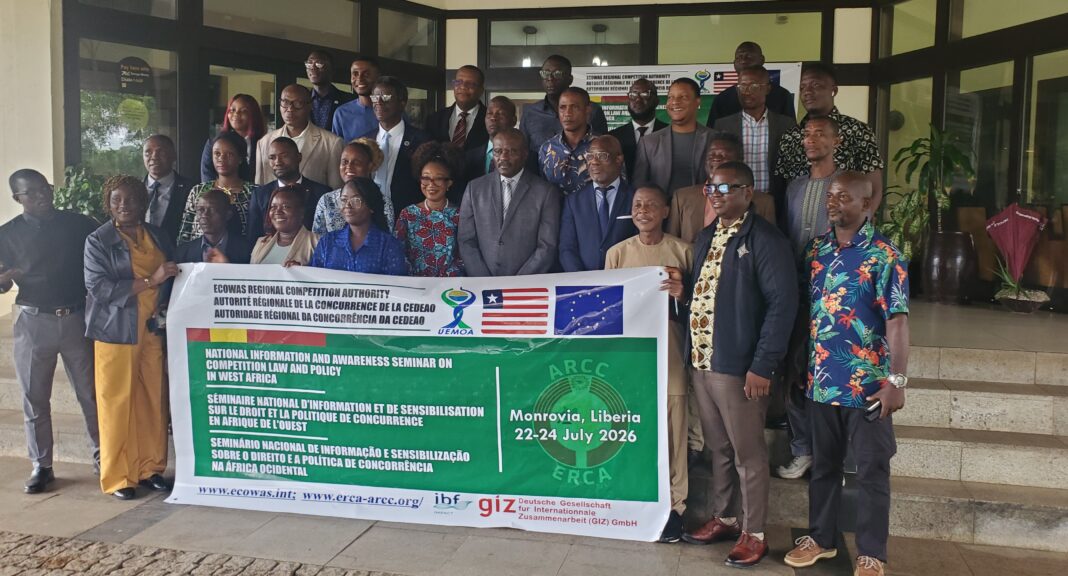
MONROVIA, LIBERIA – The ECOWAS Regional Competition Authority (ERCA) on Wednesday officially launched a three-day National Information and Awareness Seminar on Competition Law and Policy in West Africa, calling on Liberia and other ECOWAS member states to strengthen competition laws, protect consumers, and build transparent markets capable of driving sustainable economic growth and regional integration.
The seminar, being held at the RLJ Kendeja Resort in Monrovia from July 22-24, 2026, has brought together senior government officials, regulators, development partners, private sector representatives, consumer organizations, civil society actors, and members of the media to examine the role of competition law in promoting investment, innovation, and economic transformation across West Africa.
The event is organized by the ECOWAS Regional Competition Authority with support from the European Union through the Competition and Consumer Protection Support Programme (PACOSPro).
Competition Essential to ECOWAS Vision 2050
Delivering the keynote opening address, Dr. Juliette Twumasi Anokye, Chairperson of the ECOWAS Regional Competition Authority (ERCA), described competition policy as far more than a legal framework, insisting that it is central to the future prosperity of West Africa.
She said competitive markets are indispensable to achieving the ambitions outlined in ECOWAS Vision 2050, which seeks to transform the regional bloc into “an ECOWAS of Peoples” built on prosperity, democratic governance, peace, and sustainable development.
According to Dr. Anokye, regional integration cannot be achieved solely by removing customs barriers or promoting the free movement of people and goods.
Instead, she argued, success depends on creating markets where businesses compete fairly across borders, consumers enjoy wider choices and affordable prices, investors operate in transparent environments, and small and medium-sized enterprises have equal opportunities to grow.
“Competitive markets are therefore indispensable to achieving the aspirations of ECOWAS Vision 2050 and unlocking the full potential of the African Continental Free Trade Area,” she declared.
She explained that ERCA was established under the 2008 ECOWAS Supplementary Act to prevent anti-competitive practices, review regional mergers and acquisitions, strengthen cooperation among member states, and promote a culture of fair competition throughout the region.
“Our mandate extends beyond enforcement,” she emphasized.
“We are building institutions. We are strengthening cooperation. We are supporting Member States. We are promoting a competition culture that encourages innovation, protects consumers and creates confidence in regional markets.”
Fair Competition Drives Prosperity
Dr. Anokye stressed that effective competition policy increases productivity, stimulates innovation, attracts investment, strengthens entrepreneurship, and ensures businesses compete on merit rather than through monopolies or market manipulation.
For consumers, she said, effective competition translates into lower prices, improved quality, greater product choices, and stronger confidence in the marketplace.
She cautioned, however, that strong competition regimes require more than legislation.
According to her, successful implementation depends on informed institutions, capable regulators, an independent judiciary, businesses committed to compliance, consumers who understand their rights, and societies that value fair competition as a driver of national development.
She praised Liberia for the progress it has already made toward establishing a modern competition and consumer protection regime, particularly the ongoing review of national legislation and plans to establish an independent Competition and Consumer Protection Authority.
Dr. Anokye assured participants that ERCA remains committed to supporting Liberia through technical cooperation, institutional capacity building, and the sharing of regional best practices.
“The future of our region depends not only on the resources beneath our soil, but on the strength of our institutions, the integrity of our markets and our collective commitment to good governance,” she said before officially declaring the seminar open.
Foreign Affairs Ministry Links Competition to Liberia’s Development Agenda
Speaking on behalf of Foreign Minister Sara Beysolow Nyanti, Cllr. Jeddi Mowbray Armah, Deputy Minister for Legal Affairs at the Ministry of Foreign Affairs said competition law is fundamental to Liberia’s efforts to achieve sustainable economic transformation under the Government’s ARREST Agenda for Inclusive Development.
He described the seminar’s theme as both timely and strategic, noting that Liberia must continue strengthening legal and institutional frameworks that promote investment, innovation, consumer welfare, and equal economic opportunities.
According to Armah, vibrant markets reward innovation, improve efficiency, expand consumer choices, and encourage businesses to offer higher-quality goods and services at competitive prices.
Conversely, he warned that monopolistic practices, price fixing, bid rigging, abuse of market dominance, and anti-competitive conduct suppress innovation, discourage investment, and ultimately hurt consumers.
“Competition law exists not to punish businesses, but to ensure that success is achieved fairly,” he said.
He added that competition principles have already demonstrated practical benefits within Liberia’s telecommunications and electricity sectors.
Using telecommunications as an example, Amah said market liberalization has significantly expanded consumer choices, improved service quality, strengthened network coverage, encouraged technological innovation, reduced prices, and accelerated financial inclusion through mobile money services.
Similarly, he noted that reforms in Liberia’s electricity sector have promoted greater transparency, accountability, regulatory certainty, and responsible private sector participation aimed at encouraging long-term investment while protecting consumers.
Finance Ministry Highlights Investor Confidence
Representing Finance and Development Planning Minister Augustine Kpehe Ngafuan, Amos Tumbey, Deputy Head of the ECOWAS National Office, said effective competition policy is an essential pillar of modern economic development.
He emphasized that competition encourages businesses to compete on merit, improves product quality, lowers prices, stimulates innovation, and expands consumer choice.
Consumer protection, he noted, complements competition policy by ensuring citizens receive safe products, truthful information, fair treatment, and effective mechanisms for resolving disputes.
“For Liberia, the adoption and implementation of an effective competition law and policy represent an important step toward strengthening our investment climate and promoting inclusive economic development,” he said.
Tumbey stressed that open, transparent, and competitive markets are necessary if Liberia hopes to attract both domestic and foreign investment while ensuring businesses of all sizes can compete fairly.
He further observed that competition policy supports ECOWAS’ broader objectives of regional economic integration by facilitating cross-border trade, encouraging investment, strengthening regional value chains, and advancing the bloc’s vision of a prosperous, integrated, and people-centered West Africa.
He called on government institutions, businesses, academia, consumer organizations, civil society, and the media to actively participate in implementing Liberia’s emerging competition framework.
Commerce Ministry Announces Major Legal Reforms
Launching the seminar on behalf of Commerce and Industry Minister Magdalene Ellen Dagoseh, Deputy Minister for Trade Services Wilmot A. Reeves described the event as another milestone in Liberia’s economic reform agenda.
He thanked ERCA, the European Union, and PACOSPro for their continued technical and financial support, noting that Liberia has moved beyond discussions about competition policy to actively establishing the legal and institutional systems necessary for effective implementation.
Reeves said competition is ultimately about creating opportunities by ensuring businesses compete through innovation rather than monopolies, allowing small and medium-sized enterprises to thrive on a level playing field while guaranteeing consumers access to quality products at fair prices.
According to him, these reforms directly support President Joseph Nyuma Boakai’s ARREST Agenda by helping build a diversified, competitive, private sector-led economy capable of creating jobs and improving livelihoods.
He revealed that Liberia’s diagnostic review conducted jointly with ERCA identified significant legal and institutional weaknesses that have limited enforcement of the country’s 2016 Competition Law.
As a result, government is now pursuing comprehensive reforms aimed at repealing and replacing the existing legislation, establishing an independent Competition and Consumer Protection Authority, strengthening consumer rights, expanding institutional capacity, and promoting a nationwide culture of fair competition.
Over the course of the three-day seminar, participants are expected to deepen their understanding of competition law, exchange regional experiences, strengthen cooperation among stakeholders, and develop practical recommendations to support the successful implementation of Liberia’s new competition and consumer protection framework.
Reeves concluded by urging all stakeholders, including government institutions, the private sector, academia, regulators, development partners, civil society, consumer organizations, and the media, to work collectively toward building markets that are fair, transparent, innovative, and inclusive, stressing that government alone cannot create a competitive economy.