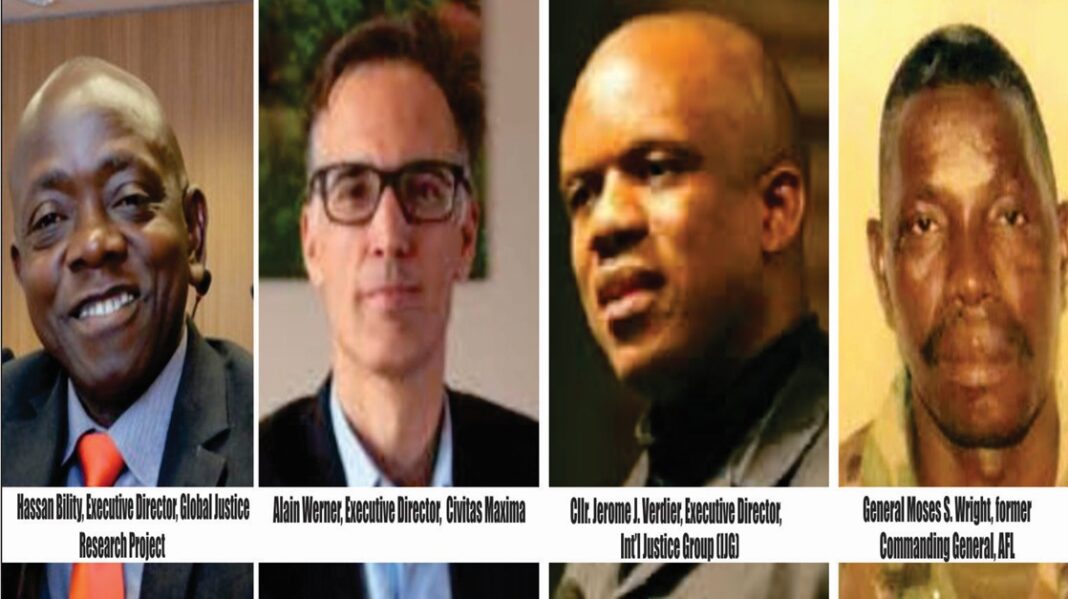
Alain Werner of Civitas Maxima in Switzerland, Hassan Bility of the Global Justice Research Project in Liberia, and the Center for Justice and Accountability in California are individuals and organizations whose activities, according to allegations reportedly raised in proceedings before the United States District Court for the Eastern District of Pennsylvania, warrant careful scrutiny regarding their handling of witnesses and evidence in Liberia’s war crimes cases. The allegations include claims that witnesses were recruited, coached, and financially compensated to provide false or misleading testimony, raising serious concerns about witness credibility, the integrity of certain prosecutions, and the possibility that the pursuit of transitional justice arising from Liberia’s Truth and Reconciliation Commission (TRC) process could be influenced by financial, institutional, or other interests.
These allegations are serious and must be investigated objectively through verifiable court records, sworn affidavits, witness statements, financial documentation, and independent evidence. They must not be treated as established facts unless supported by credible evidence and appropriate judicial findings. At the same time, allegations of witness manipulation, fabrication of evidence, or improper financial inducements should not be dismissed without a thorough and impartial examination. The fundamental question is whether the evidence presented in Liberia-related war crimes proceedings is truthful, reliable, and sufficient to establish the allegations against the accused beyond a reasonable doubt, where that is the applicable legal standard.
One individual whose reputation has allegedly been affected by these accusations is General Moses Wright, who reportedly served as a colonel and commander of the First Infantry Battalion of the Armed Forces of Liberia (AFL) during the periods of the People’s Redemption Council (PRC), the Interim National Assembly (INA), and the National Democratic Party of Liberia (NDPL) government. According to the information provided concerning his military career, Wright continued serving during the administration of President Amos C. Sawyer, who headed Liberia’s Interim Government of National Unity, and reportedly attained the rank of brigadier general and served as Commanding General of the AFL. General Wright disputes allegations connecting him to the July 1990 massacre at St. Peter’s Lutheran Church in Monrovia. According to his defense, he remained at Camp Schefflin during the relevant period and did not travel to Monrovia until a few days before the death of President Samuel K. Doe.
This account, if supported by reliable documentary and testimonial evidence, could be relevant to determining his whereabouts, responsibilities, and potential involvement in the events under investigation. A local advocate in Liberia has reportedly indicated that more than 3,000 potential witnesses may be available to challenge the allegations against Wright and provide information concerning his whereabouts, military assignments, and conduct during the conflict. The existence, identities, and firsthand knowledge of these potential witnesses must be independently verified, and their statements must be evaluated according to their credibility, consistency, and relevance. If credible evidence supports Wright’s account, it should receive fair consideration alongside the evidence presented against him. The defense should have a meaningful opportunity to present admissible evidence, challenge the credibility of opposing witnesses, and contest any testimony alleged to have been fabricated or improperly influenced.
In this regard, individuals concerned about the fairness of Liberia-related war crimes proceedings are calling on the United States District Court for the Eastern District of Pennsylvania not to impose a blanket restriction on cases brought by these nongovernmental organizations solely because allegations of misconduct have been raised. Instead, any concerns should be addressed through evidence-based judicial scrutiny, appropriate procedural safeguards, and the fair evaluation of each case on its own merits. The objective should be to ensure that legitimate cases proceed while allegations of fraud, witness manipulation, or evidentiary misconduct are investigated and addressed in accordance with the law.
The allegations surrounding the St. Peter’s Lutheran Church massacre have also involved Colonel Moses Thomas, a former commander of the Special Anti-Terrorist Unit (SATU). According to information provided in support of Thomas’s defense, former President Amos C. Sawyer, who headed Liberia’s interim government and held significant national leadership responsibilities during the relevant period, reportedly issued a letter supporting his position. Eddie Diggs, the son of Bishop Diggs of the Lutheran Church, and other individuals are also said to have provided a notarized letter in support of Colonel Thomas. According to the account provided, these documents were forwarded to members of the United States Congress and U.S. immigration authorities for consideration. The existence and contents of these documents should be verified by obtaining the original correspondence, confirming the identities and signatures of the authors, and establishing the circumstances under which the documents were prepared and submitted.
Furthermore, Cllr. Jerome J. Verdier, former Chairman of Liberia’s Truth and Reconciliation Commission, has reportedly challenged allegations against several individuals, including Colonel Moses Thomas, General Moses Wright, Mrs. Agnes Reeves Taylor, and Gibril Massaquoi. Verdier is also reportedly prepared to provide further clarification and supporting information concerning General Wright’s defense. Any such statements should be documented and assessed in accordance with applicable evidentiary rules, with particular attention to whether the information is based on firsthand knowledge, contemporaneous records, or other verifiable sources.
A letter of support, notarized statement, or public declaration does not automatically establish that an accused person is innocent or that allegations against that person are false. Equally, such material should not be disregarded merely because it supports the defense. Its evidentiary value depends on its authenticity, contents, reliability, and relevance to the specific allegations. A fair judicial process requires that potentially exculpatory evidence be examined with the same seriousness as evidence offered by the prosecution, ensuring that neither accusations nor defenses are accepted without proper scrutiny.
A comprehensive examination of these matters must also consider the historical deployment, command structures, and operational responsibilities of the Armed Forces of Liberia during the country’s periods of political instability and civil conflict. According to the military deployment information provided, the Third Battalion of the AFL reportedly had responsibilities in several locations, including the Postage Battalion Training Center, Buchanan, the Weasuah diamond-mining areas, government officials’ buildings throughout Monrovia, and Bella Yallah Prison.
The Fourth Battalion reportedly operated in southeastern Liberia, with Company A stationed in Greenville, Sinoe County; Company B assigned to Maryland County; and Company C stationed at Gleo Tambo, near the border with Côte d’Ivoire. The Fifth Battalion reportedly operated in Lofa and Nimba counties, with Company A assigned to Lofa County, Company B stationed in Namba, and Company C assigned to Tapita, Nimba County. These reported deployments may provide useful historical context for understanding the geographical distribution of military personnel, the responsibilities assigned to individual units, and the possible chain of command during the relevant periods. However, these details should not be treated as conclusively established without corroboration from official AFL records, military orders, operational reports, contemporaneous correspondence, historical documentation, and testimony from personnel who served during those years. Particular attention should be given to the dates of deployment, the distinction between permanent postings and temporary assignments, the authority exercised by individual commanders, and the movement of military units during periods of active conflict.
Establishing these facts could help investigators and courts determine whether particular officers were present at relevant locations, what responsibilities they exercised, and whether the available evidence supports or contradicts allegations concerning their conduct. Nevertheless, general information about a battalion’s deployment cannot, by itself, establish the whereabouts of a specific officer or prove that the officer did or did not participate in a particular incident. Individual responsibility must be assessed on the basis of reliable evidence relevant to the person and the alleged conduct.
Taken together, the allegations concerning false affidavits, witness compensation, possible witness coaching, and the handling of evidence raise important questions about the credibility of testimony, the integrity of war crimes investigations, and the responsibilities of organizations involved in pursuing accountability for atrocities committed during Liberia’s civil conflict. These issues deserve impartial investigation because the credibility of the evidence is central to the legitimacy of any prosecution and to public confidence in the pursuit of justice. If credible evidence establishes that an individual knowingly fabricated testimony, improperly influenced a witness, concealed material evidence, or participated in other forms of unlawful interference with judicial proceedings, that individual should be held accountable under applicable law through appropriate legal procedures.
At the same time, allegations of misconduct against named individuals and organizations must be carefully distinguished from proven findings, and no person should be declared guilty of wrongdoing solely on the basis of accusations that have not been substantiated. General Wright’s defense, the reported letters attributed to former President Amos C. Sawyer and members of the Diggs family, the claimed availability of more than 3,000 potential defense witnesses, statements attributed to former TRC Chairman Cllr. Jerome J. Verdier, and the historical information concerning AFL battalion deployments should be examined alongside the original court filings, sworn affidavits, witness statements, military records, and other relevant documentation. The public should be able to distinguish between allegations made by a party, evidence admitted in court, findings made by a judge or jury, and claims that remain unverified.
This distinction is especially important when discussing cases involving alleged atrocities, because both the victims and the accused are entitled to a process grounded in truth, fairness, and the rule of law. The United States District Court for the Eastern District of Pennsylvania should evaluate relevant evidence and allegations of misconduct according to applicable law, established evidentiary standards, and the procedural rights of all parties. Any request to restrict or scrutinize cases associated with particular organizations should be considered on its legal merits and supported by specific evidence rather than by unsupported generalizations.
Ultimately, Liberia’s pursuit of justice must serve the interests of victims, preserve the integrity of the judicial process, protect witnesses from intimidation and improper influence, and safeguard the rights of the accused. No individual should be condemned on the basis of fabricated testimony, political considerations, improper financial inducements, or unsubstantiated accusations, just as credible allegations of serious crimes should not be dismissed without a fair and thorough examination. The credibility of Liberia’s war crimes cases depends on the quality of the evidence, the independence of the investigations, the transparency of the proceedings, and the consistent application of the law. Justice for Liberia’s victims can only be strengthened by establishing the truth, holding proven offenders accountable, protecting the innocent, and ensuring that every allegation is judged on reliable evidence rather than assumption, influence, or financial interest.
Hassan Bility is alleged to have been a card-carrying member of the United Liberation Movement of Liberia for Democracy (ULIMO) and a co-chairman of its AlCOP youth wing. We are also going to expose individuals alleged to be agents of these nongovernmental organizations who are working with Bility to recruit witnesses to provide false testimony in exchange for monetary compensation, as well as examine their roles in Liberia before their departure for the United States.