By Socrates Smythe Saywon | Smart News Liberia
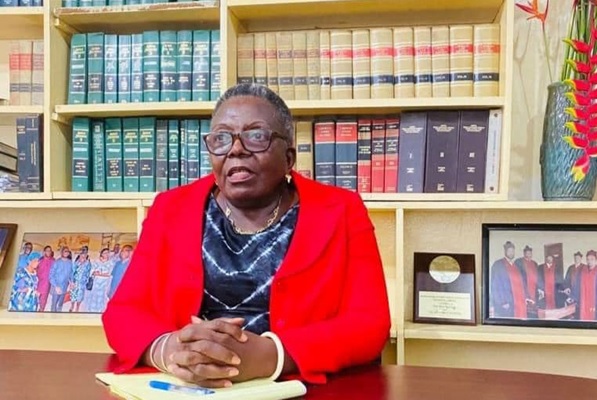
MONROVIA – Former Chief Justice Gloria Musu Scott has publicly challenged Gbarpolu County Senator Amara Konneh’s call for Senate intervention in a growing dispute involving the National Oil Company of Liberia (NOCAL) and the Liberia Petroleum Regulatory Authority (LPRA), arguing that lawmakers cannot bypass constitutional boundaries by issuing administrative directives to agencies within the Executive Branch.
Scott’s remarks, issued on Wednesday, June 3, 2026, represent a direct response to efforts by Senator Konneh and River Gee County Senator Jonathan Boye Charles Sogbie to push for the suspension and investigation of controversial petroleum agreements reportedly entered into by NOCAL with two foreign companies, GeoPartners and Searcher.
While the senators have framed their intervention as an exercise of legislative oversight, Scott contends that the Constitution does not permit lawmakers to interfere in the day-to-day operations of executive agencies.
“Good morning Senators Konneh and Sogbie. I am just reading your post,” Scott wrote before delivering a pointed constitutional rebuttal.
“The Constitution of Liberia does not give you the authority to give administrative instructions to an agency in the Executive Branch of government,” the former Chief Justice declared.
Scott further argued that the Legislature’s oversight authority, though important, has constitutional limits that must be respected.
“The exercise of constitutional legislative authority does not extend to the administrative day-to-day operations of agencies of the Executive Branch,” she wrote.
Taking her criticism a step further, Scott warned that lawmakers risk crossing constitutional lines when they attempt to directly instruct agencies outside the legislative sphere.
“With all due respect and deference, the oversight function of the Honorable Legislature is not and cannot be administrative mandates which bypass the Presidency and go directly to the lawful and legal day-to-day function of an agency in the Executive Branch,” Scott stated.
Her intervention comes just one day after Senator Konneh publicly announced that he and Senator Sogbie had called for immediate action regarding what they described as questionable petroleum agreements involving NOCAL.
“Today, my colleague, Senator Jonathan Boye Charles Sogbie of River Gee County, and I urgently called for the immediate suspension and investigation of NOCAL’s controversial oil contracts,” Konneh wrote following Senate proceedings on Tuesday.
According to Konneh, information available to lawmakers suggests that NOCAL entered into agreements with GeoPartners and Searcher that allegedly permit the companies to conduct petroleum reconnaissance activities in Liberia without obtaining licenses from the LPRA, as required under the Petroleum (Exploration and Production) Act of 2014.
“It has come to light that NOCAL has entered into agreements with two overseas firms, GeoPartners and Searcher, which allegedly permit these companies to conduct petroleum reconnaissance activities in Liberia without the required license from the LPRA,” Konneh stated.
The senator cited Section 11.1 of the Petroleum Law, which provides that companies seeking to conduct reconnaissance activities must first obtain authorization from the LPRA.
For Konneh, the issue is not merely administrative but a matter of legal compliance and institutional accountability. He argues that the Petroleum Law established clear and separate responsibilities for NOCAL and the LPRA to prevent conflicts of interest and strengthen governance in Liberia’s petroleum sector.
“When the Petroleum Law was enacted, it clearly defined the roles: NOCAL was established as a commercial state-owned enterprise, while LPRA was empowered to oversee upstream petroleum activities, including NOCAL itself,” Konneh argued.
“This structure was designed to promote accountability, prevent conflicts of interest, and align Liberia’s legal framework with international standards.”
The senator warned that if the disagreement between the two institutions remains unresolved, it could create uncertainty within Liberia’s emerging petroleum industry and potentially discourage future investment.
According to Konneh, the dispute threatens investor confidence, revenue generation, regulatory clarity, and the overall integrity of Liberia’s hydrocarbon governance framework.
“Despite this clear legal framework, NOCAL claims its actions are lawful. However, if this jurisdictional fight remains unresolved, it could set a dangerous precedent, weakening the rule of law in Liberia’s petroleum industry and hindering future legislative reforms,” he stated.
Konneh further insisted that the Senate must move quickly to address the matter before the situation escalates.
“The Senate must act decisively now to settle this dispute by preserving the law before it inflicts lasting damage on energy-sector governance,” he asserted.
The clash between Scott and Konneh has now transformed what was initially a debate over petroleum regulation into a broader constitutional discussion about the separation of powers in Liberia.
While Konneh and Sogbie maintain that legislative intervention is necessary to ensure compliance with the Petroleum Law and protect the country’s natural resources, Scott argues that lawmakers must be careful not to exceed their constitutional mandate by directing executive agencies in the performance of their duties.