By Staff Writer | Smart News Liberia
NEW YORK – Liberia has joined seven other members of the United Nations Security Council in calling for stronger and more coordinated action to address the growing links between climate change, resource pressures and security challenges in Libya.
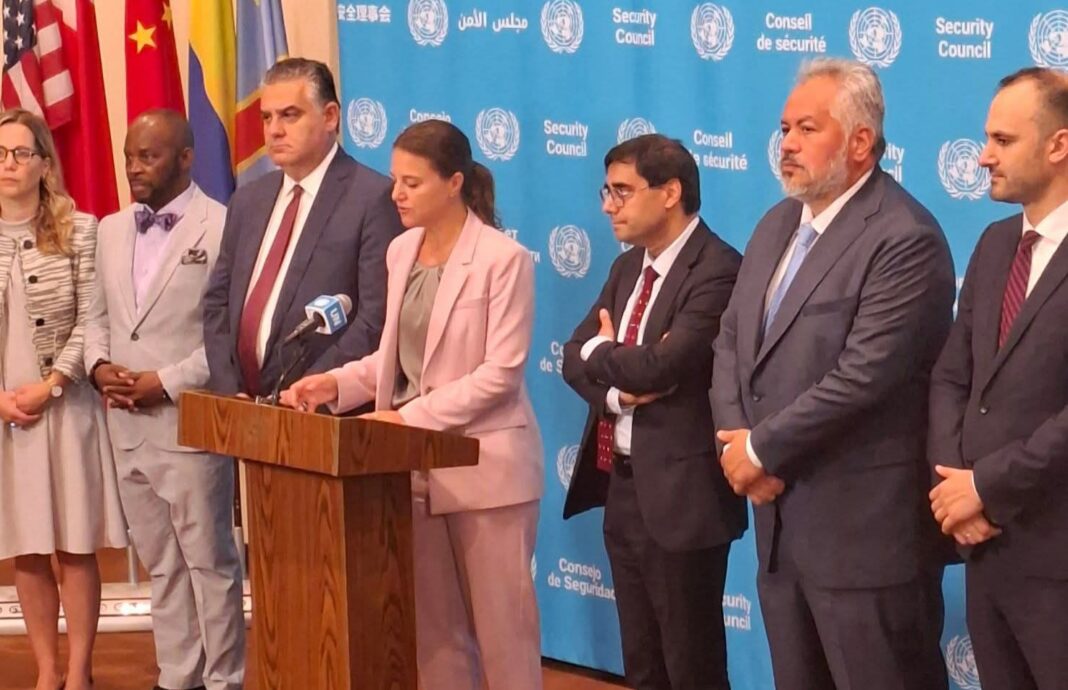
Liberia, Colombia, Denmark, France, Greece, Latvia, Panama and the United Kingdom issued a joint statement Tuesday during a Security Council stakeout, expressing concern over the convergence of climate and security risks facing Libya amid years of political fragmentation.
The countries warned that climate pressures are increasingly undermining stability and contributing to competition over already strained resources, particularly water.
Representing Liberia at the stakeout was Counsellor Aloysius T. Jappah, Political Coordinator of Liberia’s UN Security Council Team. The statement was delivered to UN reporters alongside the Deputy Permanent Representative of Denmark to the United Nations and Ambassador Sandra Jensen Landi.
The Security Council members urged Libyan authorities to strengthen national risk management by improving coordination and building stronger institutions capable of addressing climate adaptation, conflict prevention and disaster management through a unified approach.
The group also called for accelerated international support for implementation of Libya’s National Water Security Strategy for 2026 to 2050, describing the strategy as a practical roadmap for addressing aquifer depletion, infrastructure deficiencies and growing demand for water.
The signatories stressed that effective management of Libya’s water resources will require stronger and more inclusive local governance.
They called for women, young people and local communities to have meaningful participation in decisions concerning shared water resources, emphasizing that local involvement is essential to building sustainable solutions.
The joint statement also called for targeted support to strengthen resilient livelihoods for communities increasingly exposed to climate-driven instability.
The Security Council members said climate pressures should be treated as part of the broader peace and security landscape, particularly in countries where political fragmentation and institutional weaknesses can intensify competition over natural resources.
For Liberia, the intervention reflects its continued engagement in international efforts to address emerging threats to peace and security through prevention, cooperation and sustainable development.
The eight Security Council members pledged continued support for Libyan-led efforts and international cooperation aimed at implementing strategic reforms through adequately funded and coordinated actions.
The statement underscores growing international recognition that Libya’s security challenges cannot be addressed separately from its environmental and resource pressures.
With climate change placing additional strain on water supplies, livelihoods and local communities, the Security Council members are urging a coordinated response that combines climate resilience, stronger institutions, inclusive governance and conflict prevention.
Liberia’s participation in the joint position further highlights its role in supporting multilateral approaches to emerging peace and security challenges during its tenure on the UN Security Council.