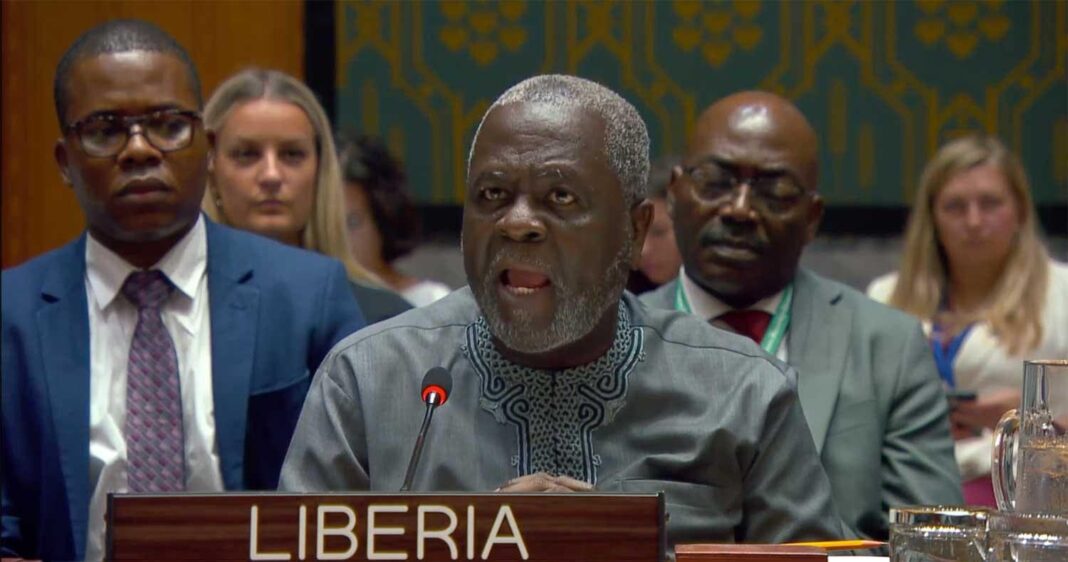
MONROVIA, LIBERIA – Liberia has taken the plight of seafarers directly into the United Nations Security Council’s debate over the war in Ukraine, warning that attacks on commercial vessels and ports are turning the Black Sea into a growing danger zone for civilians whose only role is to keep global trade and food supplies moving.
Liberia’s Permanent Representative to the United Nations, Ambassador Lewis Garseedah Brown II, used the Security Council’s August 24 meeting on Ukraine to make a broader argument: the international community must recognize merchant crews, commercial vessels and ports as civilians deserving protection under international law.
The intervention was particularly significant for Liberia because of the country’s enormous role in global shipping.
Brown told the Council that the Liberian flag covers more than 300 million gross tons of shipping, representing roughly one in six ocean going vessels around the world.
That maritime presence, he said, means Liberia is not a distant observer of the Ukraine conflict.
The war is reaching Liberian citizens and foreign seafarers aboard Liberian flagged vessels operating in the Black Sea.
Brown cited a series of incidents involving Liberian flagged ships.
In July, a strike on a Liberian flagged merchant vessel in the Black Sea killed its master, according to the statement.
Another Liberian flagged vessel anchored at Odesa was struck three times in August, while a Liberian flagged bulk carrier approaching a Russian port to load grain caught fire, forcing its crew to evacuate.
For Liberia, the incidents reveal a disturbing expansion of the war’s impact.
“These are the world’s most invisible civilians,” Brown told the Council, referring to seafarers operating under the Liberian flag.
He emphasized that the crews aboard the vessels are multinational and include Filipinos, Syrians, Indians, Ukrainians and Egyptians.
They are not soldiers.
They are workers transporting commodities between countries, including food destined for nations that have no involvement in the war.
Brown therefore urged the Council to apply the protections afforded to civilians to commercial shipping and maritime workers caught in the conflict.
He invoked Resolution 2417, which addresses the protection of civilians and the relationship between armed conflict and hunger, warning that attacks on shipping and ports can quickly become a global food security problem.
His warning carried particular weight for Africa, where disruptions to grain and other food shipments can affect countries far removed from the battlefield.
“A corn carrier burning within sight of shore” is what food under fire looks like, Brown told the Council, turning an abstract discussion about food security into a vivid picture of the consequences of attacks on commercial shipping.
The Liberian envoy also connected the safety of shipping to the broader principles of the UN Charter.
He reaffirmed Liberia’s support for sovereignty, territorial integrity and political independence, while insisting that civilian protection must remain universal.
But Brown argued that the international community must move beyond statements of principle.
“Principles without action to uphold them are mere decorations,” he said.
Liberia therefore proposed an immediate and unconditional ceasefire as the most appropriate response.
But recognizing the difficulty of achieving a comprehensive ceasefire immediately, Brown offered a narrower alternative that could be implemented sooner.
He called for a moratorium on long range strikes against populated areas and attacks against shipping and ports.
Such an arrangement, he argued, would target some of the areas where civilian harm is most concentrated while creating a measure that could be independently monitored and verified.
Liberia also urged the international community to pursue practical areas of agreement even where broader political consensus remains impossible.
Brown cited humanitarian corridors, medical evacuations, prisoner exchanges, the return of children and measures to protect the Zaporizhzhia nuclear power plant.
He argued that such limited agreements could become building blocks toward a broader settlement.
Liberia further called on the international community to support credible peace initiatives without becoming preoccupied with which country or political actor receives credit for ending the war.
“We do not care who ends this war,” Brown said in substance. “We care simply that it ends.”
His argument was shaped by Liberia’s own painful history.
The country’s civil war once consumed international attention, leaving Liberia repeatedly before the Security Council as a conflict requiring international intervention.
Brown recalled that Liberia’s eventual peace was reached through negotiations in Accra, Ghana, in 2003, where adversaries who had deep reasons to distrust and oppose each other nevertheless came to a negotiating table.
The Liberian experience, he suggested, demonstrates that peace negotiations become possible when the parties recognize that continued war carries a greater cost than compromise.
The longer negotiations are delayed, the greater that human cost becomes.
Brown warned that the world risks becoming accustomed to counting casualties without taking sufficient action to stop them.
He said the Security Council should not measure its success merely by the accuracy of its casualty reports but by its ability to reduce and ultimately end the loss of life.