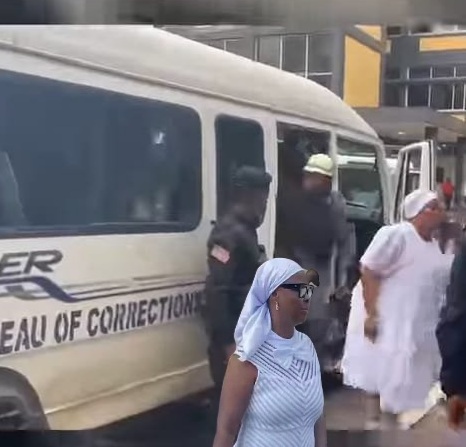
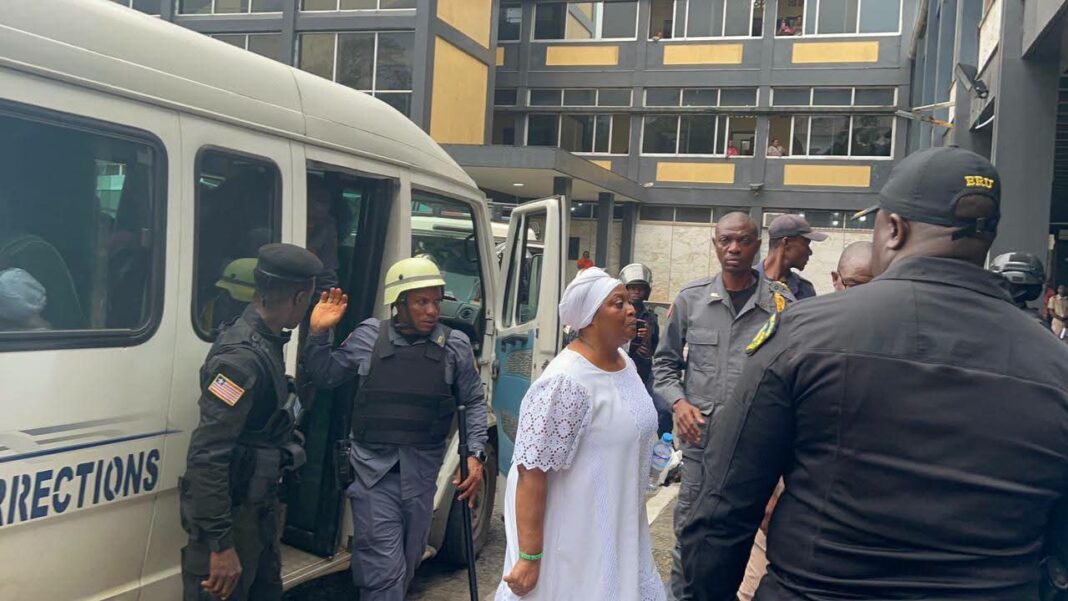
MONROVIA – Former Vice President Jewel Howard Taylor appeared before the Monrovia City Court on Friday under heavy police escort as prosecutors advanced a preliminary hearing in the sprawling drug related investigation involving an alleged international narcotics network.
Taylor, who has been held at the Monrovia Central Prison, was brought to court amid heightened security as the prosecution called a senior Liberia National Police investigator to the witness stand.
The witness, LNP Assistant Commissioner of Crime Services Raphael Wilson, delivered a lengthy and highly consequential account of the investigation, telling the court that investigators had traced elements of the alleged narcotics network back to activities beginning in 2021.
Wilson told the court that his investigation identified several individuals allegedly connected to the network, including persons she identified as Nicholas, Tony and Michael, with Nicholas allegedly regarded as a kingpin.
According to the police witness, the individuals had previously traveled to Liberia to conduct business but allegedly encountered difficulties during their earlier visit.
Wilson testified that the group later met Bashiru Kanteh in Dubai and explained that they were reluctant to return to Liberia unless they could secure protection or assistance from a senior government official.
The witness said the nature of the group’s alleged business was not initially disclosed to Kanteh.
Dubai meeting allegedly opened door to Liberia
Wilson told the court that Kanteh subsequently connected the group with Taylor after discussions about obtaining protection for their activities in Liberia.
According to his testimony, Taylor traveled from Monrovia through Accra to Dubai as part of a five person delegation.
The delegation, Wilson said, included Taylor’s sister, Noah Howard, and Bernice Taylor, although she maintained that the two women were not participants in the substantive discussions allegedly held between Taylor, Kanteh and members of the group.
It was during those discussions, Wilson testified, that the group allegedly disclosed that its intended business involved using Liberia as a transit point for illegal drugs.
Wilson further alleged that Kanteh had represented that he could connect the group with a senior Liberian official who could facilitate their operations.
The investigator told the court that Taylor subsequently became involved in the discussions and allegedly received money from the group.
He also claimed that investigators possess photographs, videos and other materials that allegedly show Taylor, Kanteh and members of the group together, including footage from a yacht trip.
Alleged political financing claims emerge
The most dramatic portion of Wilson’s testimony involved allegations concerning Liberia’s political future.
According to the police witness, one of the alleged cartel members asked Taylor during a conversation whether she intended to contest the presidency.
Wilson testified that Taylor allegedly did not directly answer yes or no but instead discussed a financial amount, which she said was initially put at US$100 million.
The witness further alleged that members of the group offered as much as US$250 million to support her political campaign.
Wilson then made an extraordinary allegation concerning what she claimed was discussed about former President George Weah.
According to the testimony, Taylor allegedly discussed a plan under which Weah would remain in power for three years before being assassinated.
The witness further alleged that the body would then be handed over to individuals she described in court as the “the Kru people.”
The allegations were presented as part of the investigator’s account of evidence gathered during the investigation. No independent determination of the allegations has been made by the court.
Investigators cite phone evidence
Wilson also told the court that investigators obtained electronic communications allegedly exchanged between Taylor and Kanteh.
According to the witness, Kanteh voluntarily surrendered his mobile phone to investigators and permitted them to examine communications contained on the device.
Wilson said investigators subsequently extracted what he described as text messages, WhatsApp conversations, photographs and other materials allegedly involving Taylor and Kanteh.
The investigator told the court that some of the extracted material was subsequently presented during the proceedings.
The evidence reportedly triggered an immediate legal challenge from Taylor’s defense team.
Wilson said Taylor’s lawyers examined a single sheet containing extracted messages for approximately seven to eight minutes before raising objections.
Defense challenges admissibility
The defense reportedly argued that the presentation of the communications raised constitutional and legal concerns, including an alleged violation of Taylor’s rights.
The defense’s challenge introduces a potentially significant legal question in the preliminary proceedings: whether electronic communications obtained from a third party’s device were lawfully acquired and whether such material can properly be relied upon at this stage of the case.
The court’s handling of the evidence could therefore become a critical component of the proceedings as prosecutors seek to establish the basis for the allegations against the former vice president.
Friday’s hearing was not a determination of Taylor’s guilt or innocence.
Instead, the preliminary proceedings are expected to test the prosecution’s evidence and determine whether the allegations presented against the accused warrant further judicial proceedings.
Taylor has previously faced intense public scrutiny since being detained in connection with the wider investigation into the alleged international narcotics network.
The case has attracted national attention because of the scale of the alleged drug operation and the identities of individuals reportedly implicated in the investigation.
As the proceedings continue, the credibility of the police testimony, the authenticity and legality of the alleged electronic evidence, and the prosecution’s ability to independently corroborate the investigator’s claims are likely to remain central to the case.
For now, the allegations presented in court remain allegations, and Taylor retains the presumption of innocence unless and until a competent court determines otherwise.