
There is something profoundly symbolic about Liberia celebrating its 179th National Flag Day at a time when the country is being asked to confront some of its most difficult national challenges.
The Lone Star is flying.
But the more important question is whether the nation beneath that flag is living up to what the flag represents.
President Joseph Nyuma Boakai’s Flag Day address offered an opportunity to consider that question seriously.
His message was not simply about history.
It was about responsibility.
It was about the relationship between national identity and national conduct.
And perhaps most importantly, it was about whether Liberians are prepared to build the country they so often celebrate in speeches, songs and ceremonies.
The President recalled that Liberia’s flag was created in 1847 by seven courageous women led by Susana Lewis.
That story deserves greater prominence in Liberia’s national consciousness because it demonstrates that nation-building has always required the participation of people who may not occupy the most powerful positions.
The women who stitched the flag did not simply create a piece of national fabric.
They helped give physical expression to an emerging national identity.
Today, generations later, the responsibility has changed hands.
The question is no longer who will stitch the flag.
The question is who will protect what it represents.
That responsibility belongs to every Liberian.
It belongs to politicians.
It belongs to civil servants.
It belongs to teachers.
It belongs to security officers.
It belongs to business people.
It belongs to journalists.
It belongs to religious and traditional leaders.
And it belongs particularly to young Liberians, because they will inherit the consequences of decisions being made today.
President Boakai’s decision to place young people at the center of his Flag Day message was therefore appropriate.
Liberia cannot build a sustainable future while treating young people simply as spectators during national celebrations.
Young Liberians must become participants in the country’s development.
But participation requires preparation.
This is where the President’s announcement concerning the reintroduction of civics education becomes important.
For a country with Liberia’s complicated history, civic education is not a luxury.
It is a necessity.
Young Liberians should understand why Liberia was founded, how the Constitution functions, what their rights are, what their responsibilities are and why national institutions matter.
They should understand that democracy is more than elections.
Democracy requires tolerance.
It requires accountability.
It requires respect for opposing views.
It requires peaceful political competition.
It requires citizens who are willing to defend institutions even when those institutions make decisions they dislike.
Without that foundation, young people can easily become instruments in political conflicts they do not fully understand.
And Liberia has experienced enough of that already.
The President’s call for young people to reject drugs is therefore another critical part of the national conversation.
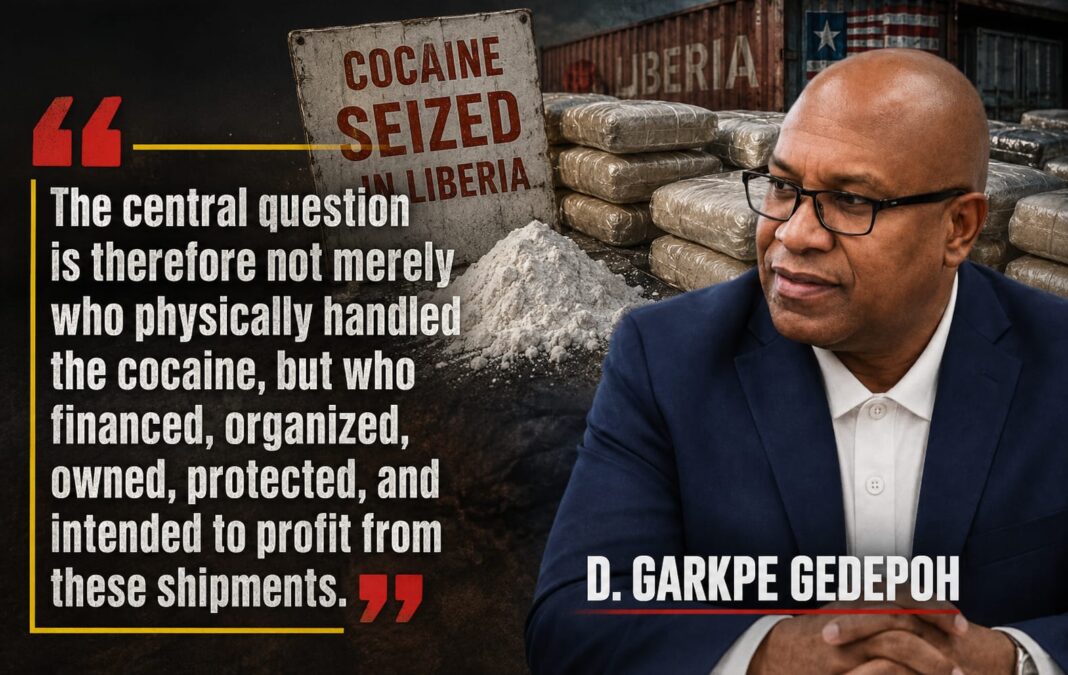
The recent cocaine seizures have provided a sobering demonstration of the scale of the narcotics challenge facing Liberia.
The discovery of massive quantities of cocaine, including a shipment valued at hundreds of millions of dollars, should force the country to ask difficult questions.
How are such quantities reaching Liberia?
Who is financing the networks?
How are the drugs transported?
Who protects the traffickers?
Are institutions being compromised?
And most importantly, what is being done to protect young Liberians from becoming consumers, couriers, dealers or victims of the narcotics economy?
These questions cannot be answered through political rhetoric.
They require professional investigations, strong institutions, credible prosecutions and a justice system capable of following evidence wherever it leads.
The drug crisis also exposes the connection between national security and economic opportunity.
A young person with education, skills, employment and hope has more reason to reject criminal networks.
A young person without opportunities can become vulnerable to traffickers who offer quick money.
Therefore, Liberia’s anti-drug strategy cannot depend exclusively on arrests and seizures.
Law enforcement is necessary.
But prevention is equally important.
Education is necessary.
Employment is necessary.
Rehabilitation is necessary.
Community engagement is necessary.
And strong families and institutions are necessary.
This is why President Boakai’s broader development message matters.
He spoke about roads, electricity, healthcare, education and opportunities.
Those are not separate from national identity.
They are the practical expression of it.
What does the Liberian flag mean to a mother whose child cannot access adequate healthcare?
What does it mean to a student who attends school without sufficient learning materials?
What does it mean to a farmer who cannot easily transport produce to market?
What does it mean to a young graduate who has no realistic pathway into employment?
National pride becomes much stronger when citizens can connect it to their daily lives.
The flag should therefore become a symbol of service delivery.
When electricity reaches a community, the Lone Star should mean something.
When a road connects a remote county to a market, the Lone Star should mean something.
When a child receives quality education, the Lone Star should mean something.
When a patient receives competent medical care, the Lone Star should mean something.
When a citizen receives equal treatment before the law, the Lone Star should mean something.
That is the standard Liberia should demand from itself.
The President also made a difficult but necessary observation: adults cannot demand patriotism from children while failing to practice it themselves.
That statement deserves to be repeated.
Liberian children should not be taught that corruption is wrong while watching adults become wealthy through corruption.
They should not be taught to obey the law while seeing powerful people evade accountability.
They should not be told to reject tribalism while political leaders exploit ethnic identities.
They should not be encouraged to respect national institutions while adults deliberately weaken those institutions for personal or political advantage.
Children learn as much from what adults do as from what adults say.
If Liberia wants patriotic young people, Liberia must produce patriotic examples.
If Liberia wants honest citizens, leaders must demonstrate integrity.
If Liberia wants respect for the law, those in authority must submit themselves to the law.
If Liberia wants unity, political leaders must stop treating every disagreement as an existential conflict.
This is the real test of national leadership.
A president can deliver an inspiring speech.
A minister can give a powerful address.
A school can organize an impressive parade.
But the strength of Liberia’s national identity will ultimately be measured by what happens after the microphones are switched off.
The 179th Flag Day should therefore be viewed as a national audit of our values.
Are we more united?
Are we more accountable?
Are our institutions stronger?
Are our young people safer?
Are citizens more confident in the future?
Are we doing enough to fight corruption and criminality?
Are we providing meaningful opportunities for the next generation?
These are the questions that matter.
The Lone Star has survived nearly two centuries.
It has flown through periods of prosperity, political instability, military rule, civil conflict, democratic transition and reconstruction.
It has witnessed Liberia at its best and at its worst.
But the flag itself cannot build Liberia.
Liberians must.
The President’s call to “Think Liberia, Love Liberia, and together Build Liberia” should therefore be understood as a collective responsibility rather than a government slogan.
Thinking Liberia means thinking beyond ourselves.
Loving Liberia means loving all Liberians, including those with whom we disagree.
Building Liberia means accepting that progress requires sacrifice and accountability.
The country has another generation waiting.
They deserve a Liberia where the national flag is not merely a reminder of sovereignty but an assurance of opportunity.
They deserve a Liberia where patriotism does not mean silence but responsible citizenship.
They deserve a Liberia where justice is credible, education is meaningful, public institutions are respected and national resources serve the national interest.
And they deserve a Liberia where the Lone Star represents hope rather than merely history.
As the country celebrates 179 years of its national flag, Liberia should remember that the greatest tribute to the Lone Star is not how proudly we salute it.
The greatest tribute is how faithfully we live beneath it.
That is the real work of nation-building.
And that work belongs to all of us.