By Socrates Smythe Saywon | Smart News Liberia
MONROVIA – The University of Liberia on Monday, June 8, 2026, celebrated the enduring legacy of former Interim President Dr. Amos Claudius Sawyer while issuing a renewed call for academic excellence, ethical leadership, and national transformation during the 2026 Dr. Amos C. Sawyer Academic Lecture Series.
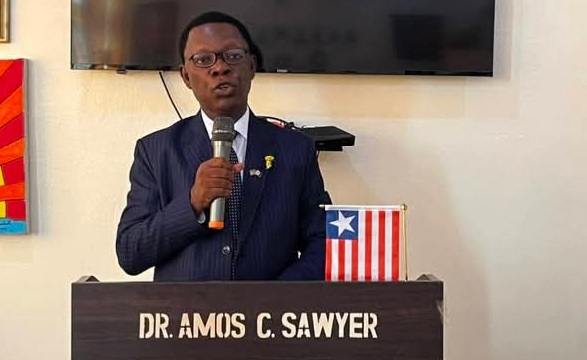
Speaking at the Thelma E. Duncan Sawyer Faculty Lounge on the University’s Fendall Campus, Associate Professor Dr. Josephus M. Gray, Doyen of Deans and Dean of the Amos C. Sawyer College of Social Sciences and Humanities, challenged students and scholars to embrace the values that defined Dr. Sawyer’s life and use education as a powerful tool for societal change.
“It is with immense honor that I extend a heartfelt welcome to our esteemed President of the University of Liberia, our respected faculty members, dedicated students, and distinguished guests gathered for the Dr. Amos C. Sawyer Academic Lecture Series,” Dr. Gray said as he opened the event.
The lecture series, organized by the leadership of the Amos C. Sawyer College Student Association under the auspices of the Dean’s Office, brought together members of the university community, academics, students, and guests to reflect on the life, vision, and contributions of one of Liberia’s most respected scholars, statesmen, and democratic reformers.
Dr. Gray said the gathering was not merely about commemorating a historic figure but about inspiring a new generation of Liberians to pursue academic excellence, critical thinking, integrity, and responsible leadership.
“Your presence here today highlights your unwavering commitment to education and your desire to make a meaningful impact in the lives of our students, all while celebrating the lasting legacy of the late Prof. Dr. Amos C. Sawyer,” he noted.
According to Dr. Gray, Dr. Sawyer’s legacy continues to serve as a guiding light for students and future leaders seeking to transform Liberia through knowledge, service, and principled leadership. He stressed that universities must remain centers of intellectual engagement where ideas are cultivated and solutions to national challenges are developed.
“Today, we come together not just to engage with one another but to share knowledge, spark ideas, stimulate dialogue, and reinforce the academic spirit that embodies Dr. Sawyer’s legacy through his life, work, contributions, and vision,” he declared.
A major highlight of the event was the participation of keynote speaker Professor Dr. D. Elliott Wreh-Wilson, former President of Tubman University and Emeritus Professor at Edinboro University in Pennsylvania. Dr. Gray described him as uniquely qualified to address the gathering because of his longstanding academic relationship with both Dr. Sawyer and the late Professor Wolor Torpor.
“We are truly fortunate to have you share your insights with us today, enriched by your collaboration with Prof. Dr. Sawyer and Prof. Dr. Wolor Torpor,” Gray said.
The Dean also used the occasion to reaffirm the University’s commitment to preserving and advancing the vision behind the annual lecture series. Reflecting on the launch of the inaugural event in June 2024, he recalled a promise made to the Dr. Amos C. Sawyer Board of Directors, the Sawyer Educational Foundation, and the Sawyer family.
“On June 13, 2024, during the official launch of the inaugural Dr. Amos C. Sawyer Annual Lecture Series, I assured the Dr. Amos C. Sawyer Board of Directors, the Sawyer Educational Foundation, and the Sawyer Family of our unwavering commitment to keeping this dream alive,” he stated.
Dr. Gray emphasized that placing ownership of the initiative in the hands of the Amos C. Sawyer College Student Association was a deliberate effort to ensure that students become active custodians of Dr. Sawyer’s legacy. He praised the association for embracing the responsibility with enthusiasm and commitment.
The event attracted students from across the University’s academic divisions, including the College of Engineering, the William R. Tolbert College of Agriculture and Forestry, the College of Science and Technology, the William V.S. Tubman College of Education, and the College of Health Sciences.
For Dr. Gray, the broad participation demonstrated that Dr. Sawyer’s influence extends beyond a single discipline and continues to inspire students throughout the institution to pursue excellence in their respective fields.
Drawing inspiration from remarks by renowned Liberian diplomat and businessman Professor Ambassador Dew Tuan-Wleh Mayson, a close associate of Dr. Sawyer, Gray reflected on the significance of a life dedicated to purpose and service.
Quoting Mayson, he said, “I know that one can only live once. If you live well, once is enough.”
He argued that Dr. Sawyer exemplified that principle through a lifetime of scholarship, public service, and unwavering commitment to Liberia’s democratic development.
“Dr. Sawyer lived well and lived rightly, which is why we continue to nurture our optimism,” Gray said.
The University administrator further highlighted what he described as the rare combination of intelligence and integrity that made Dr. Sawyer an exceptional leader. Referencing observations made by Ambassador Mayson, Gray noted that while many intellectuals dedicate their lives to interpreting society, Dr. Sawyer chose to use his knowledge to improve it.
“Dr. Sawyer chose to use his education not just to interpret and analyze the world but, more importantly, to create meaningful change within it,” he emphasized.
As the lecture series commenced, Dr. Gray challenged students to uphold the standards of excellence exemplified by Dr. Sawyer and to recognize education as a catalyst for national development and social transformation.
His remarks reinforced the University of Liberia’s determination to preserve the memory of one of Liberia’s most influential intellectual figures while inspiring future generations to embrace scholarship, integrity, leadership, and service. The message was clear: honoring Dr. Amos Sawyer’s legacy requires more than remembrance. It demands a commitment to excellence and a willingness to use education to transform society for the better.