Official records show that the US$36.6 million Chinese-funded project was formally agreed upon in 2019 under former President George Weah, while President Joseph Boakai launched construction in September 2025.
MONROVIA, LIBERIA — Who deserves credit for Liberia’s two long-awaited overpass bridges along Tubman Boulevard in Congo Town: former President Ellen Johnson Sirleaf, former President George Manneh Weah, or incumbent President Joseph Nyuma Boakai?
The question has resurfaced following an explanation attributed to political commentator Henry Costa, who has challenged Liberians to examine the historical record rather than allow political loyalties to determine the facts.
Costa’s central argument is that Liberians should distinguish between the initial conception of a development project, the signing of the agreements that secured it, and the administration that eventually commenced construction.
A review of official Liberian government records supports a clear timeline: the agreement committing Chinese grant funding for the two bridges was signed on September 9, 2019, during the Weah administration, while the Boakai administration officially broke ground on September 2, 2025.
The records also establish that the project was implemented through cooperation between Liberia and China, with the Chinese government providing grant assistance.
ELLEN JOHNSON SIRLEAF: THE EARLY CONCEPTION
The history of the overpass project has been linked to traffic congestion along Tubman Boulevard, particularly around the Ministerial Complex and the SKD Boulevard junction in Congo Town.
According to the account circulated by Costa, the Sirleaf administration initiated discussions and explored the possibility of obtaining Chinese assistance for the construction of the bridges.
However, the critical distinction is whether the project had reached the stage of a binding funding agreement before Sirleaf left office in January 2018.
The publicly available official records reviewed for this report establish that the decisive exchange of letters committing the Chinese grant was signed in September 2019, after the Weah administration took office.
Consequently, while the earlier administration may have contributed to the project’s conception and preparatory discussions, the documented funding commitment came later.
GEORGE WEAH: THE GOVERNMENT THAT SIGNED THE FUNDING AGREEMENT
Official records from Liberia’s Ministry of Foreign Affairs identify September 9, 2019, as the date the Liberian and Chinese governments signed the agreement for the construction of the two overpass bridges.
The agreement was signed by then-Foreign Minister Gbehzohngar Milton Findley on behalf of Liberia and Chinese Ambassador Fu Jijun on behalf of China.
According to the Ministry of Foreign Affairs, the agreement covered two bridges intended to reduce traffic congestion and protect lives and property along Tubman Boulevard.
The Chinese government committed 261.7 million yuan in grant funding, valued at approximately US$36.6 million under the current project valuation announced by the Liberian government.
The agreement followed an earlier Economic and Technical Cooperation Agreement signed in September 2018, which provided a broader Chinese grant package.
Official documentation from the Ministry of Public Works further confirms that an implementation agreement was signed on June 8, 2021, during the Weah administration.
That agreement provided the framework for implementing the project based on the 2019 exchange of letters.
These documents are important because they distinguish the administration that formally secured the project agreement from the administration that subsequently commenced construction.
The available records therefore establish that the Weah administration signed the principal funding agreement and a subsequent implementation agreement for the two overpasses.
However, the assertion that political tensions between the United States and China caused the project’s delay or suspension would require additional documentary evidence before it could be presented as an established fact.
BOAKAI: THE ADMINISTRATION THAT COMMENCED CONSTRUCTION
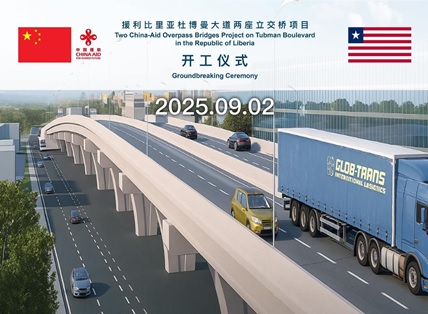
On September 2, 2025, President Joseph Nyuma Boakai officially broke ground for the construction of the two Chinese-funded overpass bridges.
The ceremony, held near the Edward B. Kesselly Ministerial Complex, marked the formal launch of construction under the current administration.
According to the Ministry of Public Works, the project has a total value of approximately US$36.6 million, equivalent to 261.7 million Chinese yuan, and is funded through Chinese government grant assistance.
The project includes two overpasses:
– West Overpass: Located near the Ministerial Complex, comprising an approximately 300-metre bridge and associated approach roads.
– East Overpass: Located at the SKD Boulevard junction, comprising an approximately 180-metre bridge and associated approach roads.
The construction period was announced as 24 months, running from September 2025 to August 2027.
The government has presented the project as part of its infrastructure development programme, emphasizing the potential benefits of reduced traffic congestion, improved road safety, and increased economic activity.
Boakai’s administration therefore has a documented role in moving the project into its construction phase.
But the September 2025 groundbreaking does not change the historical date on which the principal funding agreement was signed.
THE POLITICAL QUESTION: SHOULD ONE ADMINISTRATION TAKE ALL THE CREDIT?
The controversy highlights a recurring problem in Liberian politics: the tendency of successive administrations to claim ownership of major development projects without adequately acknowledging the contributions of their predecessors.
When one government initiates discussions, another secures the funding agreement, and a third begins construction, the historical record should reflect those different responsibilities.
In this case, the available documentation establishes three important milestones.
First, the Sirleaf administration is associated with the earlier conception and discussions surrounding the project, although the extent of its formal preparatory work requires further documentary verification.
Second, the Weah administration signed the September 2019 exchange of letters committing Chinese grant funding and the subsequent implementation agreement in June 2021.
Third, the Boakai administration officially launched construction in September 2025.
These are distinct contributions, and they should not be confused.
The project is funded through Chinese government assistance, meaning that its financing should not be presented as an exclusively Liberian government-funded undertaking.
At the same time, recognizing China’s financial contribution does not diminish the importance of the Liberian officials and administrations involved in negotiating, formalizing, and implementing the agreement.
WHAT LIBERIANS SHOULD DEMAND
Beyond the political debate over who deserves credit, citizens have a legitimate interest in the project’s delivery.
The government and the implementing authorities should provide regular updates on construction progress, expenditure and grant arrangements, employment opportunities for Liberians, construction quality, and the project’s expected completion date.
The public also deserves clarity on any delays between the original agreements and the commencement of construction.
These questions are more consequential than political arguments over who should receive the most praise.
Liberians need safe and reliable infrastructure, and they have the right to know whether public commitments are being fulfilled.
THE DOCUMENTS TELL THE STORY
Henry Costa’s argument raises a legitimate question about historical accuracy in Liberia’s development debate.
The official record confirms that the principal agreement committing Chinese grant funding for the Congo Town overpasses was signed in 2019 under former President George Weah. A subsequent implementation agreement followed in 2021, also under his administration.
President Joseph Boakai officially launched construction in September 2025, while the earlier history of the project’s conception and preliminary discussions requires separate verification.
The fairest account is therefore one that recognizes the documented roles of the successive administrations without allowing political allegiance to replace evidence.
The central fact is clear: the Weah administration signed the principal funding agreement, and the Boakai administration commenced construction. Liberia’s development history should acknowledge both milestones while holding the current authorities accountable for delivering the completed bridges.