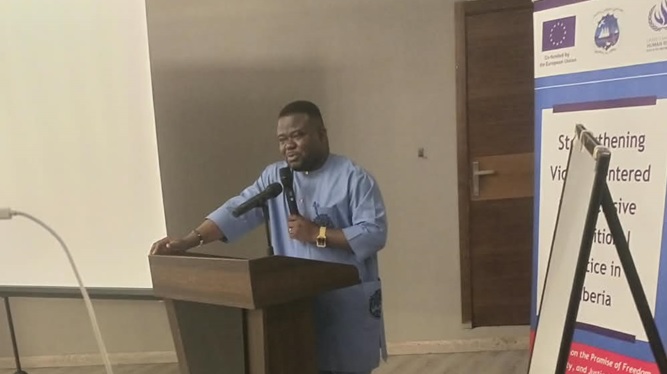
MONROVIA, LIBERIA – Witness Protection Agency Director Atty. Teklo Maxwell Grigsby II has challenged Liberia’s justice institutions to build a system in which victims, witnesses and whistleblowers can provide information and testimony without fear of intimidation, retaliation or exposure, warning that a justice system cannot effectively prosecute crime when people are afraid to speak.
Grigsby made the statement on Thursday, September 17, 2026, at Mamba Point Hotel in Monrovia during a one day dialogue on victims, witnesses and whistleblowers’ judicial protection in Liberia. The event, organized by the Witness Protection Agency with support from the Office of the United Nations High Commissioner for Human Rights, brought together justice sector professionals and other stakeholders to examine international lessons and best practices that could inform implementation and strengthening of Liberia’s human rights based judicial protection framework.
The WPA Director described the gathering as more than a conventional workshop or training. He said it was an opportunity for Liberia to reflect on how people who become involved in criminal proceedings are treated, particularly individuals whose testimony or information can help prosecutors establish criminal responsibility.
Grigsby argued that no person who comes forward to testify in a criminal case should have to live in fear because of that decision. He questioned how a government that collects taxes and funds law enforcement institutions could allow criminals to intimidate people who are prepared to testify against wrongdoing.
His central argument was that witness protection is not an optional addition to criminal justice but an essential condition for the justice system to function. If witnesses fear retaliation, intimidation or exposure, they may refuse to cooperate, withdraw information or avoid appearing in court, potentially weakening cases before they are fully tested through the judicial process.
The WPA’s mandate is built around protecting witnesses and whistleblowers from threats, political harm, coercion, intimidation and retaliation during investigations, hearings and after trial. The Agency’s stated protection framework includes identity and physical protection, temporary relocation, safe housing, psychosocial counselling, legal assistance, continued threat assessment and reintegration where necessary.
Grigsby also drew attention to whistleblower protection, saying people who expose corruption or other wrongdoing must not be punished simply because they made protected disclosures. He said the existing legal framework provides protection against retaliation and indicated that the Agency is preparing to address complaints involving retaliatory conduct.
According to Grigsby, the Agency, working with the Ministry of Justice and the Liberia Anti-Corruption Commission, is expected to begin hearing complaints involving alleged retaliatory actions, including matters involving officials of the current administration. The remarks do not establish that any named official committed retaliation, but signal that the WPA intends to apply the protection framework to complaints regardless of the status of the persons involved.
The WPA has previously said that Liberia’s Whistleblower Act of 2021 protects individuals who make protected disclosures and that unauthorized disclosure of protected identities can constitute an offense. In June 2026, the Agency publicly condemned the disclosure of protected identities connected to a major drug investigation and called for enforcement of the relevant provisions of the Whistleblower Act.
The Director also used the gathering to emphasize the relationship between whistleblowing, corruption investigations and Liberia’s natural resources. He argued that citizens who provide information about corruption in the public or private sector should have confidence that the state will protect their identities and ensure that their disclosures are properly investigated.
His remarks come as Liberia is already considering amendments to its witness protection and whistleblower laws. Earlier stakeholder consultations examined weaknesses in confidentiality protections, eligibility for protection, institutional coordination, retaliation, digital threats and incentive mechanisms for people who report corruption and other serious crimes.
The government’s reform process has also included proposals to increase incentives for reporting persons. The WPA has reported that proposed amendments could increase rewards from five percent to 10 percent in certain circumstances and introduce other incentive mechanisms intended to encourage disclosures concerning corruption, organized crime, smuggling and other serious offenses.
Grigsby urged participants to examine the practical realities facing witnesses once they enter the court system. He raised questions about where witnesses sit, how they enter court, the level of their exposure, how they travel to court and what mechanisms exist to protect them before, during and after testimony.
He said the Agency deliberately invited participants from outside Monrovia to ensure that the discussion included experiences from Liberia’s counties. He also indicated that the WPA intends to continue engagement with courts across the country as it develops its protection system.
The Director thanked the Office of the United Nations High Commissioner for Human Rights and the European Union for supporting the initiative, acknowledging that Liberia’s public institutions do not always have the resources required to implement every aspect of the protection system without external assistance.
He also called for a human rights centered approach to the country’s criminal justice system, urging participants to consider the experiences of victims, witnesses, whistleblowers and human rights defenders who have faced threats or suffered consequences for standing against injustice.
For the WPA, the challenge is therefore not simply to create legal protections on paper but to make those protections work when an individual is confronted with an actual threat.
The Agency has said that stronger laws must be matched by implementation, coordination and resources. Its stated mission is to create an environment in which witnesses and whistleblowers can provide information and testimony without fear of political harm, coercion, intimidation or retaliation.