By Staff Writer | Smart News Liberia
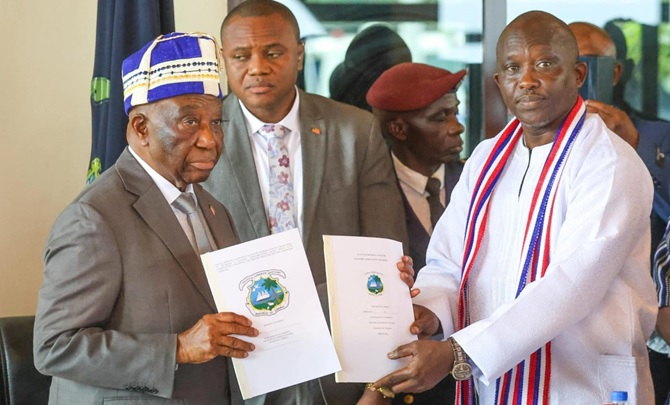
MONROVIA – President Joseph Nyuma Boakai on Wednesday, May 6, 2026, formally received the draft legislation for the establishment of Liberia’s long-awaited War and Economic Crimes Court (WECC), marking a decisive moment in the country’s renewed transitional justice agenda.
The presentation, held at the Executive Mansion in Monrovia, brought together senior government officials and the leadership of the WECC Office headed by Cllr. Jallah A. Barbu.
During the high-level ceremony, President Boakai reaffirmed his administration’s commitment to justice, accountability, and the rule of law, while dismissing perceptions that the proposed legislation is politically motivated or targeted at specific individuals.
“Some people thought that signing the War and Economic Crimes law was intended for them, but it was not,” President Boakai said.
He stressed that the initiative is instead rooted in national responsibility and the need to end impunity in Liberia’s governance and justice system.
“It was intended to show that Liberia is a country governed by the rule of law and determined to end impunity,” he added.
The President noted that for many years, silence among victims of injustice was often misinterpreted as acceptance or satisfaction.
He explained that large segments of the population endured hardship and violations without the means or opportunity to challenge them.
“Maybe people saw others walking in the streets and not complaining or protesting, and assumed they were happy. But people were not actually happy; they just couldn’t do anything about it,” Boakai stated.
The President emphasized that his administration will not govern on the basis of fear, favoritism, or political pressure, but strictly within the framework of law and institutional accountability.
He said Liberia must now demonstrate to the international community that it is serious about justice, reconciliation, and democratic governance.
“If what we are doing shows the world that Liberia respects laws and is not standing for impunity, then that is the path we must follow,” the President noted.
The Wednesday presentation of the draft legislation is being viewed as a key milestone in efforts to operationalize a court designed to address war-time atrocities and economic crimes committed during Liberia’s civil conflict.
The process is widely considered central to national healing and rebuilding public trust in state institutions that were severely weakened by years of conflict and governance failures.
The development comes just days after the Government of Liberia confirmed a US$2 million annual budget allocation to support the establishment and operational activities of the War and Economic Crimes Court.
The funding will be channeled through the Ministry of Justice and disbursed quarterly in the amount of US$500,000 to support preparatory work at the WECC Office.
Deputy Information Minister Daniel O. Sando disclosed the funding arrangement during a Ministry of Information press briefing on Tuesday, May 5, 2026.
He described the allocation as a clear shift from policy rhetoric to implementation, signaling that government is now investing directly in the institutional framework required for the court’s establishment.
“This allocation demonstrates the government’s commitment to ensuring the establishment of the War and Economic Crimes Court becomes a reality,” Sando said.
The funding decision aligns closely with Executive Order No. 164 issued by President Boakai, which extends the mandate of the WECC Office for an additional year.
The Executive Order provides the legal and administrative foundation for both the War and Economic Crimes Court and a proposed National Anti-Corruption Court.
Under the directive, the WECC Office is tasked with coordinating legislative drafting, stakeholder engagement, and international partnerships necessary for the court’s creation.
According to the Executive Order, the Office has already completed significant preparatory work, including drafting legislation for submission to the National Legislature.
One bill establishes the War and Economic Crimes Court, while the second proposes the creation of a National Anti-Corruption Court to strengthen Liberia’s accountability architecture.
The Boakai administration has framed both initiatives as part of a broader national commitment to justice, reconciliation, and the fight against corruption and impunity.
Executive Order No. 164 further mandates the WECC Office to mobilize international support and funding to ensure long-term sustainability of the proposed judicial institutions.
It also outlines strict timelines requiring the Office to present a resource mobilization plan within 60 days, intensify legislative engagement within 90 days, and develop full operational frameworks within 120 days.
These deadlines are intended to accelerate the transition from planning to full implementation after years of stalled efforts under previous governments.
The War and Economic Crimes Court proposal originates from recommendations of Liberia’s Truth and Reconciliation Commission, which documented widespread human rights abuses during the country’s 14-year civil war.
That conflict claimed an estimated 250,000 lives and left deep social, political, and economic scars that continue to shape national discourse today.
Despite repeated calls from victims’ groups and civil society organizations, successive administrations struggled to advance the establishment of the court due to political sensitivities and institutional constraints.
However, the Boakai administration’s combination of executive authority, legislative action, and direct budgetary support marks one of the most concrete steps yet toward implementing those long-standing recommendations.