NEW YORK – Liberia has warned the United Nations Security Council that the growing terrorism crisis in Africa’s Sahel region is increasingly threatening coastal West Africa, urging stronger international support for countries on the frontline before extremist violence and transnational criminal networks gain deeper footholds.
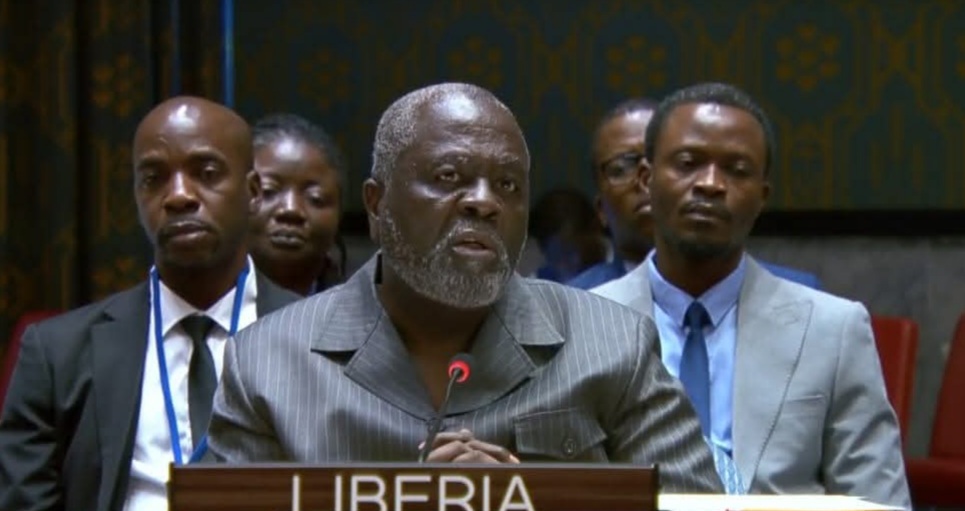
Liberia’s Permanent Representative to the United Nations, Ambassador Lewis G. Brown II, issued the warning during a Security Council meeting on threats to international peace and security caused by terrorist acts, held on September 11, 2026, as the international community marked 25 years since the September 11, 2001 terrorist attacks in the United States. Brown said Liberia viewed the anniversary not only as a moment to remember the nearly 3,000 people killed in the attacks, but also as an opportunity for the Security Council to reassess how the international community is responding to a terrorist threat that has changed dramatically since 2001.
Brown said the international community had established an important multilateral counterterrorism framework following the September 11 attacks, pointing to Security Council Resolutions 1368 and 1373 as foundational measures that strengthened international cooperation against terrorist financing, safe havens and cross border terrorist activities. He also referenced subsequent Council measures dealing with foreign terrorist fighters, illicit financing and organized crime, but said the evolution of terrorism has created new challenges that require a corresponding evolution in international responses.
“Terrorism did not remain frozen in 2001,” Brown told the Council, arguing that violent extremist organizations have moved beyond the isolated cells associated with earlier terrorist threats and have increasingly adopted decentralized structures and digital tools. According to the Liberian diplomat, terrorist actors now exploit online platforms for recruitment, use increasingly sophisticated methods to move money across borders, exploit artificial intelligence and make use of commercially available unmanned aerial vehicles.
The evolution, he said, has created a threat that can move across national borders faster than governments and communities can respond. Brown warned that the changing nature of terrorism has particular implications for Africa, where violent extremist activity has expanded across parts of the Sahel and placed enormous pressure on communities, governments and regional institutions.
He said the consequences of the crisis are already being felt across the continent, noting that the Sahel and surrounding areas have accounted for a large share of deaths linked to violent terrorism in recent years, while millions of people across West Africa and the Sahel have been forcibly displaced from their homes.
For Liberia, Brown said the situation cannot be treated as a crisis taking place somewhere else. He described the instability in the central Sahel as an immediate security concern because extremist activity and associated criminal networks are pressing toward the countries along the Gulf of Guinea.
“Instability in the central Sahel is aggressively pressing southward toward the Gulf of Guinea,” Brown said, identifying illicit small arms, terrorist financing, transnational criminal syndicates and radicalized networks as challenges capable of testing the security of countries far beyond the immediate areas of conflict.
He warned that Liberia and other coastal West African countries cannot assume that their geographic distance from the main centers of extremist violence will protect them from its consequences. “Geography grants no diplomatic immunity,” Brown declared, emphasizing that instability in one part of West Africa can quickly create security, humanitarian and economic pressures elsewhere.
“When the Sahel is engulfed in flames, coastal West Africa cannot expect the smoke to respect national borders,” he said.
Against that backdrop, Liberia called on the Security Council to close what Brown described as the gap between international counterterrorism obligations and the practical capacity of smaller and developing countries to implement them. He argued that international requirements must be accompanied by predictable and sustained resources so that countries facing emerging threats have the tools needed to respond.
Brown said frontline and transit countries need greater investment in judicial institutions, border security technology, digital forensics and financial intelligence capabilities. He stressed that governments cannot be expected to intercept sophisticated digital financial transactions, secure remote borders or investigate increasingly complex terrorist networks without the necessary technology, trained personnel and institutional support.
The Liberian diplomat also urged the international community to strengthen cooperation against the use of emerging technologies by violent extremist organizations. He called for deeper partnerships between governments, the United Nations system and responsible technology companies to counter terrorist recruitment and illicit digital financing.
At the same time, Brown cautioned that the fight against terrorism must not become a justification for undermining fundamental rights and civic freedoms. He said counterterrorism measures should remain necessary, proportionate and firmly grounded in international human rights standards and the rule of law.
“A state that discards human rights in pursuit of security may temporarily win a checkpoint, but it inevitably loses the peace,” Brown said.
Liberia also used the Security Council platform to call for greater international support for African regional security mechanisms. Brown said Liberia remains committed to African Union and regional counterterrorism frameworks and emphasized the importance of regional institutions because of their proximity to affected communities, knowledge of local conditions and ability to respond to threats within their respective regions.
He said United Nations multilateralism and African regionalism should not be viewed as competing systems, but as complementary parts of a common security architecture. According to Brown, stronger coordination between global and regional institutions would allow counterterrorism responses to become more responsive to realities on the ground.
The Liberian representative further argued that military operations alone cannot eliminate terrorism because extremist groups often exploit poverty, local grievances, weak governance and communities that feel abandoned by the state.
He urged greater attention to prevention by investing in women, young people and local communities. Brown pointed to Liberia’s own experience of moving from civil conflict toward sustained peace, saying women played an important role in rebuilding social cohesion and bridging divisions.
He called for young people to be provided with education, digital literacy and meaningful economic opportunities rather than being treated primarily as potential security threats.
As Liberia marked the 25th anniversary of September 11, Brown said the international community should measure its response not simply by statements of condemnation but by the strength of its collective action to prevent future violence.
He concluded by calling on the Security Council to move “from reactive condemnation to proactive resilience,” saying the international community must work toward a world where terrorists have no safe haven, no illicit financial channels, no technological corridor and no abandoned community available for exploitation.
For Liberia, the message places West Africa’s evolving security environment firmly within the wider international peace and security debate and calls for preventive action before extremist threats deepen their reach into coastal states.