
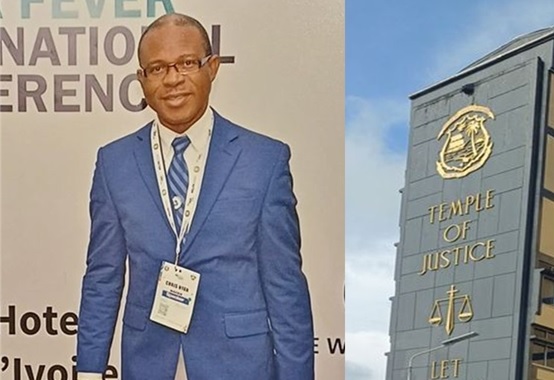
Justices raise critical legal questions as Boakai administration challenges ruling in favor of former official
Monrovia, Liberia — The Supreme Court of Liberia has raised critical questions about tenure rights and due process in the government’s appeal of a ruling favoring Dr. Dougbeh Chris Nyan in his unlawful termination case against the Executive Branch.
The Supreme Court’s full bench heard arguments on Tuesday, October 27, 2026, in the government’s challenge to a February 16, 2026, ruling by a Chambers Justice in Nyan’s favor.
According to Nyan’s public account of the proceedings, the justices questioned the legal meaning of tenure and whether the appropriate due process had been followed in terminating his appointment—issues central to determining whether the government acted within the law.
The questions place the legality of the termination, rather than simply the government’s authority to remove an official, at the heart of the dispute.
At stake is a broader constitutional and administrative question: Can an official whose position is protected by law be removed without following the procedures and safeguards attached to that tenure?
The final answer will depend on the applicable law, the terms governing Nyan’s appointment, and the Supreme Court’s assessment of the arguments presented.
GOVERNMENT CHALLENGES RULING IN NYAN’S FAVOR
The government appealed the Chambers Justice’s February ruling, which favored Nyan in his case alleging unlawful termination.
In his statement published on his official Facebook page, Nyan said the government had filed a motion asking the Supreme Court to decide the appeal based on written briefs rather than oral arguments.
Despite that request, he said, the full bench proceeded to question the parties about tenure and due process.
Those questions could prove significant because the dispute concerns whether the termination complied with the legal protections applicable to Nyan’s position.
However, the Supreme Court has yet to issue its final ruling, and the legal effect of the justices’ questions should not be confused with a judgment on the merits of the appeal.
NYAN QUESTIONS GOVERNMENT’S LEGAL APPROACH
Nyan also criticized the government’s handling of the appeal, claiming that Acting Solicitor General Cllr. Abrahim Boimah Sillah Sr. did not appear before the court and that another lawyer represented the government and President Joseph Nyuma Boakai.
He said his legal team asked the court to penalize the government for what he characterized as wasting judicial time and appealing a ruling grounded in settled legal principles.
These assertions reflect Nyan’s account of the hearing. The government’s explanation for its legal representation and its response to his criticisms were not included in the statement provided.
GONGLOE, JA’NEH LEAD NYAN’S LEGAL TEAM
Nyan was represented by Senior Counsellors Tiawan Saye Gongloe and Kabineh Ja’neh, alongside Cllr. Momulu Kandakai.
He described the case as a fight to protect tenure rights, due process, judicial prudence, and the rule of law.
The case also raises questions about the limits of executive authority when appointments are governed by statutory protections. While executive officials may have powers to appoint and remove certain public officers, the exercise of those powers remains subject to the Constitution and applicable laws.
Whether those protections were violated in Nyan’s case is a matter for the Supreme Court to determine.
RULING AWAITED
The Supreme Court’s full bench is expected to deliver its decision on the government’s appeal. Until then, the dispute remains unresolved.
The forthcoming ruling could clarify the legal standards governing tenure and due process in the circumstances of Nyan’s termination.
For now, the central question remains whether the government followed the law in ending his appointment—and whether the earlier ruling in Nyan’s favor should stand.
The government’s position and an independent account of Tuesday’s proceedings were not available in the statement on which this report is based.