The third-place finish of Liberia’s U-15 team in Group F in Baku signifies more than just a youth football achievement. It poses a challenge to a nation that has yet to see its senior team qualify for a FIFA World Cup and continues to grapple with inconsistency in international competitions.
For years, Liberians have nurtured a football dream that has proven to be frustratingly elusive; witnessing the Lone Star take the field at a FIFA World Cup finals tournament, with the national flag waving proudly and the country’s name announced among the elite of world football.
This dream has endured through disappointing campaigns, heart-wrenching defeats, coaching changes, and repeated setbacks. It persists because football in Liberia transcends mere sport. It serves as a source of national identity, a universal language that bridges political and social divides, and one of the few platforms where this small West African nation can envision itself standing alongside the world’s most renowned countries.
Yet, as the years roll by, qualifying campaigns come and go, and that ultimate dream remains unachieved.
Liberia’s senior men’s national team has never made it to the FIFA World Cup finals. The country has participated in the Africa Cup of Nations twice but has yet to claim the continental title.
These historical realities highlight the ongoing struggles of the national team and clarify why every encouraging performance from a younger squad garners attention that extends well beyond the football field.
Now, from Baku, Azerbaijan, comes a development that provides Liberia with something it has long sought; a reason to believe that the next chapter of its football narrative can be different from the last.
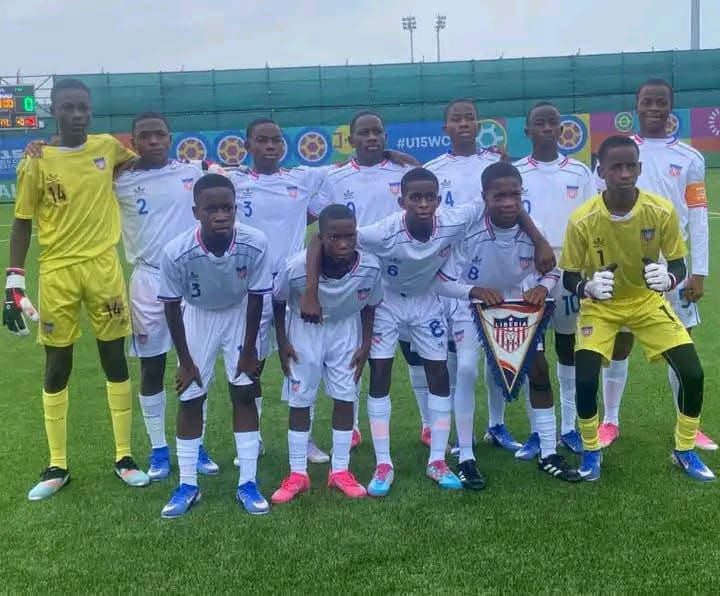
The Young Lone Star, Liberia’s Under-15 national team, achieved a commendable third place in Group F at the first-ever FIFA U-15 World Cup and Festival, amassing seven points over five matches. The team notched up two wins, one draw, and two losses, netting 10 goals while conceding 18.
This performance earned them a spot in Tier C for the tournament’s next phase. This is certainly a milestone to celebrate.
Howbeit, it also raises a challenging question; can Liberia harness the potential of its young footballers to build a sustainable national football program, or will this moment of optimism fade into yet another overlooked chapter in the country’s ongoing quest for international recognition?
A WORLD CUP DREAM THAT KEEPS SLIPPING AWAY
Liberia’s quest for World Cup glory is a long-standing one. Generations of players and fans have witnessed the Lone Star come tantalizingly close to achieving their dream, only to fall short of a spot in the world’s premier football tournament.
Icons of Liberian football, such as George Weah, James Debbah, Jonathan Sogbie, Kelvin Sewbe, Joe Nagbe, Zizi Roberts, Christopher Wreh, and Oliver Makor, among others, have shown that the nation possesses talent worthy of international acclaim. Their achievements serve as a powerful counterargument to the notion that Liberia cannot produce exceptional players.
Howbeit, the success of a few individuals does not equate to the success of a cohesive national football system. A country can generate remarkable footballers without developing a team capable of enduring the rigors of a lengthy qualification process.
While individual talent can secure victories, World Cup qualification demands depth, tactical acumen, physical readiness, consistent coaching, effective management, and the ability to achieve results against tough opponents, both at home and away.
Liberia’s history reflects the magnitude of this challenge. International football databases record 77 World Cup qualifying matches from 1980 to 2025, resulting in 22 wins, 15 draws, and 40 losses.
The most recent qualifying campaign for the 2026 World Cup concluded without the Lone Star making it to the finals in the United States, Canada, and Mexico. Although Liberia had promising moments, such as a 3–1 win over Namibia in October 2025, these glimpses of potential did not lead to qualification.
For fans, this disappointment is all too familiar. Each new campaign brings fresh hopes, but those hopes are often met with the harsh realities of international football; points need to be secured, goals must be scored, defensive errors minimized, and chances converted.
The issue isn’t just that Liberia hasn’t qualified for a World Cup; it’s that the nation hasn’t created a reliable route to transform its football potential into lasting success on the international stage. This is the true challenge facing Liberian football—not a lack of aspirations, but the ongoing struggle to turn those aspirations into competitive successes.
A BROADER PATTERN OF DISAPPOINTMENT
The failure of the World Cup cannot be seen in isolation. Liberia’s challenges in senior international competitions highlight a broader issue in converting football passion and individual talent into reliable team performance.
The qualifying campaign for the 2025 Africa Cup of Nations serves as a stark example. Liberia ended up third in its qualifying group, earning only four points from six matches, with one win, one draw, and four losses. The team managed to score four goals but conceded 12, ultimately missing out on a spot in the tournament in Morocco.
Following that, the 2026 World Cup campaign also concluded without qualification. More recently, the Lone Star began its 2027 Africa Cup of Nations qualifying campaign with losses to Rwanda and Mali in September 2026, falling 3–1 away to Rwanda and 1–0 at home against Mali.
These outcomes do not indicate that Liberian football lacks potential; rather, they illustrate the gap between potential and consistent success.
The challenges extend beyond just the senior men’s team. Liberia’s involvement in regional and continental competitions has yet to yield the sustained breakthroughs that fans hope for. Therefore, the country needs to look beyond the performance of a single squad and assess how its entire football framework prepares, develops, and supports players.
This assessment should encompass youth competitions, women’s football, domestic leagues, coaching education, scouting, medical support, and national team management. Each area has unique requirements and should be evaluated based on its specific outcomes rather than a generalized conclusion that all of Liberian football is failing.
The fundamental question is whether young players receive the sustained preparation necessary to compete as they grow older. A promising Under-15 team is encouraging, but its members will need years of structured development before anyone can reasonably expect them to carry the senior national team’s ambitions.
If the country celebrates the boys in Baku today but fails to provide them with a stronger football environment tomorrow, the achievement risks becoming an isolated success rather than the beginning of something bigger.
BAKU: A THIRD-PLACE FINISH THAT CARRIES A BIGGER MESSAGE
The failure of the World Cup cannot be seen in isolation. Liberia’s challenges in senior international competitions highlight a broader issue in converting football enthusiasm and individual talent into consistent team performance.
The qualifying campaign for the 2025 Africa Cup of Nations serves as a stark example. Liberia ended up third in its qualifying group, earning just four points from six matches, with one win, one draw, and four losses. It’s crucial to note Liberia’s achievement in Azerbaijan.
The Young Lone Star finished third in Group F, not overall in the entire FIFA U-15 World Cup and Festival. This group-stage position allowed the team to advance to Tier C for the tournament’s second phase. The competition’s structure is intended to provide teams with additional matches based on their group-stage results.
Howbeit, this does not lessen the significance of their accomplishment. For a nation still striving for its first senior men’s World Cup appearance, participating in a FIFA-organized global youth event offers essential international exposure and a chance to evaluate young players against opponents from diverse footballing backgrounds.
The boys’ record—two wins, one draw, and two losses—tells a more nuanced story than either unrestrained celebration or harsh criticism might imply.
Liberia scored 10 goals in five matches, showing that the team can find the net. Yet, they conceded 18 goals, reminding us that attacking potential must be complemented by defensive organization, tactical maturity, and consistency.
The 9–2 loss to Costa Rica, in particular, underscores the work that lies ahead if the team hopes to compete more effectively against stronger rivals.
The appropriate response is not to dismiss the boys for not topping their group or to exaggerate their potential as future world champions. Instead, we should acknowledge their achievements, analyze what their performances reveal, and invest in their future development.
For these young players, Baku should mark the beginning of their journey, not the end.
THE REAL TEST BEGINS AFTER THE APPLAUSE
Liberia has a history of celebrating its football heroes, but the real challenge lies in creating an environment where talent can thrive consistently.
The Liberia Football Association (LFA) should view the Under-15 team’s achievements as a chance to enhance its youth development program. This means establishing a solid plan for what happens when the players return home; ongoing coaching, regular competitive matches, individual development evaluations, physical training, injury prevention strategies, and a clear pathway to higher age-group national teams.
The young athletes shouldn’t have to rely solely on sporadic tournaments or the goodwill of individual coaches. Their growth should be part of a well-structured program that guides them from the Under-15 level through to the Under-17 and Under-20 teams, eventually leading to the senior national team.
Such a pathway would enable national selectors to spot emerging talent early, track their progress, and tackle any weaknesses before they become major issues.
It would also provide players and their families with a better understanding of the opportunities and challenges that come with pursuing a professional football career.
The LFA should set clear, measurable goals and regularly report on their progress. How many of these players stay involved in organized football over the next three years? How many move up to higher youth teams? What advancements are being made in coaching, facilities, and local competitions? What support is available for talented players who struggle to cover the costs of regular training?
These are essential questions, and the answers are far more important than ceremonial receptions or congratulatory remarks.
The government certainly has a role to play, but it needs to be clearly defined. Public support can enhance playing facilities, school sports, community pitches, and access to qualified coaches. Any investment should be transparent, linked to specific development goals, and coordinated with the local football house, rather than just being a temporary reaction to a surge of national enthusiasm.
The private sector, schools, local clubs, and communities should also be encouraged to get involved. A national football program cannot rely solely on one institution, nor can the burden of future success fall entirely on the young players themselves. If Liberia seeks different outcomes, it must establish new conditions for its footballers to thrive.
FROM GERORGE WEAH’S LEGACY TO THE NEXT GENERATION
George Weah’s accomplishments serve as a powerful reminder of the potential within Liberian football.
Howbeit, the focus should extend beyond just producing standout individuals. The goal should be to cultivate teams that can consistently qualify for major tournaments, compete with discipline, and ensure ongoing development across generations. Achieving this vision necessitates a shift in how we define success.
While qualifying for a World Cup would be a monumental achievement for the senior team, we cannot measure progress solely by this benchmark.
Regular qualification for the Africa Cup of Nations, improved performances in regional tournaments, competitive youth squads, and a robust domestic football framework are all vital indicators of advancement.
The Young Lone Star’s third-place finish in Group F presents an early chance to start tracking this progress more intentionally.
The players have shown that Liberia can field a youth team capable of competing internationally. The pressing question now is whether the institutions responsible for their growth can build upon this foundation.
It would be unjust to place the weight of revitalizing the nation’s football on young players still honing their skills. They deserve support, quality coaching, and the freedom to grow without facing unrealistic expectations. The onus lies with the adults and organizations that shape the football landscape.
Moreover, these young athletes should not be seen as a guaranteed fix for the senior team’s challenges. Development is seldom a straightforward journey. While some will reach the pinnacle of the sport, others will follow different paths. What truly matters is ensuring that every player has a fair chance to develop and that the country establishes a system capable of consistently nurturing talented players, rather than depending on a handful of exceptional talents.
A CALL TO ACTION FOR LIBERIAN FOOTBALL
Liberia’s football authorities have a crucial opportunity to address the longstanding issues surrounding the national game.
Why has the country found it difficult to translate its passion for football into consistent success? What steps can be taken to enhance youth development? What improvements are necessary in domestic competitions and coaching practices? How can national teams better prepare for significant tournaments? And how will we evaluate progress beyond the fleeting excitement of a single victory?
These questions require thoughtful, evidence-based responses, a well-defined development strategy, and ongoing public oversight.
Football fans also have an important role to play. They should celebrate the achievements of the players while holding the governing bodies accountable for their responsibilities.
Taking pride in the national team and critically examining football administration are not mutually exclusive; both are essential for the sport’s advancement.
Liberia should not give up on its World Cup aspirations. Instead, it must create a credible roadmap to achieve them. This roadmap cannot be built on catchy slogans, emotional appeals, or promises made following a successful match. It will require years of preparation, investment, effective management, skilled coaching, and opportunities for young talents to flourish.
LET BAKU BE THE TURNING POINT
For far too long, Liberia’s aspirations in senior football have been overshadowed by a gap between what is hoped for and what has been achieved.
The Lone Star has yet to qualify for the men’s FIFA World Cup finals, and the nation’s track record in major continental tournaments is quite limited.
Howbeit, the Young Lone Star has provided a new reason for optimism. Finishing third in Group F in Baku may not equate to a world championship. It doesn’t erase previous disappointments, ensure future successes, or fix the issues that have plagued Liberian football.
Yet, it stands as a significant accomplishment for a group of young athletes who have proudly represented their nation on an international platform.
Their performance deserves to be celebrated with pride, assessed with honesty, and followed by constructive actions.
But the best way for Liberia to honor these young players is not just to applaud them during the tournament but to ensure that upon their return, the football infrastructure is ready to nurture their growth as athletes.
Let their success serve as a reminder that the future of the Lone Star isn’t solely defined by the setbacks of the senior team. It will also be influenced by the opportunities afforded to the youth currently learning, training, and competing in communities and schools across the country.
Liberia has long harbored dreams of appearing in a World Cup. The Young Lone Star’s achievements in Baku present a chance to start asking a more thoughtful question; what steps must the country take today to make that dream a reality tomorrow?
The solution won’t be found solely in Baku. It will emerge from the choices made after the tournament—in training facilities, classrooms, local leagues, the football association’s strategies, and the national commitment to fostering young talent.
To this end, the boys have done and continue to do their part in Baku. Now it’s time for Liberia to do its own.