Former Finance Minister presents new payroll figures, credits CDC administration with major education investments, and challenges Boakai government to demonstrate its record on national problem-solving
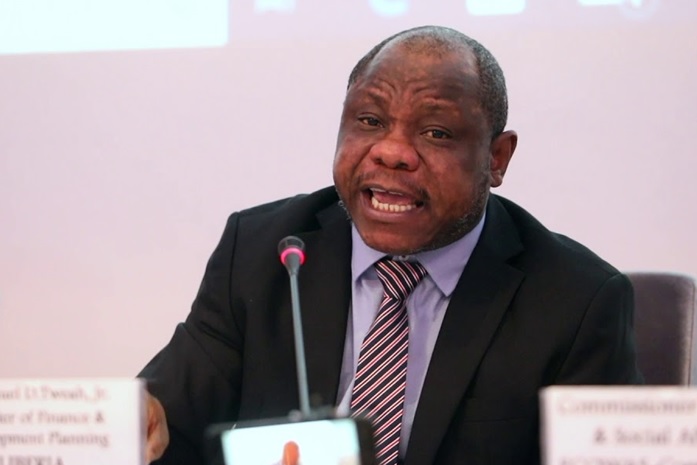
MONROVIA – Former Finance Minister Samuel D. Tweah has reopened the debate over former President George Weah’s governance record, presenting figures he says demonstrate that the CDC administration made significant progress in expanding access to secondary education and reducing salary inequality among Liberian government employees.
In a strongly worded statement ahead of his appearance on the OK Conversation with Julius Jeh, Tweah challenged the Boakai administration to focus on addressing outstanding national problems rather than undermining or reversing reforms he believes were already achieved.
His presentation focuses on two major areas of the former CDC government’s record: education infrastructure and public-sector wage harmonization.
But it is the wage figures that carry perhaps the strongest political message, with Tweah arguing that the Weah administration significantly improved the earnings position of thousands of low-paid government workers.
25 HIGH SCHOOL EXPANSIONS: TWEAH HIGHLIGHTS EDUCATION ACHIEVEMENTS
Tweah credited three major World Bank and Global Partnership for Education-supported programmes with helping transform Liberia’s education sector between 2018 and 2023.
The programmes included Getting to Best (G2B), Improving Results in Secondary Education (IRISE), and Liberia Learning Foundations (LLF), with reported investments of US$11.07 million, US$47 million and US$5.6 million, respectively.
According to Tweah, the combined interventions reached all 15 counties and supported improvements from early childhood education through senior secondary school.
Under the G2B programme, implemented between 2018 and 2023, 20 community early childhood education centres were established, while 60 caregivers were trained to serve more than 1,250 children.
The programme also reportedly facilitated the certification of 356 previously unqualified primary school teachers and removed 1,900 ghost teachers from the education payroll.
Tweah further reported that 373,845 students received textbooks in mathematics, physics, chemistry and biology, while digital textbooks were made available online to approximately one million students.
However, it was the IRISE programme that Tweah particularly highlighted as a major intervention in expanding access to secondary education.
He said the programme reached 184 schools, supported the construction of three new secondary schools in Kakata, Gbarnga and Ganta, and expanded 25 junior secondary schools into senior high schools across 24 districts.
According to him, these expansions brought senior high school opportunities to communities that had historically lacked such access since the founding years of Liberia.
The programme also reportedly rehabilitated 156 existing senior secondary schools, provided scholarships to 3,165 girls in counties with high female dropout rates, and recruited 200 female counsellors who were placed on government payroll and deployed in public senior secondary schools.
Tweah added that digital laboratories were established in public senior secondary schools and that the textbook-to-student ratio improved from 1:16 to 1:5.
EARLY CHILDHOOD EDUCATION AND SCHOOL FACILITIES
The Liberia Learning Foundations programme, implemented between 2021 and 2023, reportedly constructed 54 early childhood education classrooms across 18 schools in six counties.
It also provided 72 girl-friendly latrines, installed 18 water systems, distributed 100,000 teaching and learning materials to 523 schools, and trained 286 Alternative Learning Programme teachers.
More than 4,000 overage students were also reportedly transitioned through the programme.
While acknowledging that education quality remains a long-term challenge, Tweah argued that these investments helped improve the country’s education infrastructure and access to learning opportunities.
He nevertheless conceded that more work remains to be done, raising questions about what the current Unity Party administration is doing to improve education quality and build on previous investments.
WAGE HARMONIZATION: TWEAH PRESENTS NUMBERS HE SAYS WILL REOPEN THE DEBATE
The former Finance Minister’s most politically charged argument concerns the CDC administration’s wage harmonization programme.
Tweah said a new analysis comparing government payroll data from May 2019 and January 2024 demonstrates that wage standardization substantially reduced inequality and shifted a greater share of government payroll resources toward lower-paid employees.
He presented four key indicators to support his argument.
First, the Gini coefficient, which measures inequality on a scale from zero to one, reportedly declined from 0.550 in May 2019 to 0.444 in January 2024. Tweah described this as an approximately 19 percent reduction in wage inequality.
Second, the 90th-to-10th percentile wage ratio fell from 6.93 to 4.33. In practical terms, the wage gap between employees near the top and bottom of the public-sector pay distribution narrowed considerably.
Third, the share of total government payroll going to the highest-paid 10 percent of employees reportedly declined from 48.6 percent to 39.7 percent.
Meanwhile, the bottom 50 percent of government employees increased their share of the total wage bill from 17.2 percent to 22.3 percent.
For Tweah, these figures demonstrate that harmonization did not simply change salary structures; it redistributed a greater proportion of the public wage bill toward lower-paid workers.
THE US$150 MINIMUM WAGE FIGURE THAT TWEAH CALLS THE BOMBSHELL
Perhaps the most striking claim in Tweah’s presentation concerns the number of government employees earning below US$150 per month.
According to his figures, 20,501 government employees, representing approximately 31 percent of the workforce, were earning below the US$150 threshold in May 2019.
By January 2024, that number had reportedly fallen to 1,693 employees, representing approximately 2.56 percent.
If independently verified, the figures would indicate that the number of government workers earning below US$150 declined by approximately 18,808 between the two reporting periods.
Tweah used the comparison to challenge the Boakai administration, arguing that the remaining number of workers below the minimum wage should have been a manageable problem for the current government to address.
He questioned why the Rescue administration was still struggling to resolve what he portrayed as an outstanding payroll problem inherited after the harmonization exercise.
However, there is a discrepancy in Tweah’s presentation: while his explanatory text refers to 1,963 employees earning below US$150 in January 2024, the accompanying statistical table lists 1,693. The discrepancy requires clarification before the figure can be treated as definitive.
The accompanying narrative gives 1,963 rather than 1,693. The original payroll data and calculation methodology have not been independently examined for this report.
TWEAH’S CHALLENGE TO THE RESCUE GOVERNMENT
Tweah’s central argument is that national politics should be driven by measurable problem-solving rather than attempts to reverse policies and programmes that have already delivered results.
He questioned whether the Boakai administration had maintained the gains made in education and wage reform, particularly the effort to improve the earnings of lower-paid public employees.
In a pointed challenge, he asked those opposed to harmonization to reverse it if they believed the policy had failed, insisting that the figures demonstrated its equalizing impact.
His remarks are expected to generate renewed debate over the economic and social legacy of the Weah administration and the current government’s handling of public-sector salaries.
However, the claims also raise important questions that deserve independent examination: Are the payroll figures accurate? How were the Gini coefficient and wage-distribution calculations produced? Have the education facilities and digital laboratories remained operational? And what measurable progress has the current government made in building on those investments?
For Liberia’s public workers, the debate goes beyond political arguments. It concerns whether government salaries are fair, whether workers can earn a living wage, and whether reforms introduced by one administration are being sustained by the next.
Tweah is scheduled to discuss the education and wage reform figures on the OK Conversation with Julius Jeh at 4:30 p.m.
The broader question facing the Boakai administration is whether it can produce comparable evidence of progress in addressing Liberia’s longstanding education and public-sector wage challenges.