
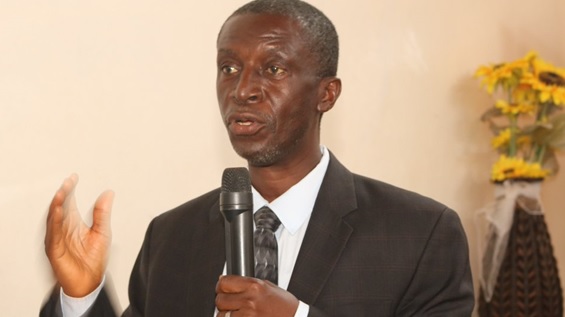
Former Solicitor General urges prosecutors to strengthen evidence collection, protect constitutional rights and ensure every criminal case is supported by credible, admissible proof.
MONROVIA — Former Solicitor General of Liberia, Cllr. Tiawan Saye Gongloe, has challenged prosecutors to improve the collection, preservation and management of criminal evidence, warning that poorly handled investigations and unreliable evidence could undermine prosecutions, expose innocent people to wrongful convictions and allow offenders to escape justice.
Gongloe made the remarks on October 20, 2026, while presenting a paper titled “Strengthening Criminal Prosecution through Effective Evidence Collection and Management” at a prosecution training workshop organized by the Prosecution Division of the Ministry of Justice at D’ Calabash Hotel in Congo Town.
The presentation summarized a detailed 31-page paper prepared for prosecutors, focusing on the legal, technical and professional standards required to build criminal cases capable of withstanding judicial scrutiny.
At the center of his presentation was a warning that the size of an investigation file does not necessarily determine the strength of a criminal prosecution.
According to Gongloe, an investigation file may contain improperly obtained confessions, unexplained telephone records, unsupported audit conclusions or exhibits whose origins and handling cannot be established. Such weaknesses, he cautioned, can seriously damage the prosecution’s case in court.
He emphasized that every important piece of evidence must have a clear history, a lawful basis for its collection and a demonstrable connection to the facts the prosecution intends to establish.
Constitutional violations and weak investigations
Gongloe stressed that prosecutors and investigators must place constitutional protections at the center of criminal investigations, particularly Article 21 of Liberia’s Constitution, which safeguards fundamental rights, including protection against unlawful searches and seizures, access to legal counsel, humane treatment, confrontation and the presumption of innocence.
He warned that obtaining a suspect’s signature or recording a statement does not automatically make evidence legally acceptable if constitutional requirements were violated during its collection.
He also urged prosecutors to understand the difference between evidence that is relevant, legally obtained, authentic, admissible and sufficient to establish guilt beyond a reasonable doubt.
According to him, evidence may be relevant to a criminal investigation but still be inadmissible in court. Similarly, evidence admitted by a judge may carry little persuasive weight or fail to establish an essential element of the alleged offence.
He therefore advised prosecutors to identify the specific elements of an alleged crime before collecting evidence, ensuring that every witness statement, document or physical exhibit contributes to proving a particular legal requirement.
Using financial investigations as an example, Gongloe cautioned that an irregular payment or procurement violation does not automatically establish criminal responsibility.
He said investigators must go beyond identifying irregularities and establish the additional facts necessary to prove the specific offence charged.
Warns against mishandling evidence and fabricated records
The former Solicitor General also placed significant emphasis on the chain of custody, describing evidence management as a process that begins when an exhibit is recovered and continues through its storage, examination and eventual presentation in court.
He recommended that every exhibit be assigned a unique identification number, with investigators documenting where and when it was recovered, who collected it, its condition and how it was packaged and sealed.
Every subsequent transfer, he explained, must be properly documented, including the identities of the individuals releasing and receiving the evidence, the date, time and reason for the transfer.
Gongloe issued a strong warning against fabricating evidence records, backdating entries or concealing gaps in the chain of custody.
He argued that investigators should honestly document any break in the continuity of evidence because an unexplained substitution or contamination could have consequences far more serious than a missing signature.
An honest record, he maintained, allows the court to examine and assess the evidence, while fabricated documentation undermines the credibility of the entire prosecution.
Digital evidence, DNA and fingerprints require greater scrutiny
Addressing the growing importance of scientific and digital evidence in criminal investigations, Gongloe urged prosecutors to exercise greater caution when handling DNA samples, fingerprints, firearms, narcotics and electronic devices.
He explained that a DNA match or fingerprint may establish that a person came into contact with an object or location, but it does not necessarily prove when that contact occurred, the person’s intention or every element of the alleged crime.
On digital evidence, he cautioned that legally possessing a mobile phone does not automatically give investigators unrestricted authority to examine its contents.
He said investigators must establish the legal authority and scope of a proposed search before accessing information stored on electronic devices.
He further advised prosecutors to preserve original recordings, native digital files, metadata and relevant context, while using verified working copies where appropriate.
Gongloe also challenged the assumption that screenshots and displayed names are sufficient to establish the identity of individuals communicating through digital platforms.
A screenshot alone, he explained, does not necessarily establish authorship, while a displayed name does not conclusively identify the person who sent a message.
Prosecutors urged to protect witnesses and disclose evidence that challenges their cases
The presentation also addressed witness credibility and the prosecution’s responsibility to preserve evidence that may contradict its case.
Gongloe advised investigators to interview witnesses separately, maintain their initial and subsequent statements and clearly distinguish between what witnesses personally observed and what they merely heard from other people.
He warned that witness preparation must never become an opportunity to manufacture facts, influence testimony or encourage witnesses to conceal uncertainty.
Importantly, he stressed that prosecutors must preserve negative test results, inconsistent witness statements and information that could support an innocent explanation.
He called for compliance with applicable disclosure obligations, emphasizing that criminal prosecution must be conducted fairly rather than through selective presentation of evidence.
Calls for institutional reforms within the justice system
Beyond individual prosecutorial responsibilities, Gongloe called for stronger institutional arrangements to improve evidence management across Liberia’s criminal justice system.
Among his recommendations were a common evidence-management protocol, early coordination between investigators and prosecutors, trained evidence custodians, secure storage facilities, disclosure registers and systematic assessments of evidence against every element of an alleged offence before trial.
He also highlighted the need for adequate funding for evidence packaging, transportation, specimen storage, forensic services, interpreters and secure digital backups.
According to him, training alone cannot improve prosecution if investigators and prosecutors lack the equipment and institutional resources needed to implement professional standards.
He further recommended reviewing adverse court rulings to identify recurring investigative and prosecutorial weaknesses and prevent similar mistakes in future cases.
Before taking any criminal case to trial, Gongloe challenged prosecutors to answer five fundamental questions about every essential exhibit: Who can identify it? What legal authority permitted its acquisition? What establishes its identity and integrity? How will it be admitted in court? And which element of the alleged offence does it help prove?
He warned that if essential questions remain unanswered, prosecutors must conduct further investigations and reassess the strength of the case rather than proceed on assumptions.
Reflects on reforms introduced during his tenure
Gongloe also used the occasion to reflect on efforts to strengthen Liberia’s prosecution service during his tenure as Solicitor General, beginning in 2006.
He recalled that when he assumed the position, the prosecution service had very few trained lawyers, with the late Cllr. Samuel Jacobs, then Montserrado County Attorney, being the only trained lawyer serving in that capacity.
He said his administration worked with colleagues and the government to advocate for the appointment of law school graduates as county attorneys across Liberia’s 15 counties.
He also recalled securing scholarship assistance from the Open Society Initiative for West Africa to train additional lawyers for the prosecution service.
Gongloe expressed satisfaction that some beneficiaries of those initiatives were participating in the workshop and that more than 50 law school graduates now serve as prosecutors.
He credited successive administrations, development partners and dedicated legal professionals for contributing to the development of the prosecution service.
Concluding his presentation, Gongloe warned that mishandled evidence carries consequences beyond the courtroom, potentially denying victims justice, exposing innocent people to wrongful convictions and allowing criminal offenders to escape accountability.
He reminded prosecutors that their responsibility is not simply to secure convictions but to pursue justice through lawful, credible and reliable evidence.
“The strength of a prosecution of any case lies in proof that withstands fair scrutiny,” Gongloe emphasized.