
By Socrates Smythe Saywon | Smart News Liberia
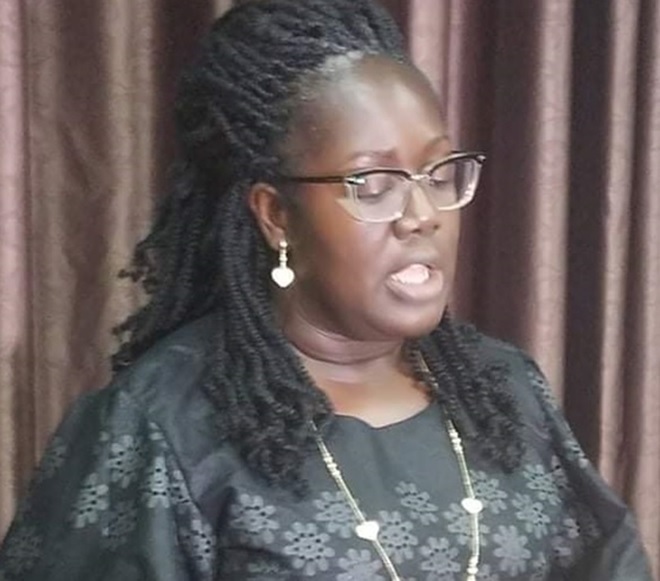
MONROVIA – The legal battle surrounding former Commerce Minister Mawine G. Diggs has taken a new turn after the Asset Recovery and Property Retrieval Taskforce (AREPT) successfully resisted an application seeking permission for the former government official to travel to the United States for medical treatment, prompting Criminal Court “C” to order an independent medical assessment within Liberia.
The court’s decision marks another significant development in the high-profile Rural Women Empowerment Funds case, a corruption prosecution involving allegations of the misappropriation of hundreds of thousands of United States dollars and millions of Liberian dollars intended to improve the lives of rural women across the country.
In a statement issued on Friday, June 5, 2026, through its Chairperson, Cllr. Edwin Kla Martin, and signed by Public Relations Officer Joseph F. Daniels, AREPT disclosed that lawyers representing Diggs had petitioned the court for authorization to travel abroad for medical treatment. However, AREPT, in collaboration with the Ministry of Justice, strongly opposed the request, arguing that local medical options must first be explored before overseas treatment is considered.
The Taskforce maintained that granting such requests without sufficient justification could undermine judicial accountability and set an undesirable precedent in cases involving public officials facing serious criminal charges.
In its resistance before the court, AREPT argued that any request for medical treatment outside Liberia should be supported by compelling medical evidence demonstrating that the required care cannot be adequately provided within the country.
The Taskforce further expressed concerns about the potential impact that foreign travel could have on ongoing judicial proceedings, particularly in a case that has attracted considerable public attention due to the magnitude of the alleged financial losses involved.
Recognizing the concerns raised by both sides, Criminal Court “C”, presided over by Judge Ousman F. Feika, opted for a middle-ground approach.
Rather than immediately granting or denying the request, the court ordered an independent healthcare provider in Liberia to conduct a comprehensive medical assessment of Diggs and submit a report within forty-eight hours.
The ruling effectively places the burden on an impartial medical evaluation to determine whether the former minister’s condition can be treated locally or whether specialized care abroad is medically necessary.
For AREPT, the court’s decision represents validation of its position that due process must be guided by objective evidence rather than assertions alone.
“The Taskforce welcomes the Court’s decision to seek an independent medical assessment,” AREPT stated.
According to the Taskforce, medical travel abroad should only be considered after all reasonable local treatment options have been exhausted and where credible medical evidence establishes that the required treatment cannot be adequately provided within Liberia.
The position reflects a growing determination by anti-corruption institutions to ensure that individuals facing prosecution do not evade accountability through legal maneuvers that could delay or complicate judicial proceedings.
The case itself stems from allegations surrounding the management of funds allocated for rural women empowerment programs.
Court records indicate that approximately US$493,669.38 and LRD$190,345,028.26 intended for initiatives benefiting rural women are at the center of the prosecution.
According to AREPT, the funds were allegedly mismanaged or unlawfully diverted, resulting in criminal charges against eight individuals, including Diggs.
Those indicted face accusations ranging from theft of property and economic sabotage to misapplication of entrusted property and criminal conspiracy.
The case has become one of the most closely watched corruption prosecutions under the Boakai administration, particularly because it involves public resources earmarked for vulnerable women in rural communities.
For many Liberians who reacted on social media following the release of AREPT’s statement, the dispute over Diggs’ travel request is about more than medical treatment; it is also about accountability in a high-profile corruption case.
It raises concerns regarding accountability in corruption cases and whether individuals accused of misusing public funds should be permitted to leave the country’s jurisdiction while criminal proceedings remain active.
AREPT has consistently maintained that its opposition to the request is not intended to deny medical care but rather to ensure that judicial proceedings remain protected and that all available domestic options are fully considered before international travel is approved.
Through Chairperson Cllr. Edwin Kla Martin, the Taskforce reiterated its commitment to balancing the constitutional rights of defendants with the public’s interest in seeing corruption cases proceed without unnecessary disruption.
“AREPT remains committed to respecting the judicial process and ensuring that all matters before the courts are handled in accordance with due process, fairness, and the rule of law,” the statement noted.
The Taskforce further reaffirmed its broader mandate to investigate, prosecute in collaboration with the Ministry of Justice, and recover public assets allegedly lost through corruption and financial misconduct.