By Socrates Smythe Saywon | Smart News Liberia
MONROVIA – The Center for Transparency and Accountability in Liberia (CENTAL) has delivered one of the most sweeping and sobering assessments yet of Liberia’s fight against corruption, warning that despite notable institutional reforms under President Joseph Nyuma Boakai Sr., the country remains trapped in a cycle of weak enforcement, selective accountability, judicial delays, and persistent public distrust.
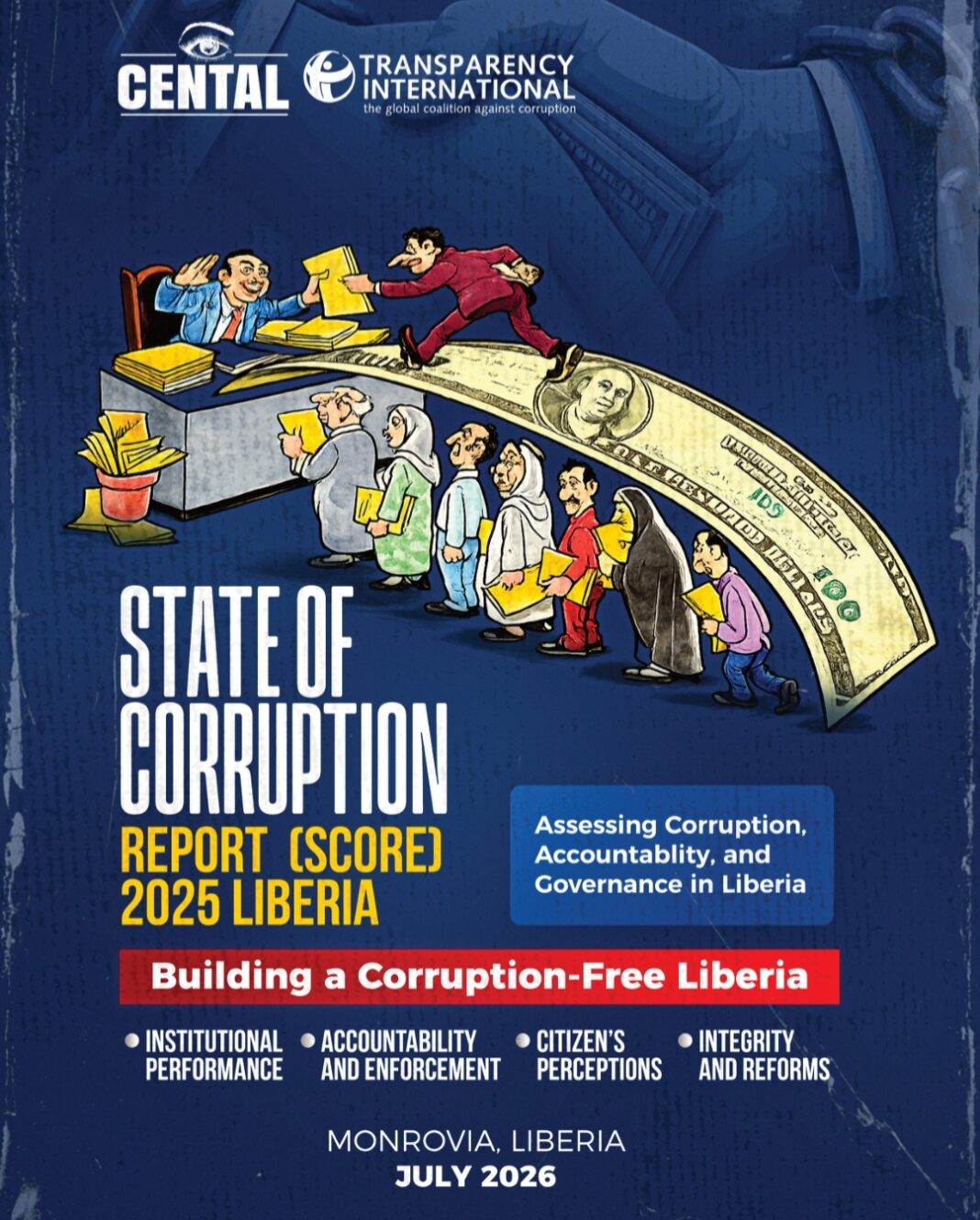
Launching its 2025 State of Corruption Report (SCORE 2025) on Wednesday, July 8, 2026, at the Royal Grand Hotel in Sinkor under the theme, “SCORE 2025: Documenting the Gaps Between Promise and Practice,” CENTAL concluded that while Liberia has made measurable progress in strengthening anti-corruption institutions, the government’s biggest challenge remains transforming political commitments into consistent, impartial, and effective action.
The comprehensive report paints a picture of a nation standing at a crossroads where policy ambitions increasingly collide with weak implementation, exposing significant cracks in Liberia’s governance and accountability architecture.
According to the report, corruption continues to undermine public confidence, drain scarce national resources, weaken public institutions, distort service delivery, and threaten Liberia’s democratic and economic development despite years of reform initiatives.
Promise Meets Practice
CENTAL acknowledged that the Boakai administration has publicly elevated anti-corruption, rule of law, and good governance as central pillars of its ARREST Agenda for Inclusive Development.
The report credits the administration with several important reforms during 2025, including strengthening the Liberia Anti-Corruption Commission, reconstituting the Assets Recovery and Property Retrieval Task Force, operationalizing the Witness Protection Agency for the first time, improving asset declaration compliance, and expanding investigations into alleged corruption involving former government officials.
However, CENTAL argues that these institutional gains remain overshadowed by inconsistent enforcement, delayed prosecutions, inadequate funding, and political questions surrounding the handling of major corruption cases.
The report stresses that Liberia’s anti-corruption framework is expanding on paper, but implementation continues to lag significantly behind official promises.
Nearly Every Liberian Still Sees Corruption as a National Problem
One of the report’s most striking findings is that although fewer Liberians now rate corruption as “high,” public concern remains overwhelmingly widespread.
The nationwide survey found that 59 percent of respondents described corruption as high in 2025, down from 83 percent in 2024.
Yet when combined with those who rated corruption as moderate, an overwhelming 94 percent of Liberians still consider corruption a serious national problem.
CENTAL cautions that the apparent decline should not be interpreted as evidence that corruption has substantially improved.
Instead, researchers say many citizens simply shifted their assessment from “high” to “moderate,” meaning public concern remains nearly universal.
Police, Hospitals and Courts Top Corruption List
The report reveals growing alarm over corruption within frontline public services that citizens interact with daily.
Police services remained the institution most widely perceived as corrupt, with 75 percent of respondents identifying law enforcement as the country’s most corruption-prone public service.
Medical services ranked second at 57 percent, reflecting increasing concerns over bribery and unethical practices within Liberia’s healthcare system.
Court services followed at 36 percent, while education and transportation services also recorded sharp increases in corruption perceptions.
CENTAL warns that worsening public perceptions across these essential services indicate that ordinary Liberians continue encountering corruption where government should be delivering fairness and protection.
Public Confidence in Institutions Continues to Collapse
Although citizens expressed slightly greater confidence in the government’s stated commitment to fighting corruption, trust in Liberia’s public institutions continued to decline.
The report found that only 31 percent expressed confidence in the Executive Branch.
Confidence in the Judiciary dropped dramatically from 33 percent to just 16 percent.
The Legislature remained the least trusted branch of government, attracting confidence from only 12 percent of respondents.
Meanwhile, confidence in public integrity institutions also fell sharply from 45 percent in 2024 to 28 percent in 2025.
Interestingly, the media emerged as Liberia’s most trusted institution despite experiencing its own decline in public confidence.
Bribery Makes an Alarming Comeback
CENTAL also sounded the alarm over the resurgence of bribery.
Thirty-seven percent of respondents admitted paying a bribe in 2025, reversing two consecutive years of decline.
More concerning, over half of those who paid bribes said they did so simply to speed up government services.
The report says this trend demonstrates that corruption remains deeply embedded within Liberia’s public administration, forcing citizens to pay unofficial fees to receive services that should be provided fairly and efficiently.
Audit Reports Reveal Massive Accountability Failures
The report also highlights disturbing findings from the General Auditing Commission.
According to CENTAL, GAC audits uncovered widespread financial irregularities across major government institutions, including the National Port Authority, Liberia Electricity Corporation, Forestry Development Authority and the Government Consolidated Funds Account.
Despite more than 7,000 audit recommendations being issued across 62 government entities, only 37 percent had been implemented.
Four government institutions reportedly failed to implement a single audit recommendation.
CENTAL describes the low implementation rate as one of Liberia’s biggest accountability weaknesses, arguing that audits have little value if recommendations are routinely ignored.
Record Caseload for LACC
The report notes that the Liberia Anti-Corruption Commission experienced its busiest year since its establishment.
The Commission received 44 corruption complaints against an annual target of just 16 cases.
Investigators completed 27 investigations, secured 12 indictments, obtained three convictions and recorded one acquittal.
Cases investigated involved alleged financial exposure exceeding US$19.7 million and over L$523 million.
The report also highlighted successful prosecutions involving the Liberia Institute of Statistics and Geo-Information Services and the Planned Parenthood Association of Liberia, alongside the landmark petroleum theft convictions involving former employees of the Liberia Petroleum Refining Company.
AREPT Intensifies Pursuit of Former Officials
CENTAL says the reconstituted Assets Recovery and Property Retrieval Task Force made significant progress by opening 28 investigations and securing indictments against more than 40 officials of the former CDC administration.
Among the highest-profile matters were the Saudi Rice case and allegations involving millions of dollars in public funds.
However, judicial proceedings slowed considerably after Supreme Court interventions and procedural delays.
The report also revisits the high-profile trial involving former Finance Minister Samuel D. Tweah Jr. and several co-defendants.
While Tweah and another defendant were acquitted, two others were convicted.
The acquittals later triggered allegations of jury tampering after jurors accused court officials of misconduct during deliberations.
CENTAL notes that the Supreme Court ordered an open inquiry into the allegations, but no final determination had been reached at the time the report was completed.
Asset Declaration Compliance Improves Dramatically
One of the report’s strongest positive findings concerns public officials’ compliance with asset declaration requirements.
According to CENTAL, compliance rose dramatically to 91 percent during 2025 after the Executive imposed sanctions, including suspensions and salary blocks affecting more than 400 officials who failed to declare their assets.
The report also notes that all Justices of the Supreme Court reportedly submitted asset declarations, along with many judges and senior judicial officers.
Nevertheless, CENTAL says verification of declared assets remains inadequate, limiting the effectiveness of the exercise.
Integrity Institutions Still Face Funding Crisis
Despite improvements in some agencies, CENTAL warns that chronic underfunding continues to cripple Liberia’s anti-corruption fight.
Several integrity institutions reportedly struggled with delayed budget releases and insufficient operational funding.
The Office of the War and Economic Crimes Court reportedly required more than US$120,000 each month to function but received only a fraction of its operational needs.
CENTAL argues that without adequate financing, even the strongest legal mandates cannot deliver meaningful accountability.
Citizens Still Fear Reporting Corruption
The report further reveals that corruption reporting remains alarmingly low because many Liberians believe authorities simply will not act.
Researchers found that limited access to reporting mechanisms, particularly in rural communities, continues to discourage whistleblowers.
CENTAL believes strengthening witness protection, expanding digital reporting platforms, and increasing public confidence in investigations will be essential if corruption reporting is to improve.
CENTAL Calls for Political Will Beyond Rhetoric
Concluding the report, CENTAL warns that Liberia’s anti-corruption future depends less on creating additional institutions and more on ensuring existing laws are applied fairly, consistently, and without political interference.
The organization argues that genuine progress will require sustained commitment from the Executive, Legislature, and Judiciary, backed by adequate funding, impartial investigations, stronger prosecutions, transparent decisions on dropped corruption cases, and active participation from civil society, the media, and ordinary citizens.
One of the report’s central findings is that although Liberia has strengthened its anti-corruption framework, a significant gap remains between government commitments and actual enforcement. CENTAL warns that unless this gap is narrowed through impartial investigations, timely prosecutions, and sustained political will, public confidence in governance institutions will continue to decline.
Editor’s Note: This article is part of Smart News Liberia’s continuing coverage of CENTAL’s SCORE 2025 Report. We will publish additional in-depth analyses examining the report’s major findings, corruption trends, and their implications for governance and accountability in Liberia.