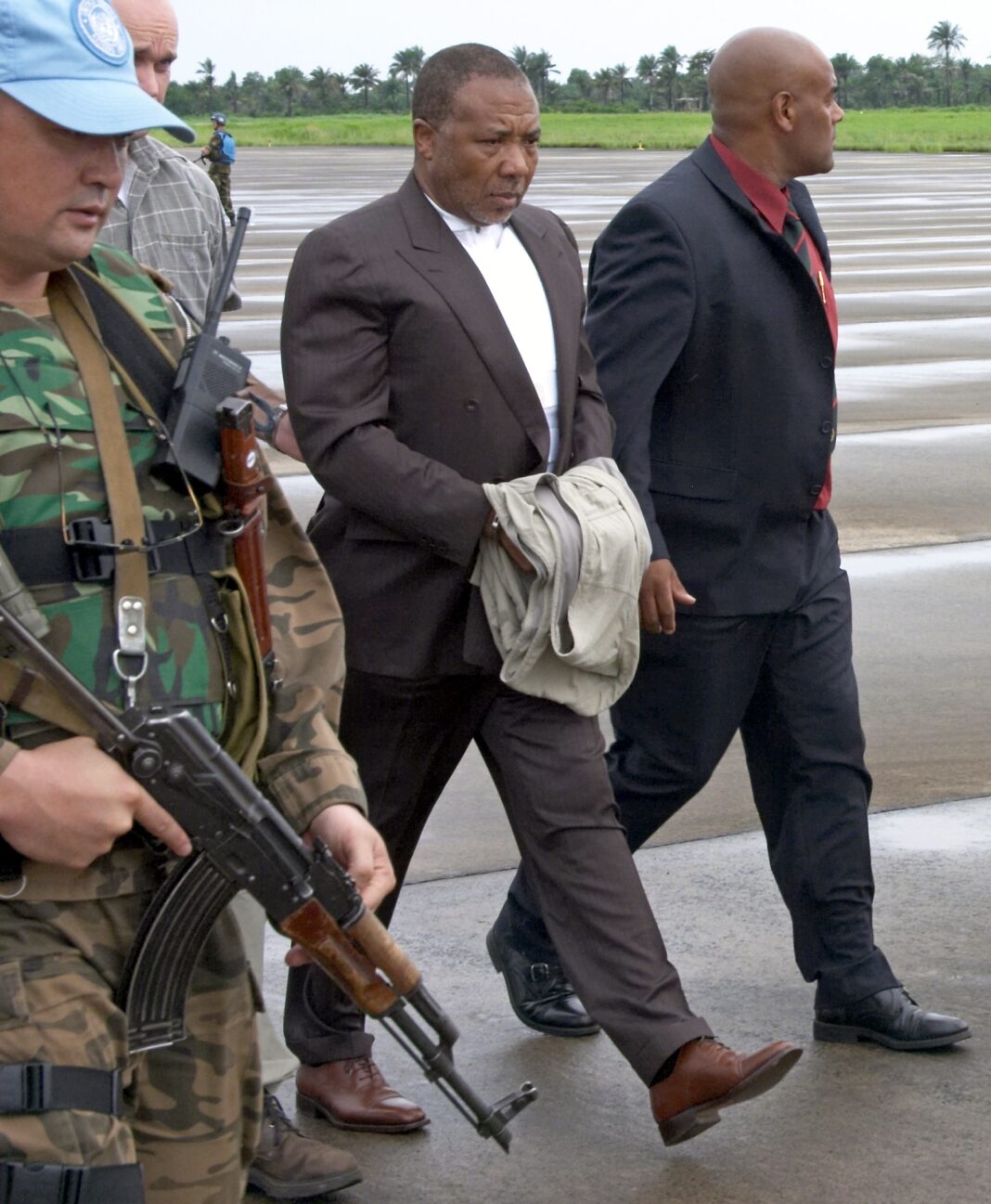
MONROVIA, LIBERIA — For nearly two decades, former Liberian President Charles Ghankay Taylor has remained outside Liberia, serving a 50-year sentence imposed by the Special Court for Sierra Leone.
But as time passes, a question that once appeared distant is becoming increasingly relevant:
If Charles Taylor eventually qualifies for conditional early release, could he return to Liberia?
The answer is not as simple as saying that Taylor would be “free.”
His conviction was imposed by the Special Court for Sierra Leone, and the Residual Special Court for Sierra Leone (RSCSL) continues to supervise outstanding matters arising from that tribunal, including enforcement of sentences. The Court’s current rules and practice directions govern the possibility of conditional early release.
THE TWO-THIRDS QUESTION
Taylor was sentenced to 50 years in prison in May 2012 after being convicted on 11 counts relating to crimes committed during Sierra Leone’s civil war. His conviction and sentence were later upheld on appeal.
Under the RSCSL’s conditional-release framework, a convicted person must generally have served at least two-thirds of the sentence before becoming eligible to apply.
For a 50-year sentence, two-thirds is approximately 33 years and four months.
That calculation is important because eligibility to apply is not the same thing as automatic release.
The Court must consider the circumstances surrounding the individual request and the applicable legal criteria before making a decision.
The RSCSL has previously explained that conditional early release may allow a convicted person to serve the remainder of a sentence in the community, subject to strict conditions and monitoring.
COULD LIBERIA BECOME HIS DESTINATION?
This is where Taylor’s case becomes particularly complicated.
Taylor is a Liberian citizen and former president. But his imprisonment is the consequence of an international criminal conviction.
The question, therefore, is not simply whether Liberia would want him back.
There are several legal questions:
Would the RSCSL approve Liberia as the place where Taylor serves the remainder of any sentence under conditional release?
Would Liberia agree to receive him under whatever conditions the Court imposes?
What restrictions could accompany his return?
Could those restrictions affect his freedom of movement, political activity or contact with particular persons?
These questions cannot be answered merely by referring to Taylor’s Liberian citizenship.
The RSCSL has made clear that conditional release remains subject to the Court’s judicial authority and conditions. The Court has also stated that the proposed community and the potential risks to the community and witnesses can be relevant considerations.
RETURNING HOME IS NOT THE SAME AS RESTORING POLITICAL RIGHTS
Another issue could become even more controversial.
Suppose Taylor were eventually permitted to return to Liberia.
Would that automatically restore every political right he once possessed?
Not necessarily.
There is a difference between:
physical return to Liberia,
release from imprisonment,
restoration of civil rights,
and
eligibility to hold public office.
Those questions involve different legal frameworks.
A conditional release granted by an international tribunal does not, by itself, necessarily answer every question under Liberian constitutional and electoral law.
That means Liberia could eventually face a constitutional question of its own:
What rights does a former Liberian president retain after serving—or being conditionally released from—an international criminal sentence?
WHAT ABOUT THE LIBERIAN PRESIDENCY?
The question becomes even more complicated if Taylor were ever to seek political office again.
Liberia’s Constitution establishes qualifications for the presidency, including citizenship, age and residency requirements.
Article 52 requires a presidential candidate to be a natural-born Liberian citizen, at least 35 years of age, and a resident of Liberia for at least 10 years immediately preceding the election.
That residency requirement could become a major legal issue for Taylor after decades outside Liberia.
Even if he were legally permitted to return, another question would remain:
Would time spent outside Liberia while serving an international prison sentence satisfy the Constitution’s 10-year residency requirement?
That is not something that should be assumed either way.
It would require a constitutional and electoral-law determination based on the facts existing at the time.
THE POLITICAL RIGHTS QUESTION
There is another distinction.
Being a Liberian citizen does not necessarily mean that every civil or political right automatically follows a person regardless of criminal proceedings or legal restrictions.
Liberian law contains provisions concerning elections, public office and the consequences of criminal convictions.
At the same time, any attempt to restrict a citizen’s constitutional rights would have to be grounded in law.
That means the issue could ultimately require interpretation by Liberia’s courts or the National Elections Commission, depending on the particular question presented.
TAYLOR’S CASE IS DIFFERENT FROM ORDINARY PRISON RELEASE
The Taylor case is also unusual because his sentence was imposed by an international tribunal rather than a Liberian criminal court.
The Special Court for Sierra Leone found Taylor guilty of planning and aiding and abetting crimes committed by rebel forces during Sierra Leone’s civil war. The 50-year sentence covered 11 counts, including terrorism, murder, rape, sexual slavery, cruel treatment, conscripting or enlisting child soldiers, enslavement and pillage.
The Court later designated the United Kingdom as the state in which Taylor would serve his sentence.
Therefore, any future release would have to be considered within the international legal framework governing his sentence.
WHAT THE RSCSL HAS ALREADY DONE
Taylor is not the first person convicted by the Special Court for Sierra Leone to become subject to conditional-release proceedings.
The RSCSL has previously explained that Moinina Fofana received conditional early release after serving two-thirds of his sentence.
It has also dealt with conditional-release issues involving other former Special Court convicts.
The Court has emphasized that release decisions are judicial decisions made under the Court’s legal framework.
This precedent does not mean Taylor will necessarily receive conditional release.
It demonstrates only that the mechanism exists within the RSCSL’s legal framework.
WHAT WOULD HAPPEN IF TAYLOR WERE APPROVED?
If the Court eventually approves conditional early release, the process would likely involve conditions.
Those conditions could be significant.
Taylor could potentially be required to:
– comply with restrictions imposed by the Court;
– report to designated authorities;
– respect limitations on movement or contact;
– avoid interference with witnesses or the administration of justice; and
– comply with other conditions attached to his release.
Conditional release therefore should not be confused with an unconditional pardon.
Taylor would not necessarily be free from all obligations simply because he was no longer physically confined in prison.
THE BIG QUESTION FOR LIBERIA
For Liberia, the issue is larger than Charles Taylor personally.
It raises questions about how Liberia’s Constitution interacts with international criminal justice.
If an international court eventually permits a former Liberian president to return while serving the remainder of his sentence under conditions, who would supervise those conditions inside Liberia?
Would Liberia enter into an agreement with the RSCSL?
Would another country or international institution monitor compliance?
Could Liberian authorities arrest Taylor for a separate offence?
Could Taylor participate in political activities?
Could he vote?
Could he join a political party?
Could he contest an election?
Could he hold public office?
And if the presidency were ever contemplated, how would the constitutional residency requirement apply?
These are questions that Liberia has not yet had to answer in practice.
THE CONSTITUTIONAL QUESTION
Ultimately, the most important point is this:
Taylor’s eventual release from international custody and his political future in Liberia are two separate legal questions.
The first belongs primarily to the RSCSL’s framework for enforcement and conditional release.
The second would involve Liberian constitutional, electoral and statutory law.
Neither question should be decided by rumor, political allegiance or public emotion.
It should be decided by the applicable law and, where necessary, by the competent judicial and electoral authorities.
WHAT COMES NEXT?
Charles Taylor’s story may therefore not end with the opening of a prison gate.
If the conditional-release process eventually becomes applicable to him, another legal chapter could begin—one involving Liberia’s Constitution, citizenship, residency, political rights and the country’s obligations under international law.
For Liberia, the challenge will be to distinguish between Taylor the former president, Taylor the convicted international prisoner, and Taylor the Liberian citizen.
Whether those three legal identities eventually converge again inside Liberia remains a question for the law.
And that is where Part Three of this investigation begins:
CAN CHARLES TAYLOR EVER RUN FOR PUBLIC OFFICE AGAIN?
That question takes us directly into Liberia’s Constitution, the 10-year residency requirement, electoral law, criminal convictions and the legal meaning of political rights after an international conviction.