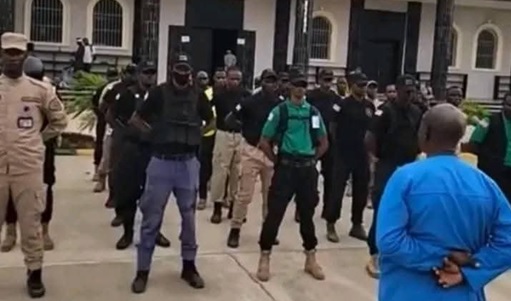
MONROVIA – Barely two days after news broke on social media about the reported establishment of a group called the “National Fula Security of Liberia” ahead of the Holy Month of Ramadan, the issue has ignited a nationwide debate over legality, ethnicity, and national cohesion. What began as a viral Facebook post has rapidly evolved into a full-blown national conversation touching on security, religion, and constitutional authority.
Critics were quick to question the necessity and legitimacy of such a group. Social commentator Vickjune Headliner Wutoh openly challenged the rationale behind forming a security structure under a tribal banner, asking whether Fula people are the only Muslims observing Ramadan. She argued that Muslims from various ethnic backgrounds participate in fasting and questioned why a single ethnic group would establish what appears to be a specialized security entity.
Wutoh went further, drawing controversial comparisons to security challenges in Nigeria and Guinea, warning that Liberia must not ignore potential risks associated with ethnically branded security formations. According to her, attempts to frame criticism as religious intolerance distract from legitimate national security concerns. She concluded by urging the Liberian government to take firm action, insisting there is no religious justification for what she described as a dangerous development.
Adding to the heated discourse, Ogense Dorbor asserted that Fula is not one of Liberia’s recognized indigenous ethnic groups and described members of the community as foreigners within the country’s borders. Dorbor called for the immediate dissolution of the group, questioning whether any mosques had previously been attacked during Ramadan to justify such a measure. His remarks, particularly his reference to Liberia as a Christian nation, further intensified online reactions.
Amid the growing uproar, Presidential Special Envoy on Investment, Ambassador Mohammed Bah, who is himself a member of the Fula community on Sunday, February 15, 2026, issued a measured and clarifying statement. Bah emphasized that no ethnic group has the authority to establish its own national security structure. “The concept of national security is reserved solely for the Republic of Liberia and its legally established state security institutions,” he stated.
Ambassador Bah disclosed that he personally engaged the leader of the group and urged that it be disbanded. According to him, the original intention was not to create a militia or promote ethnic division, but rather to provide protection for a mosque and certain community businesses during Ramadan. However, he maintained that the naming and branding of the group as “Fula National Security” was inappropriate and potentially harmful.
“The naming was inappropriate, the branding was inappropriate,” Bah stressed, warning that even if the intentions were benign, the perception alone could create fear and division. He reaffirmed that Liberia’s security architecture must remain unified and under the authority of the state, adding that steps have been taken to ensure the group is dissolved.
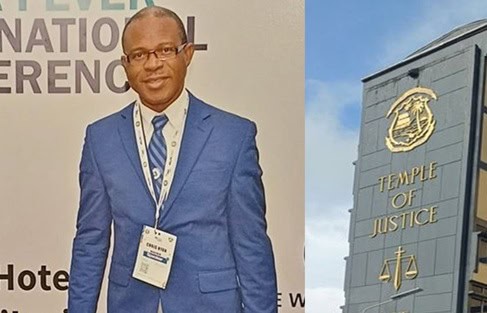
As tensions mounted, Montserrado County Senator Abraham Darius Dillon also on Monday, February 16, 2026 weighed in, urging calm while calling for legal clarity. In a strongly worded statement titled “No Rush To Judgment!!” Senator Dillon reminded the public that under Liberian law, private security entities must first obtain an Operational Permit from the Public Safety Department of the Ministry of Justice before legally operating in the country. He noted that such permits must be renewed annually.
“In consideration of the above, we will be looking forward to the Ministry of Justice today to speak to the existence of a ‘Fulani National Security,’” Dillon stated. He emphasized that clarification from the Justice Ministry is necessary to ease growing public concerns and prevent misinformation from escalating tensions.
The Montserrado lawmaker further warned that if the Ministry of Justice fails to provide answers, he will champion the matter on the Senate floor to have the Justice Minister summoned before Plenary. “Until then, no rush to judgment,” Dillon cautioned, signaling both vigilance and restraint as the controversy unfolds.