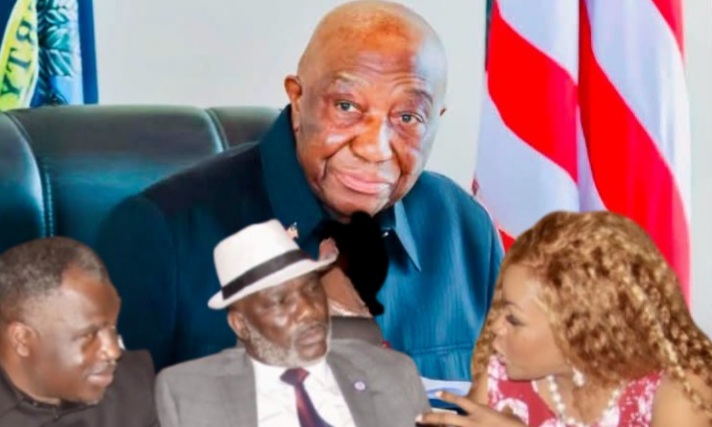
MONROVIA, LIBERIA – A Facebook post by MacDella Cooper, Senior Political Advisor to President Joseph Nyuma Boakai, has sparked discussions about Liberia’s upcoming presidential election, which is still over two years away.
The post, made on Tuesday, September 8, 2026, stated, “Discussing the future and the work ahead with Vice President Jeremiah Koung and the RT. Honorable Speaker, Richard Nagbe Koon. Cheers to JNB 6 more years!”
The phrase “6 more years” suggests strong support for President Boakai’s bid for a second term, making the post politically significant.
This meeting highlights the collaboration of three key figures in Liberia’s political landscape: Cooper, Vice President Koung, and House Speaker Koon.
Koung is more than just the Vice President; he is Boakai’s running mate and a vital part of the administration’s framework. The Vice President is elected alongside the President and serves a term of six years.
On the other hand, Koon holds the speakership of the House of Representatives, which grants him significant power over the legislative branch and the administration’s legislative goals.
Meanwhile, Cooper plays a key role as one of Boakai’s senior political strategists within the Executive Mansion. When you combine these three figures and add the phrase “six more years,” the political implications become quite striking.
From presidential aspirant to presidential adviser.
Cooper’s transition from a presidential aspirant to a presidential adviser shows that she is no stranger to the political arena.
Her political path is quite unique. As a philanthropist and a former candidate for the presidency, she became one of the most prominent female political figures in Liberia before aligning with the Boakai camp.
In the 2017 presidential race, she stood out as the sole female candidate, garnering approximately 0.75 percent of the votes in the first round.
Cooper’s political journey didn’t stop there. She later became involved with the Movement for One Liberia (MOL), a group dedicated to boosting the participation of women, youth, and other marginalized communities.
Additionally, she continued to play a significant role through the MacDella Cooper Foundation, which focuses on education and supporting vulnerable children.
Then came a significant shift in her political stance. In May 2023, Cooper and the Movement for One Liberia backed Joseph Boakai and Jeremiah Koung for the presidency, framing their endorsement as a strategic move to unify support for a change in national leadership.
This decision firmly positioned a former presidential candidate within Boakai’s political circle. After Boakai’s victory in the 2023 election and his inauguration in January 2024, Cooper took on the role of Senior Political Advisor to the President.
Official government records confirm her position, and by August 2024, she was publicly showcasing the administration’s accomplishments on behalf of the government.
Her journey is noteworthy: from presidential candidate to political party leader, then to Boakai supporter, and finally to senior presidential advisor.
This background lends significant weight to her insights regarding Boakai’s political future, far beyond what an average supporter might offer.
Is there already a plan in place for 2029?
Legally, there’s nothing wrong with a political adviser backing her president’s reelection. According to Liberia’s Constitution, a president can serve a six-year term and is allowed a maximum of two terms.
Boakai was sworn in on January 22, 2024, so a campaign for a second term in 2029 is constitutionally feasible.
However, in politics, timing is crucial. Liberia has a history of officials and political figures mixing governance with campaigning.
When a senior presidential adviser openly cheers for “six more years” alongside the Vice President and Speaker, it raises questions about whether the administration is shifting focus from current governance to future campaigning.
This concern is heightened given the significant challenges Liberia faces right now. The administration is under pressure regarding the economy, corruption, unemployment, infrastructure, public-sector performance, and the credibility of its reform agenda.
Liberians might justifiably wonder: Is the focus on fulfilling the promises of the Rescue Mission, or on securing another six years in power?
The Koung factor is significant in Cooper’s post.
By mentioning Vice President Koung, she highlights an important aspect of any serious conversation about Boakai’s chances for a second term, which must consider the future of the Boakai–Koung alliance.
Koung is not just any cabinet member; he holds the position of elected Vice President and serves as the President of the Senate.
According to the constitutional rules of succession, he would step in as president if the presidency were to become vacant under certain conditions.
Thus, when a senior political adviser connects Boakai, Koung, and the future, the implications go beyond a mere image. It indicates a deliberate attempt to showcase unity at the top of the government. However, the unity we see today does not guarantee that it will last.
As Liberia moves toward 2029, discussions surrounding succession, political power, and the ambitions of various factions within the ruling party are bound to intensify.
Speaker Richard Koon brings an intriguing aspect to the discussion.
As a key player in the legislative branch, he contrasts with Cooper, who holds a senior position in the Executive Mansion. Their interactions go beyond mere social exchanges; they carry significant political weight since collaboration between the Executive and Legislature is crucial for effective governance.
Howbeit, the public has every right to differentiate between institutional cooperation and electoral strategy.
When government leaders engage in talks about legislation, development goals, and national policies, that falls under governance. Conversely, discussions focused on maintaining political power beyond the current term are purely political. Cooper’s mention of “6 more years” clearly fits into that political narrative.
The biggest question.
The larger issue at hand is not that Boakai’s supporters are already thinking about 2029. That’s a given. The real concern is that the politics of 2029 might start to overshadow the governance needed for 2026.
Liberians didn’t elect the Boakai administration just to gear up for another election; they chose it to fulfill the “Rescue” that was promised during the 2023 campaign.
This administration now faces a straightforward political challenge: secure six more years before asking Liberians for another term.
While Cooper’s post may have been meant to express confidence, loyalty, and political unity, it also raises a significant question: What does the “future” really entail, and how much of the upcoming work is focused on Liberia’s future versus the Unity Party’s future?
At this moment, “JNB 6 more years” serves as a political rallying cry. By 2029, it will be up to Liberians to determine if it translates into a decision at the ballot box.
In the meantime, the Boakai administration has a more pressing task than campaigning: it needs to provide voters with six compelling reasons to support them.